
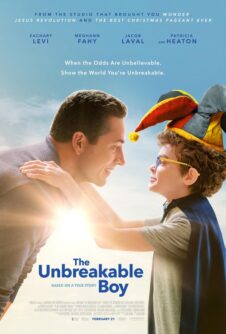
THE UNBREAKABLE BOY
A true story of unbreakable joy, and one father's breakable heart.
Should You Watch It?
This one earns its four stars. THE UNBREAKABLE BOY tells a true story with a wonderful script and performances strong enough to carry it — Zachary Levi, Meghann Fahy, and Jacob Laval all shine. It's a film about a boy whose brittle bones and autism never break his relentless, contagious optimism, and about the family that slowly learns he doesn't need fixing.
The film earns its caution too. Scott's alcoholism plays out across many scenes — including a night he drives drunk with his sons in the car — and there's one violent outburst where Austin hurts his mother and brother. Light foul language and a mention of a child born out of wedlock round out the concerns.
None of that undoes the film's core: faith, prayer, forgiveness, and a family that finds its way back to church and to each other. Bring your older kids. Talk with them about what they see.
The Story
NO SPOILERS — WE KEEP THE SURPRISESAustin was born with brittle bones and autism — and a sunny outlook nothing seems able to crack. His parents, Scott and Teresa, love him fiercely, but the stress of protecting him, paying his medical bills, and understanding his differences pushes their marriage and Scott's own struggles to the breaking point. What happens next is a true story about who ends up "fixing" whom.
Is It Any Good?
Four stars means this film does everything it sets out to do, and does it well. The script — adapted from the book of the same name — gives the true story real shape, and the performances make it land. Zachary Levi, Meghann Fahy, and Jacob Laval are singled out by name for excellent work, and the movie's warmth never feels manufactured. This is a film confident enough in its true story to let it simply be moving.
The Worldview
This is a strong, unapologetically Christian film, and it should be celebrated as one. It promotes faith, family, kindness, forgiveness, and prayer without apology. The family attends church and is shown praying together. Scott builds a real friendship with a preacher who encourages him to talk to God, and Teresa turns to prayer in a hospital chapel during her family's hardest season. The film's central conviction — that Austin's differences are not a problem to solve but a gift to receive — is a genuinely biblical one.
The one honest shadow is Scott's drinking, portrayed at real length: his secret relapses, a drunk-driving crash, and the toll it takes on his family before Alcoholics Anonymous and the Serenity Prayer become part of his path back. The film doesn't excuse this; it shows the wreckage plainly and then shows repentance and sobriety following it. That honesty is a strength, not a flaw — but it's why this film is for older children and not younger ones.
The film's deepest longing is the same one Scripture speaks straight to: that a person's worth is never measured by what's broken in them. "But he said to me, 'My grace is sufficient for you, for my power is made perfect in weakness'" (2 Corinthians 12:9).
The Content Guide
The specifics — spoilers included by nature — so you can judge for your own family.
Dominant Worldview and Other Worldview Content/Elements
Very strong Christian worldview promotes faith, family, kindness, forgiveness, prayer, attending church, embracing other people’s differences and recognizing it’s what makes them special, family attends church and are shown praying, father strikes up a meaningful relationship with preacher, preacher encourages father to talk to God, mother regularly attends church with sons and wants father to accompany them, one scene shows her praying in a hospital chapel, and father enters into Alcoholics Anonymous and says the Serenity Prayer in multiple scenes
Foul Language
Three obscenities, autistic boy says “poop” multiple times in two scenes, he also uses the word “retarded” in one scene, meant as an insult
Violence
Autistic boy throws a cup at mother, cutting her forehead, and then starts choking his brother
Sex
No sex, but a couple has a son out of wedlock
Nudity
No nudity
Alcohol Use
many scenes featuring Scott drinking heavily as he battles alcoholism, but he eventually gets sober and apologizes to Teresa for his behavior
Smoking and/or Drug Use and Abuse
No smoking or drugs;
Miscellaneous Immorality
many scenes feature Teresa and Scott arguing with each other over Austin, finances and his drinking. Scott tells Teresa he will stop drinking, but continues to drink in secret, father drives drunk in one scene with his sons in the car.
Talk About It
Questions for the drive home, the dinner table, or the youth group.
Scott says he spent years wondering how to "fix" Austin, when Austin was really the one who "fixed" him. What does that tell us about how God sees weakness and difference?
2 Corinthians 12:9 · Psalm 139:13–14Scott lies to Teresa about his drinking even after promising to stop. What does real repentance look like, versus just saying the right words?
2 Corinthians 7:10 · Proverbs 28:13Teresa keeps praying and taking her sons to church even when her marriage is falling apart. What does persistent faith in hard seasons look like in your own family?
1 Thessalonians 5:17 · Hebrews 10:23–25The preacher Rick becomes a lifeline for Scott through Alcoholics Anonymous. Why does community — not just willpower — matter so much for lasting change?
Galatians 6:2 · Ecclesiastes 4:9–10The Final Word
This is a film worth your family's time — a true story told with real craft, real faith, and real honesty about what it costs a family to love well through hardship. Older kids can handle it, and they'll likely be moved by it. Our answer: worth the trip — older children and up.