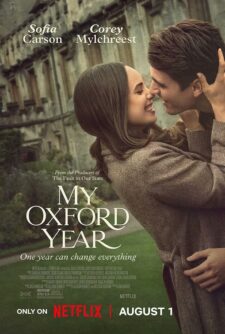
MY OXFORD YEAR
A moving Oxford romance undercut by casual sex, language, and a rushed ending.
Should You Watch It?
Here's the honest trade this one offers. MY OXFORD YEAR tells a genuinely moving story about what love costs and gives, even when it doesn't last — and it means to teach its heroine, and you, something true about embracing life's unplanned joys and sorrows. That's a worthwhile lesson, and the film lands it with real feeling.
But it earns its caution rating. The romance between Anna and Jamie is built on an unmarried, implied sexual relationship, the dialogue carries more than 25 obscenities and profanities, and Jamie's core advice to Anna — follow your heart, trust your gut — is more Hollywood than biblical. The film's moral elements (family, friendship, even a church scene) sit uneasily beside all of that.
If you're an adult who can watch with clear eyes and a firm sense of what you believe about love and marriage, there's something here worth your time — just not in a theater, and not with your kids in the room. Watch it at home, on your own terms, or skip it.
The Story
NO SPOILERS — WE KEEP THE SURPRISESAnna De La Vega has her year mapped out: study Victorian poetry at Oxford, then head home to a job at Goldman Sachs. Those plans wobble when her expected professor is replaced by Jamie Davenport, a first-time teacher who pushes her to loosen her grip on the plan and embrace life's messier, unscheduled moments.
The two grow close, then romantic — agreeing, at first, to keep it casual. But Jamie is carrying something he hasn't told her, and it's about to change everything.
Is It Any Good?
Three stars means this one mostly works, with real flaws that keep it from being more. The story of love's impact — brief but lasting — genuinely moves, and its case for embracing life's unexpected joys and sorrows lands with feeling.
Where it falters is craft. The plot turns repetitive; Anna and Jamie have essentially the same argument more than once, which drains tension the film needs. And after building slowly toward its emotional core, the ending feels rushed, as if the filmmakers ran out of room to land what they'd set up. ``
The Worldview
This is a mixed film, and it's worth naming both halves plainly. On the good side: it takes family seriously — an estranged father-son relationship reconciles by the end — and it values friendship, showing Anna leaning on the community she builds at Oxford for real support. There's a Christmas church service on screen, and Jamie points Anna toward a meaningful church in Amsterdam. Those are not throwaway details; they're a film taking faith and family seriously enough to include them.
On the other side, the film's operating philosophy is more Romantic than Christian. Jamie's central advice to Anna — follow your heart, trust your gut over your plans — sounds wise but isn't the same thing as trusting God with your path. The relationship it builds toward is physical outside of marriage, only implied on screen but clearly present in the story. A supporting character is portrayed as homosexual. None of this is presented as villainy; it's simply treated as unremarkable, which is its own quiet argument.
The film's real ache — that love, even when it doesn't last forever, still leaves you changed — is a true one. Scripture answers it more fully than the movie can: "Love never ends" (1 Corinthians 13:8), not because circumstances cooperate, but because it is rooted in something beyond us.
The Content Guide
The specifics — spoilers included by nature — so you can judge for your own family.
Content Summary
<span data-contrast="auto">(Pa, B, C, Ro, Ho, LLL, S, N, AA, M): </span><b><span data-contrast="auto">
Dominant Worldview and Other Worldview Content/Elements
</span></b><span data-contrast="auto"> Mixed pagan worldview with moral, Christian and romantic elements including an emphasis on the importance of family (male lead is estranged from his father, who doesn’t understand why he’s refusing cancer treatment, but the pair reconcile) and friendship (female lead comes to rely on the friends she made at Oxford for emotional support), there’s a scene with a Christmas church service, and the male lead tells the female lead to visit a special church in Amsterdam, but there are also Romantic themes such as male lead encourages female lead to follow her heart and emotions, plus a side character is homosexual; </span><b><span data-contrast="auto">
Foul Language
</span></b><span data-contrast="auto"> 13 obscenities (including one “f” word), one strong profanity using the name of Jesus Christ, and 16 light profanities; </span><b><span data-contrast="auto">
Violence
</span></b><span data-contrast="auto"> No violence; </span><b><span data-contrast="auto">
Sex
</span></b><span data-contrast="auto"> It's implied that the unmarried romantic leads are having a sexual relationship although nothing explicit is shown, three scenes show female lead waking up at boyfriend’s apartment, and female lead has a friend who thinks he’s homosexual, although he’s not shown kissing or being romantic with another man; </span><b><span data-contrast="auto">
Nudity
</span></b><span data-contrast="auto"> A few scenes feature upper male nudity (for example, a man doesn’t have his shirt on when he receives chemotherapy or visits the beach); </span><b><span data-contrast="auto">
Alcohol Use
</span></b><span data-contrast="auto"> Dozens of scenes feature alcohol at bars and parties, but no drunkenness; </span><b><span data-contrast="auto">
Smoking and/or Drug Use and Abuse
</span></b><span data-contrast="auto"> No smoking or drugs; and, </span><b><span data-contrast="auto">
Miscellaneous Immorality
</span></b><span data-contrast="auto"> Male romantic lead keeps a secret from female romantic lead and lies about his whereabouts to avoid her finding out, and man is estranged from his father for much of the movie, but the two reconcile by the end.</span><span data-ccp-props="{"201341983":0,"335559740":240}"> </span> <span data-ccp-props="{"201341983":0,"335559740":240}"> </span>
Talk About It
Questions for the drive home, the dinner table, or the youth group.
Jamie tells Anna to "follow her heart" over her carefully made plans. When is that good advice, and when does Scripture warn us that our hearts can mislead us?
Proverbs 3:5–6 · Jeremiah 17:9The film treats family reconciliation — a father and son healing a broken relationship — as one of its most important threads. What does that reconciliation cost each of them, and what does it cost us to reconcile with someone we've been estranged from?
Luke 15:20–24Anna and Jamie's relationship is built outside of marriage. How does the film's portrayal of "casual" love compare with the way Scripture describes love that "bears all things" and "endures"?
1 Corinthians 13:4–8The movie's title suggests one planned year turned into something entirely unplanned. Where has your own life taken an unplanned turn, and how did you see God at work in it — or wish you had?
Ecclesiastes 3:1 · Proverbs 16:9The Final Word
MY OXFORD YEAR has real heart — a love story that means something, wrapped around family reconciliation and genuine feeling. It also asks adult viewers to sit with implied premarital sex, heavy profanity, and a "follow your heart" ethic that Scripture would gently correct. Our answer stands: wait for home — adults only. Looking for something the whole family can watch together instead? Start with our latest family-friendly picks.