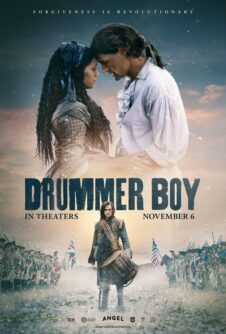
DRUMMER BOY
A moving, musical story of two brothers on opposite sides of the Revolutionary War.
Should You Watch It?
Absolutely. DRUMMER BOY offers a sweeping historical epic with a musical twist. Brothers Jeremiah and Benjamin find themselves on opposite sides of the Revolutionary War and must interrogate their own beliefs as the war brings them face-to-face on the battlefield.
The movie boasts high production value with dramatic battle scenes, excellent cinematography, and a talented cast that brings this story to life. Joel Smallbone, who serves as director and star, shines in both roles, while cast members Lucas Leach and India Brown also deliver strong performances.
A strong script weaves together its plot elements, contrasting Emmaline’s pursuit of freedom with Jeremiah and Benjamin’s own ideas about the freedom they fight for in the war. The movie includes wonderful musical moments, with catchy songs and well-shot numbers that add something unique to the movie.
Faith remains a focus as several characters discuss their relationships with God and how those beliefs shape their lives. Emmaline believes God made her to be free, while Major John Ambrose chooses to forgive the British soldiers he fights.
Although a few battle scenes contain violence, it remains minimal. Parents should use discernment with kids, but overall, this one offers an uplifting experience for teens and adults.
The Story
NO SPOILERS — WE KEEP THE SURPRISESAs the Revolutionary War dawns, brothers Jeremiah and Benjamin find themselves on opposite sides. Jeremiah fights for the British. Benjamin works as a drummer boy for the American troops. Meanwhile, their childhood friend Emmaline, an enslaved person, works to purchase her freedom. As all three struggle to find their own version of freedom, Jeremiah and Benjamin must decide how far they are willing to go for their beliefs.
Is It Any Good?
Four stars for a moving plot, excellent cinematography, great performances from its cast, and music that uniquely enhances the storytelling. Joel Smallbone shines as both star and co-director, delivering a strong performance as the complex Jeremiah while exploring and challenging the characters’ beliefs.
Lucas Leach as Benjamin and India Brown as Emmaline also deliver excellent performances; the trio shows the different facets of freedom for each character and explains why pursuing that ideal matters to them.
The movie features beautiful, sweeping views of Ireland, where it was filmed, which double for the story’s New England setting. The music shines, too, with well-placed musical numbers that give DRUMMER BOY a fresh take on the Revolutionary War. From original songs to beloved Christmas hymns, the music will linger long after the credits roll.
The Worldview
A strong Christian worldview shines from start to finish. Characters pray, attend church, and discuss how faith shapes their lives. Emmaline repeatedly declares that God made her free and that His opinion alone matters. Her conviction echoes the biblical truth that every person bears the image of God, a dignity no master can revoke.
Major John Ambrose counsels Benjamin to release his anger and forgive his enemies, as their faith commands. The cast also sings Christmas carols and hymns such as “The Little Drummer Boy,” “Silent Night,” and “O Come, O Come, Emmanuel.” These songs root the story in the hope of Christ’s birth and remind viewers that God came near to a broken world.
The movie also champions forgiveness and redemption. Jeremiah and Benjamin forgive each other for the harsh words they exchanged before the war. Jeremiah eventually rejects the British army’s message and refuses to fire on the American troops in the climactic final battle.
His choice mirrors the biblical pattern of repentance, as he turns from a false allegiance toward the truth. The story rewards mercy and reconciliation and treats bitterness as a burden its characters must lay down, much as Christ calls His followers to forgive as God forgave them.
The Content Guide
The specifics — spoilers included by nature — so you can judge for your own family.
Dominant Worldview and Other Worldview Content/Elements
A strong biblical and Christian worldview. Characters pray, attend church, and speak about the role faith plays in their lives. An Army major urges a young soldier to let go of his anger and forgive his enemies, as Jesus commands. A young woman cites Scripture as the reason she fights for her freedom. Strong moral elements of forgiveness and redemption also appear, as estranged brothers reconcile and one brother refuses to fire on American troops. Characters sing Christmas carols and hymns throughout, such as “The Little Drummer Boy,” “Silent Night,” and “O Come, O Come, Emmanuel.” Strong patriotic elements also support the American fight for independence, as one brother turns from the British cause and stands with his countrymen
Foul Language
No foul language.
Violence
Several violent battle scenes feature cannon fire and gunfire. Soldiers fall from gunshot wounds, but the movie avoids graphic detail and shows minimal blood.
Sex
No sex.
Nudity
No nudity.
Alcohol Use
No alcohol use.
Smoking and/or Drug Use and Abuse
No smoking or drugs.
Miscellaneous Immorality
Two brothers treat each other unkindly but later reconcile. A woman breaks her word and refuses to grant her half sister freedom. She acts partly out of resentment, since her father fathered the girl through an extramarital affair.
Talk About It
Questions for the drive home, the dinner table, or the youth group.
Jeremiah and Benjamin fight on opposite sides of the war, both believing in their cause. Scripture reminds us that our struggle is not against flesh and blood. How does this shift the way we view our “opponents” in a fight? Ephesians 6:12
John Ambrose tells Benjamin not to be consumed by his anger, and forgive his enemies. How does remembering the greatness of God’s forgiveness toward us change our willingness to forgive those who we need to forgive? Matthew 18:21-35
Emmaline fights for her freedom, and points to scripture to encourage herself and others, even as society tells her that she is supposed to be enslaved. How does the Bible define “what is right” compared to how culture defines it? Romans 12:2
The Final Word
DRUMMER BOY delivers a grand historical and musical epic, with beautiful cinematography and an excellent cast. Beneath the spectacle, the movie reminds viewers that hatred never has the final word: faith frees the heart, forgiveness restores broken bonds, and redemption remains open to all. Some violent battle scenes call for discretion with children, but families with teens will find a story rich with the hope of the Gospel.