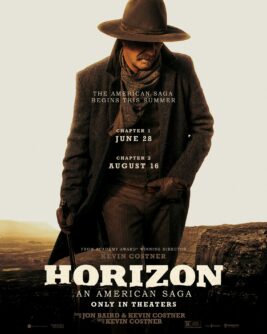
HORIZON: AN AMERICAN SAGA – CHAPTER 1
Costner's sprawling, brutal, beautiful Western — a serious film for serious adults.
Should You Watch It?
If you're an adult who loves Westerns done right, yes — go. Kevin Costner has built something rare here: a spectacular, immersive vision of the frontier, with real craftsmanship and a few genuinely moving moments, including a teenage girl sending Union-bound soldiers off with mementos. The film also does something harder than it sounds — it treats both the settlers and the Apache people fairly, without tipping into easy villains or fashionable revisionism.
That seriousness comes at a cost. This is an R-rated film with intense, sometimes brutal violence — a raid, a massacre, a scalping, gunfights and revenge killings. There's strong language throughout, a partially depicted sex scene, an implied one, and a brief scene of nudity. None of it plays as gratuitous spectacle for its own sake, but all of it is real, and none of it belongs in front of children.
This is a film for grown-ups: patient, historically minded, willing to sit with hard truths about the West. Bring your own judgment, not your kids.
The Story
NO SPOILERS — WE KEEP THE SURPRISESIn the 1860s southwest territory, a small tent settlement called Horizon draws hopeful settlers with the promise of free land — and draws the anger of the Apache whose land it sits on. When a devastating raid leaves only a handful of survivors, the U.S. Army must decide whether the town is worth defending. Meanwhile, a wagon train hundreds of miles east is already on its way toward the same dream, and a woman fleeing her past is about to cross paths with a gunfighter who wasn't looking for trouble. Their stories are only beginning to converge.
Is It Any Good?
Four stars means this is a film that mostly does everything it sets out to do, and does it with real skill. Costner's vision of the Wild West is spectacular and immersive, and the action — especially the raid on the tent city — is exciting and engaging without losing its human cost. Several quieter moments land with genuine feeling.
The seams show mainly in structure: with multiple storylines running in parallel, a few transitions feel abrupt, and the film leans on its central device — a flyer promising a better life — to hold its many threads together. It mostly works. This is Chapter 1 of two, so some payoffs are still ahead, but as an opening movement, it's confident, ambitious filmmaking.
The Worldview
At its core, this is a moral film with brief Christian content, built around ordinary people of many backgrounds risking everything for a better life — and an Army depicted with real sympathy, even as it fails to protect everyone. The settlers aren't painted as saints, but their hope is treated as genuine, not naive.
What stands out most is the film's balance. Rather than assigning blame to one side of the frontier, it lets both the settlers under attack and the Apache people facing an unstoppable tide of newcomers carry real weight and real grievance — brutality shown honestly on both sides, without a thumb on the scale. That evenhandedness, in a genre often tempted toward easy moralizing in either direction, is one of the film's real achievements.
Every character here is chasing the same thing: a home, a fresh start, a promise on a piece of paper. Scripture knows that ache well. "They wandered in the desert wilderness, finding no way to a city to dwell in... Let them thank the LORD for his steadfast love" (Psalm 107:4, 8). The film can show us the wandering. Only God can supply the city.
The Content Guide
The specifics — spoilers included by nature — so you can judge for your own family.
Dominant Worldview and Other Worldview Content/Elements
Moral worldview with some brief Christian content about settlers of all stripes and from all multiple backgrounds entering and traveling to the southwest territory to pursue a better life, with a positive depiction of the U.S. Army, but not all; the settlers have good intentions
Foul Language
14 obscenities (no “f” words), four Jesus profanities, 12 GD profanities, and five light profanities
Violence
Strong, sometimes intense violence as woman shoots her abusive husband with a shotgun and rides away with their young child (he survives and orders his two sons to hunt her down and return with the child), one of the brothers pursuing the woman eventually kills her new husband after luring the couple away from town and goes looking for the child in town, man comes upon the bodies of three dead surveyors and buries the bodies, Apache Indians attack the people in a tent city erected on their land, Indians shoot arrows and bash people with tomahawks, a big battle ensues there, Indians attack a family’s nearby cabin where some of the settlers have fled and a long battle ensues there, a gunfight occurs to two men, one of the brothers pursuing the woman kill her husband, and settlers from the tent city come upon an small Indian village and kill the people out of revenge, plus taking some Indian scalps that they can sell for money, but a teenage boy with them is sickened by their behavior
Sex
Brief partially depicted fornication scene with the couple clothed and woman moving on top of man, implied fornication scene as it’s implied the same woman has been with another man, and there’s some light bawdy talk in one scene about a house of prostitution in one town, and a loose young woman tries to entice a cowpoke and gunfighter away from the brothel and to visit her in the cabin where she’s staying, but he never gets there because he’s confronted by a ruthless killer who earlier killed the husband of the woman’s friend
Nudity
Upper female nudity when a woman takes a sponge bath at night in a wagon train and notices two men spying on her (the wagon train leader chastises her for being careless and later confronts the two men)
Alcohol Use
Some alcohol use
Smoking and/or Drug Use and Abuse
No smoking or drugs;
Miscellaneous Immorality
Man lies to married couple to give the wife over to two men who’ve been pursuing he woman for months, and a young married English couple in a wagon train are rude and careless.
Talk About It
Questions for the drive home, the dinner table, or the youth group.
The settlers risk everything on the promise of a flyer selling a dream. What promises do we build our own lives on, and how do they compare to God's promises?
Matthew 7:24–27 · Psalm 127:1Several people in this story pursue revenge for real wrongs done to them and their families. Where does Scripture draw the line between justice and vengeance?
Romans 12:19 · Leviticus 19:18A teenage boy is sickened when the men around him take scalps for money. What does his reaction show about conscience, even when the surrounding culture has gone numb to cruelty?
Romans 2:15 · Micah 6:8The film refuses to make either the settlers or the Apache people simple villains. Why does the truth usually cost us the comfort of an easy story — and why is that worth pursuing anyway?
Proverbs 18:17 · Zechariah 8:16The Final Word
Kevin Costner has made a serious, spectacular first chapter of a Western epic — one that treats history and the people caught in it with unusual fairness. It's also a hard R, with real violence, real language, and real sexual content that has no place in front of children. So here's our answer: worth the trip — adults only. Looking for something to watch with the kids this week instead? Start with our latest family-friendly picks.