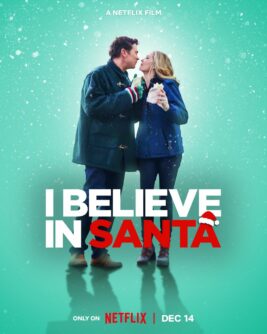
I BELIEVE IN SANTA
A sweet Christmas romance whose faith message is for discerning adults.
Should You Watch It?
I BELIEVE IN SANTA is a low-key Christmas romantic comedy with laid-back charm, sweetness, and wholesome emphasis on love and commitment. The two leads and supporting cast give fun performances, and the film’s affection for Christmas traditions can make its characters easy to enjoy.
The central problem is serious. Tom treats Santa as the most important figure of Christmas because religion, including belief in Jesus, can divide people. The movie instead promotes faith in “things bigger than ourselves,” whatever those things may be. That idea may open a conversation, but it does not offer a biblical understanding of Christmas or faith.
The movie also includes eight light profanities, a bedroom implication involving an engaged couple, and a quick homosexual reference. Adults who can weigh those elements and discuss the film’s ideas may find it worthwhile; families with children or young teens should choose something else. Practical answer: WORTH THE TRIP — ADULTS ONLY.
The Story
NO SPOILERS — WE KEEP THE SURPRISESLisa is a single mother and magazine writer who hates Christmas, even though she is repeatedly assigned holiday essays. She meets Tom, a lawyer who is intensely devoted to Christmas traditions and Santa.
As Lisa continues seeing Tom, she begins enjoying Christmas again. But Tom’s enthusiasm—and his belief that Santa is real—creates tension, especially as Lisa’s young daughter grows attached to him. Tom’s ambitious schedule of Christmas activities eventually strains their relationship.
Is It Any Good?
Three stars means a good-natured, enjoyable film with noticeable weaknesses. I BELIEVE IN SANTA has fun performances from its two leads and supporting cast, and its director keeps the story moving even though it relies heavily on dialogue.
The movie is clearly low-budget and occasionally slow. Some montages become annoyingly sticky-sweet. But the film’s best sequence—a spectacular sleigh race featuring a realistic, Santa-worthy sleigh made from cardboard boxes—is tremendous fun. Overall, this is a modest romantic comedy whose charm outweighs its flaws.
The Worldview
The film promotes the idea that being with people you love is part of the magic of Christmas. It also values commitment in romantic relationships, freedom, and Fourth of July celebrations. Those moral elements give the movie a wholesome foundation.
But the movie’s central faith message is confused. Tom says Santa is more important than Jesus because religious belief and religious celebrations can divide people. He compares belief in Santa with belief in God, arguing that neither can be proved. Lisa later praises faith “in things bigger than ourselves,” without naming God or Jesus.
Tom’s Muslim friend presents faith as a general principle that can unite everyone because all people believe in something. He also says that people are all the same when discussing past bullying. These ideas may sound inclusive, but the film’s treatment of Islam and Christianity as essentially the same is false, and its generic faith cannot replace faith in the true God.
The film’s deepest longing is for love, commitment, and shared celebration. Scripture gives those longings a firmer center: “You shall have no other gods before me” (Exodus 20:3).
The Content Guide
The specifics — spoilers included by nature — so you can judge for your own family.
Dominant Worldview and Other Worldview Content/Elements
Light mixed pagan worldview with some moral elements that say being with the people you love is part of the magic of Christmas, that promote commitment as part of the love in romantic relationships and that promote freedom and Fourth of July celebrations, but movie also has some false religion, such as lead male character places faith in Santa in celebrating Christmas and the “magic” of Christmas because religion, including religious celebrations of Jesus during Christmas, can divide people, his Muslim friend briefly discusses faith as a general principle that can unify all people because all people embrace some kind of faith in something, the lead female character says her boyfriend has taught her the importance of faith “in things bigger than ourselves,” and a Muslim friend says he didn’t know why he was bullied in past because “we’re all the same,” plus there’s a scene where lead male character says (contrary to what the Bible teaches) that you can’t prove something that’s unknowable like the existence of God or the existence of Santa Claus, and lead male character’s friend says he’ll looking for “cute guys” at a community-wide Fourth of July event, but his homosexuality never comes up again in the movie
Foul Language
No obscenities, but there are eight light profanities such as OG or OMG, and two light innuendos
Violence
A short snowball fight scene occurs and three cardboard sleds crash during a sled race down a mountain slope in Denver
Sex
No sex scenes, but engaged couple leaves living room to go to woman’s bedroom, unmarried romantic couple kisses several times and there’s one brief reference to homosexuality
Nudity
No nudity
Alcohol Use
People drink wine two or more times
Smoking and/or Drug Use and Abuse
No smoking or drugs;
Miscellaneous Immorality
Nothing else objectionable.
Talk About It
Questions for the drive home, the dinner table, or the youth group.
The film presents faith as belief in “things bigger than ourselves.” What makes biblical faith different from vague spirituality?
Hebrews 11:1 · John 17:3Tom places Santa at the center of Christmas. What does Scripture say should be at the center of our celebration?
Luke 2:10–14 · Matthew 1:21The movie values love and commitment in romantic relationships. What does faithful love require beyond strong feelings?
1 Corinthians 13:4–7 · Ephesians 5:25The characters suggest that shared beliefs can unite people. How can Christians show love to people of other faiths without pretending all beliefs are the same?
1 Peter 3:15 · Colossians 4:5–6The Final Word
I BELIEVE IN SANTA is a sweet, low-key Christmas romance with charming performances and a memorable sleigh race. Its generic faith message, light profanity, and other content make it unsuitable for children and young teens. For discerning adults willing to discuss its ideas, the answer is WORTH THE TRIP — ADULTS ONLY. For other family viewing, consider.