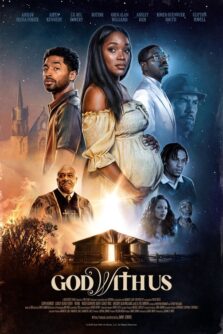
GOD WITH US
A modern-day parable about a world still waiting for the Savior.
Should You Watch It?
Yes, but go in knowing that it isn't a traditional biblical retelling. Instead, it imagines an alternate history in which Jesus was never born, faith has nearly disappeared, and the world continues to wait for a Savior. The movie establishes this fictional premise from the start. Viewers who can embrace it as a modern parable rather than Scripture will find an engaging, powerful story about doubt, suffering, God's presence, and Christ's sacrifice. Its central message that God is with us resonates throughout.
From a filmmaking standpoint, the movie succeeds in many areas. The visuals and period details create a believable world. The performances, particularly by Mary and Joseph, bring genuine warmth and depth to their relationship. Although the story takes time to establish its characters and setting, it gains momentum once Mary learns she is pregnant. The final act raises the emotional stakes and delivers several genuinely moving moments.
However, it occasionally lacks subtlety, and some dialogue feels too direct. Gabriel's comic-relief moments clash with the serious tone, while a few modern touches feel out of place. The movie also takes creative liberties with the biblical world. Although Christ has not yet come or been crucified, churches, crosses, worship, and familiar Christian language already reflect modern Christianity. These choices may challenge viewers who prefer biblical stories to remain closely grounded in Scripture.
Expect to see considerable violence, drug-related material, sexual abuse references, persecution, murder, and threatening behavior so parents should use caution for younger viewers . The imaginative premise may spark worthwhile conversations, but intense violence and disturbing subject matter make it unsuitable for younger viewers. Despite these creative liberties, the movie offers a moving reminder of Christ's love and the hope found in God's presence.
The Story
NO SPOILERS — WE KEEP THE SURPRISESFor generations, humanity has waited for the promised Messiah. But the Savior never came. Faith has nearly disappeared, and a radical group called the Stone Angels determines to erase the last traces of God from society. Then Gabriel, an angel sent to Earth with a life-changing assignment, finds Mary and Joseph, a young couple newly engaged and just beginning to build a life together. Everything changes when Mary receives an impossible announcement: she has been called to carry the Son of God. As the world around them rejects the very idea of a Savior, Joseph must decide whether he can believe Mary and trust in God.
Is It Any Good?
Three stars for an imaginative, emotionally resonant story with strong performances, a memorable soundtrack, and a message that hits home. Although the movie opens at a leisurely pace, it gradually draws viewers in. The clothing, cars, phones, pagers, color palette, and production design establish a convincing 1990s urban setting.
Mary and Joseph's relationship feels somewhat contrived at first, but as they grow up, their connection feels genuine rather than simply functional to the plot. The actors deliver convincing, emotionally grounded performances, while the soundtrack consistently deepens the story's emotional pull.
However, Gabriel's humor and some of his dialogue feel jarring against the movie's tone. Some plot points seem clunky or overly convenient, and the story increasingly asks viewers to suspend disbelief. If viewers can set aside the contradictions and embrace the film as a modern parable rather than Scripture, they will find an enjoyable story with a powerful message: God is with us.
The Worldview
The movie has a strong Christian, biblical worldview. Its setting is a world without Christ’s birth, where belief has withered and the promise of a Messiah remains unfulfilled. Within that invented frame, Mary and Joseph’s story tracks the Nativity account closely, and Scripture runs throughout the dialogue.
One question drives the story: If God is real, why does He allow terrible things to happen? The answer is the movie’s central conviction: God is real, He is present, and His absence can’t be assumed simply because people cannot see Him or make sense of their pain. Faith doesn’t mean pretending suffering away, and a corrupt church or abusive believer doesn’t disprove God.
The movie rebukes evil and calls everyone to repent. It also highlights grace, forgiveness, prayer and God’s calling, especially the idea that He works through people who feel unqualified. As one line puts it, “God doesn’t call on the ready, He calls on the willing.” Casting black actors as Mary and Joseph and presenting a black Savior is part of a wider argument about who gets represented in Christianity, which the story ties to the universality of Christ’s message.
Some choices call for discernment. Religious life here resembles present-day Christianity, crosses included, even though the Crucifixion hasn’t happened in this world. That anachronism blurs the biblical timeline. The filmmakers state they aren’t rewriting the Bible or making a prophetic claim, so the premise works best as a “what if” that points toward the Gospel rather than standing in for it.
The Content Guide
The specifics — spoilers included by nature — so you can judge for your own family.
Dominant Worldview and Other Worldview Content/Elements
Very strong Christian, biblical worldview in a reimagined Nativity story that closely follows the biblical account, with frequent Scripture quotations and many church services, though modern Christian imagery appears before the Crucifixion has taken place, and the movie rebukes evil and violence while exalting repentance and forgiveness, with a central message that God is always with us
Foul Language
No foul language, but a few instances of name-calling and verbal bullying
Violence
Kids argue and threaten one another, a deadly shooting on the church steps, a serious car crash, and danger from a possible bomb
Sex
No sexual activity, but sex is discussed several times, particularly regarding the heroine’s virginity and when the hero’s friends pressure him to have sex
Nudity
No nudity
Alcohol Use
No alcohol use
Smoking and/or Drug Use and Abuse
The heroine’s mother died from an overdose;
Miscellaneous Immorality
Conspiracy to bomb churches, references to physical and sexual abuse, gambling, references to extramarital sex, lying, bad role models, a strong anti-God movement, and a dysfunctional family life, plus one moment where an angel complains that another angel dressed him in a racist way.
Talk About It
Questions for the drive home, the dinner table, or the youth group.
Mary says yes to God’s plan even though she can’t see how it will turn out. What makes it hard to trust God when we don’t know what’s ahead? What is one area of your life where God may be asking you to say yes? Luke 1:38
Rosa learns that a bad church doesn’t mean God is bad. How can the failures of Christians make it harder for people to trust God? How can we help change that? Matthew 23:1-4
Mary and Joseph are called to do something they don’t feel ready for. What does Scripture say about God’s strength working through our weakness? 2 Corinthians 12:9
The Final Word
What if the world had waited generations for a Savior, watched hope fade, and then heard He was coming now? GOD WITH US sets the Nativity in 1990s urban America, a bold reimagining that never claims to be Scripture. It takes liberties, but its faith runs deep, celebrating prayer, repentance, grace and a God who calls ordinary, willing hearts to carry out His plan. When Emmanuel is born, the message is unmistakable: even when God seems silent, He is still with us. The journey to the manger passes through dark terrain, including murder, violence and references to sexual abuse, so kids should skip it.