TRAIN DREAMS
A gorgeous, grief-soaked drama undercut by anti-Christian revisionism.
Should You Watch It?
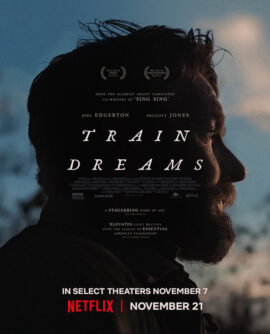
Here's the honest tension at the center of this one. Train Dreams is a genuinely beautiful film — Oscar-caliber, by the source review's own account — about an ordinary man's extraordinary losses in the early-1900s Pacific Northwest. Joel Edgerton is superb as Robert, and the film's insights into grief land with real weight. You will care about this man.
But the film keeps interrupting its own tenderness with an agenda. A devout, Bible-quoting logger turns out to be a murderous racist. A senseless scene has white railroad workers throw a Chinese laborer to his death. And when Robert's grief comes, the film pointedly lets him carry it alone, without God. Add an implied sex scene, and you have a movie that earns its extreme-caution rating on content grounds alone — before you even weigh its worldview.
This is a film best watched at home, by adults, with eyes open to both its craft and its slant. Wait for home — adults only.
The Story
NO SPOILERS — WE KEEP THE SURPRISESRobert grows up an orphan, riding a train west alone as a boy after losing his parents. As a man, he passes a church, hears a woman named Gladys singing in the choir, and starts attending just to be near her. They marry, build a small house by a river, and welcome a daughter, Kate. But the work that supports them — laying track for the Great Northern Railroad, logging in the deep woods — pulls Robert away from home for long stretches, and into the company of men who will test him in ways he doesn't expect.
Is It Any Good?
Three stars means this is genuinely strong filmmaking with a real cost to weigh, and here that's exactly right. The cinematography, story, and performances are fascinating throughout, and Joel Edgerton's work as Robert is the kind that earns awards talk — the source review flags him as an Oscar contender, and it shows. The film's handling of grief is its deepest strength; it sits with loss honestly rather than rushing past it.
Where the film falters isn't craft but conscience. Its detour into a murder subplot and a racially charged death by trestle feel grafted onto the story rather than grown from it — one such scene is historically implausible for the era it depicts. The talent is undeniable. The choices surrounding it are the problem.
The Worldview
There's real light here. Robert courts his wife by going to church; their faith and their marriage are tied together in a way Scripture would recognize as good. That's worth noting plainly, because the film could have left it out and didn't.
But the film works hard to undercut that light. Its most devout character — a logger who constantly quotes the Bible — turns out to be a killer, revealed as a racist murderer in a twist that exists mainly to indict Christian speech. A separate, senseless scene has white crew members throw a Chinese laborer off a high trestle to his death, a moment of cruelty that reads more like present-day commentary grafted onto 1917 than history. And when Robert's grief finally comes — when he loses everything that mattered to him — the film quietly declines to let him turn to God. His mourning stays entirely human, entirely alone.
That absence is the tell. Scripture doesn't ask grieving people to carry it by themselves: "Blessed are those who mourn, for they shall be comforted" (Matthew 5:4). Train Dreams understands the ache of loss with real skill. It just won't point its hero — or its audience — toward the One who answers it.
The Content Guide
The specifics — spoilers included by nature — so you can judge for your own family.
Dominant Worldview and Other Worldview Content/Elements
Light moral worldview with some positive Christian content where man goes to church to court his wife who’s in the choir, but negated by strong politically correct anti-Christian and anti-European revisionist history where a Christian logger who constantly talks about the Bible, but turns out to be a racist when a black man shoots the Bible character because the Bible character killed his brother, plus another senseless racist scene when some white members of the crew building the railroad throw a Chinese man off a high railroad trestle, the hero sees the Chinese man in his dreams quite often, and some humanism where the grieving hero doesn’t turn to God
Foul Language
Four obscenities
Violence
Man thrown off high train trestle, men hit by falling timber, one man spits blood after being hit, animals hit by falling timber, deer or elk shot and it’s said the men will skin it for food, man dreams of cracking daughter’s leg to put a stint on it, house burns down, man constantly dreams about his wife and daughter perishing
Sex
Man and wife hug, enjoy being next to each other and one implied bedroom sex scene where wife is on top of husband
Nudity
Upper male nudity, man takes a bath in a river
Alcohol Use
Man and wife drink wine
Smoking and/or Drug Use and Abuse
No smoking or drugs;
Miscellaneous Immorality
Man has nightmares about working on the train track, working in logging, and his wife and daughter being burned in their cabin while he’s away.
Talk About It
Questions for the drive home, the dinner table, or the youth group.
Robert grieves the loss of his family almost entirely alone, without turning to God. Where does Scripture point us when grief threatens to isolate us?
Psalm 34:18 · Matthew 5:4The film reveals its most vocally Christian character to be a murderer. Why might a story do that, and how should Christians respond when faith is portrayed only through its worst examples?
Matthew 7:15–20 · 1 Peter 2:12The railroad and logging scenes include real cruelty alongside moments the source review calls historically implausible. Why does it matter whether a "based on history" story gets the history right?
Proverbs 12:22 · Ephesians 4:25Robert meets many people who shape how he sees the world — some for good, some for ill. Who has shaped your own convictions, and how do you weigh their influence against Scripture?
Proverbs 13:20 · 2 Timothy 3:16–17The Final Word
Train Dreams is a lovely, well-acted film about grief that undercuts its own warmth with revisionist swipes at Christian faith and European settlers. There's real craft here, and real tenderness — and also real reasons for caution. Our answer stands: wait for home — adults only. Looking for something the whole family can watch together instead? Start with our latest family-friendly picks.