TONY
Call Me Anthony
What You Need To Know
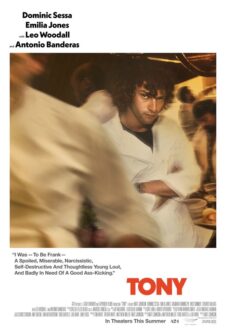
TONY presents a well-made, coming-of-age biopic set in 1975 that chronicles the early adult life of the irascible and opinionated popular chef and travel expert Anthony Bourdain. The film highlights his growing friendship one summer with a middle-aged Portuguese Catholic chef who runs a small restaurant in Cape Cod. Meanwhile, Tony pursues a long-term relationship with his high school girlfriend, Nancy.
Like the IRON MAN movies, TONY tells a moving tale of redemption. However, the movie contains strong foul language, lewd behavior, and drug use, which some may find excessive and unacceptable. Additionally, the film employs revisionist biography, making the title character appear more likable than he truly was. The Catholic chef tries to correct Tony’s use of profanities.
TONY opens with a quote from Anthony Bourdain’s first book, KITCHEN CONFIDENTIAL, where he describes himself as a spoiled, narcissistic “lout” who needed a wake-up call. He receives that call early in the film but faces a series of incidents that lead to his growth.
After attending Vassar College for two years, Tony deceives his parents about a writing fellowship. He maintains a good relationship with his father, a record industry professional, but resents his mother, a New York Times editor, for her blue-blooded ways and ambitious aspirations.
One summer night, Tony leaves without telling his parents for Provincetown, Massachusetts, a beach resort town across Cape Cod Bay from Plymouth, Massachusetts, the famous site of the Pilgrims’ landing. Tony aims to reconnect with a pretty Vassar coed named Nancy, his high school love.
The film centers on their relationship and Tony’s growing friendship with the middle-aged Portuguese chef. Tony washes dishes for the chef’s restaurant in exchange for room and board, and he receives some spending money. Despite this, he continues to lie to everyone about working on a novel.
Will Tony end up with Nancy or achieve something meaningful in his life?
Like the IRON MAN movies, TONY delivers a moving and well-acted story of redemption. In this film, Antonio Banderas shines as the Portuguese chef. Dominic Sessa and Emilia Jones deliver strong performances as the young Anthony Bourdain and Nancy. At the same time, Leo Woodall and Stavros Halkias add depth as the two young fry cooks in the Cape Cod restaurant.
The narrative leads to an extremely touching ending where Tony feels inspired by the older Catholic chef’s love for Jesus, life, food, and cooking. Despite this uplifting moment, the film features excessively strong foul language, containing over 150 obscenities and profanities. It also showcases lewd behavior and depicted drug use. The ending portrays Anthony Bourdain as more likable than he perhaps was, while the Catholic chef attempts to correct Tony’s profanity and takes him to Mass.
The Content Guide
The specifics — spoilers included by nature — so you can judge for your own family.
Strong mixed pagan worldview, with pagan, immoral, moral, Christian, and pro-capitalist content, about a young man with some bad/immoral character traits who finds some moral redemption through his friendship with an older mass-attending Catholic man, the Portuguese chef who runs the Cape Cod restaurant where the young man works one summer, but the movie has some personal revisionist history that makes the young man become or seem more likable than perhaps he really was
At least 126 obscenities (including at least 105 “f” words), six strong profanities using the name of Jesus or Christ, two GD profanities, five OMG profanities, one or two scenes with obscene gestures, and two scenes with some vomiting
Some comical and slightly comical violence where the title character is drunk and makes a nuisance of himself at a restaurant and punches a chef and then gets beaten up by the bouncer (the result is a black eye), a man lets the title character sleep in a hammock on his porch, and the man wakes him up every morning by throwing a bucket of water on the young man, another young man working at a restaurant with the title character gets angry and punches their chef/owner and gets fired, title character punches a wall in his room after he doesn’t get the college fellowship he wanted, and an accidental fire burns a kitchen in one harrowing scene
Briefly partially depicted fornication shot from a distance, implied fornication in one scene at a party (a young man and woman enter a bedroom and close the door behind them, and the man leaves the room shortly thereafter and closes the door after him), and a few lewd comments occur
Brief upper female nudity in a short depicted sex scene shot from a distance, and images of upper male nudity in other scenes
Some alcohol use multiple scenes and drunkenness in two or three scenes
Some smoking but strong use of illicit drugs, including marijuana smoking in one scene, men snort cocaine in about three scenes, and a young man shoots up heroin while his friend watches;
Title character lies to people that he has an Ivy League college fellowship for writing a novel and says he’s writing that novel and another book (eventually, though, he does write a popular book later in life, so he fulfills his professional writing desires; other books follow, though the movie doesn’t mention them).