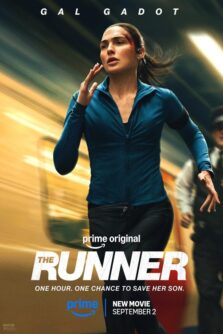
THE RUNNER (2026)
A poorly constructed action thriller with unbelievable plot points and a poorly written script.
Should You Watch It?
No. Despite a promising and engaging premise, this movie fails to deliver. The frantic editing and constant action exhaust rather than exhilarate, while the increasingly complicated plot forces you to overlook major logical gaps.
Unbelievable characters, a lack of emotional depth, and a poorly constructed story leave the audience disappointed rather than fulfilled. Additionally, the film wraps up hastily, and the awkward plot twist feels jarring and unbelievable.
The audience should also prepare for violence, some bloody imagery, coarse language, sexual material, and a brief drug reference. This one ultimately hits the adrenaline hard, but the rush doesn’t last long.
The Story
NO SPOILERS — WE KEEP THE SURPRISESSuccessful lawyer Maia Marten’s morning run takes a terrifying turn when she learns her son has been kidnapped. A mysterious caller gives her a series of increasingly dangerous commands, warning that her son will pay if she stops or asks for help. Racing across London, Maia must push herself to the limit and decide just how far she’ll go to bring her son home.
Is It Any Good?
One star means a promising premise but poor execution. Director Kevin Macdonald and cinematographer Anthony Dod Mantle give the movie an energetic visual style. They use rapid editing and London’s streets to create a sense that Maia is constantly running out of time.
Gal Gadot commits physically to the role. Her performance shines when the movie asks her to carry the action. Unfortunately, the screenplay offers her, and the rest of the cast, little emotional material to work with. Damian Lewis brings energy to the mysterious villain, but the character itself becomes more cartoonish than threatening.
The biggest problem lies in the story. What begins as a promising thriller increasingly depends on coincidences, implausible technology, and convoluted explanations. The ending leaves much to be desired, and the twist feels improbable and jarring.
Filmmakers present flashes of stylish filmmaking and committed performances, but the movie's weak script ultimately keeps it from becoming the gripping thriller it wants to be.
The Worldview
This one lands closest to a moral worldview, though it never fully commits to that ground. At its heart, the movie asks how far a parent will go to protect a child, raising questions of control, trust, technology, and personal responsibility along the way.
The movie treats Maia's drive to save her son as its clearest virtue: she refuses to give up even when fear, manipulation, and pressure push her to her limits. That sacrificial love and perseverance can resonate with a biblical worldview, particularly the Bible's call for parents to protect and care for their children. Yet the movie's moral compass wavers when Maia faces pressure to commit murder to protect her son.
A humanist worldview drives much of the story: the mother goes to any lengths to protect her son, even at the cost of a human life, and the antagonist shows the same disregard to get what he wants. Biblical elements surface here and there, especially the call to love and protect one's children, but they never take the lead. The movie also leans hard into technology as a tool of surveillance and control, tapping into real fears about our increasingly connected lives.
In the end, the movie names a familiar ache: the fear of loss and the desperate wish to regain control when things turn terrifying. But it offers no deeper answer. Maia wins that control on her own, with no outside help. The movie never asks its characters to trust a sovereign God when circumstances spin beyond their reach.
The Content Guide
The specifics — spoilers included by nature — so you can judge for your own family.
Dominant Worldview and Other Worldview Content/Elements
A humanist worldview where a mother goes to any length to protect her son and takes a human life. The antagonist shows frequent disregard for human life to get what he wants. Biblical elements stressing the call to love and protect one's children
Foul Language
Three profanities and 15 obscenities, including 3 "f" words and 7 "sh" words. A character vomits. A character urinates in his pants
Violence
Discussion of child abuse. The main character's mother supposedly kills her father. A character shoots another character repeatedly. A character gets hit by a car. A criminal stands trial for rape and murder
Sex
No sex, but a couple kisses passionately on a train, and a text message carries sexual innuendo
Nudity
Brief upper male nudity shows a man on his balcony
Alcohol Use
Characters drink alcohol at a bar
Smoking and/or Drug Use and Abuse
A man smokes a cigarette;
Miscellaneous Immorality
Child abduction, ransom, theft, and dishonesty.
Talk About It
Questions for the drive home, the dinner table, or the youth group.
Maia is repeatedly placed in situations where she has to choose between doing what is right and doing what she believes will save her son. Does the film suggest that a good outcome can justify morally wrong choices? Romans 3:8
What does The Runner suggest about the decisions people make when they're afraid, and how does that compare with Scripture's call to respond to fear with trust rather than being controlled by it? How are we as Christians to respond in a situation where our first response is fear? Psalm 56:3
Maia spends much of the film trying to regain control of an increasingly chaotic situation. Do you think the film ultimately presents control as something we can achieve, or does it reveal how fragile our sense of control really is? James 4:13-15
The Final Word
THE RUNNER opens with a strong premise and committed physical performances, but a convoluted script, implausible plot, and shallow characters undercut both. The movie's take on parental love, technology, control, and sacrifice offers real reflection, yet its worldview stops short of deeper answers about pain and trust. Foul language and graphic violence add further caution for families. The result: a stylish thriller that entertains in stretches but ends on a flat note.