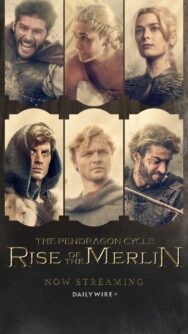
THE PENDRAGON CYCLE: RISE OF THE MERLIN: Episode 1 and 2: “Island of the Mighty” and “The Vision of Taliesin”
A poetic, faith-filled Arthurian epic — glorious, violent, and not for children.
Should You Watch It?
Here's the short version: this is a beautifully made, deeply Christian fantasy epic, and it earns its caution rating honestly. The first two episodes of this Arthurian prequel are captivating and poetic, carried by a heavy, emotional score and an expansive, detailed world. At its center is a strong Christian, moral worldview — a bard who becomes a prophet of the One True God, a princess who leaves false gods behind, a woman's conversion through her husband's faith.
But this is a violent, pagan-soaked world before it becomes a redeemed one. Battles draw blood. A woman is bloodied by a charging bull. Sorcery, false gods, and pagan ritual are everywhere the true God has not yet reached. That contrast is the whole point of the story — but it means young children and sensitive teens should sit this one out.
If you're an adult or older teen who wants a thoughtful, well-crafted fantasy with real spiritual weight, this is worth your time. If you're picking for the whole family, wait until they're old enough for the dark parts.
The Story
NO SPOILERS — WE KEEP THE SURPRISESRoman Britain, fourth century. A barbarian threat looms. A baby is pulled from a river and raised to become Taliesin, a bard with an uncanny gift of sight — pursued from birth by gods warring for his soul. Across the sea, Charis, a princess who survived the fall of her homeland, prays to a false god for strength she no longer believes will save her.
Their peoples collide. Christian monks arrive speaking of a God neither has known. As Charis's father hardens his heart against them, the foundation is quietly laid for a kingdom, and a king, still to come.
Is It Any Good?
Four stars, and the source material shows why. This is extensively detailed, poetic filmmaking — a fantasy world built with real care, matched to a heavy, emotionally resonant score. The series draws from Stephen R. Lawhead's acclaimed novels (the first won the Evangelical Christian Publishers Association's Gold Medallion for Fiction in 1988), and that literary pedigree shows in how patiently the story builds its world and its faith.
The first two episodes are genuinely captivating — the kind of premiere that leaves you wanting the next installment. It's worth noting the series, like most adaptations, departs from its source books in places.
The Worldview
This series exalts something Movieguide loves to see done well: a Christian worldview at the center of a fantasy epic, treated with seriousness rather than as set dressing. Taliesin is shaped almost like a biblical figure — a Druid pursued by pagan gods from birth who instead comes to know the true God, is filled with biblical knowledge, and becomes a prophet who foretells the coming of King Arthur and a kingdom worthy of God. Charis, an unbeliever grieving a fallen civilization, is drawn toward the same God through the monks and, eventually, through marriage. Her conversion mirrors a truth Scripture affirms: that faith often reaches us through the people who love us.
The cost of that story, though, is real. The world it's set in runs on false gods, pagan ritual, and mysticism — Bel the bull-god, druidic circles, sorcery used to deceive and seduce. None of it is treated as good, and the true God is clearly the "shining beacon and light of goodness in a dark world" — but the darkness is depicted vividly enough to warrant real caution for younger or more sensitive viewers.
What this story is really tracing is the ache of people worshiping gods that cannot save them, until something — someone — true finds them first. Scripture says it plainest: "The light shines in the darkness, and the darkness has not overcome it" (John 1:5).
The Content Guide
The specifics — spoilers included by nature — so you can judge for your own family.
Dominant Worldview and Other Worldview Content/Elements
A strong Christian, moral worldview, despite being a fantasy epic with elements of magic and sorcery, rooted in some history with real places, but also with fantastical settings as well, where the hero and heroine find the One True God, set in a world run by false gods, pagan rituals, false religions, and mysticism, but the Christians and their One True God are the shining beacon and light of goodness in a dark world and Christianity comes to defines the baby Moses figure, Taliesin, an evangelical figure who is a character worthy of biblical scripture, although he’s fictional, he begins as a Druid with a strong gift of foresight where pagan gods war for his soul from the beginning, but he follows none, as a bard his song captivates his audiences like no other but God seeks him out and he’s granted with the blessing of seeing the face of God himself, so he’s suddenly full of biblical knowledge and recognized by the Christian monks, Taliesin becomes a prophet and foretells the coming of King Arthur and of a perfect world of truth and love worthy of God, plus a woman is an unbeliever at first, but comes to God through her husband and is set free in her new Christian life
Foul Language
No foul language
Violence
Strong intense violence with some blood includes murder, battles with swords and arrows, a woman bloodied and charged by a bull, man fatally stabbed, and woman gives birth
Sex
No sex is shown, but implied, and two people are shown kissing in several scenes
Nudity
Upper male nudity
Alcohol Use
No alcohol use
Smoking and/or Drug Use and Abuse
No smoking or drugs;
Miscellaneous Immorality
A female character uses magic to deceive and seduce a man with her appearance.
Talk About It
Questions for the drive home, the dinner table, or the youth group.
Taliesin has gods warring for his soul from birth, yet he follows none of them — until the true God seeks him out. What does it mean that God pursues people before they pursue Him?
Acts 17:27 · John 15:16Charis prays to a false god for strength and later says she "killed the last god she trusted." What happens when we put our faith in something that was never meant to hold it?
Psalm 115:4–8 · Jeremiah 2:13A woman in the story comes to faith through her husband. Where else in Scripture do we see faith spreading through family and marriage — and what does that suggest about how we influence the people closest to us?
1 Peter 3:1–2 · Joshua 24:15Morgain's power struggle and Charis's father's hardened heart both bring pain onto people who love them. Where do you see pride costing people their relationships in this story — and in your own life?
Proverbs 16:18 · James 4:6The Final Word
This is a rare thing: a fantasy epic that takes both its craft and its Christian convictions seriously, and does both well. It's also a violent, pagan-soaked world before the light breaks in — which is exactly why it's built for older, sturdier viewers rather than the whole family couch. Our verdict stands: worth watching — teens and adults.