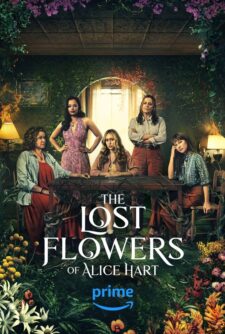
THE LOST FLOWERS OF ALICE HART
A beautifully shot abuse drama with no biblical answers.
Should You Watch It?
This one is a hard no, even though the craftsmanship is real. Sigourney Weaver gives what may be a career-best performance, the cinematography is genuinely bewitching, and the story of a girl orphaned by tragedy and raised on a flower farm turned women's shelter has real dramatic power. If this were simply about quality, it would earn its three stars honestly.
But quality isn't the only question. The series builds its entire moral universe on a Romantic, politically correct, feminist reading of domestic abuse — one where the only answer to men's violence is speaking out to the authorities, and no character has any religious or moral framework beyond that. Along the way it delivers 54-plus obscenities, scenes of fornication, a reference to incest, a lesbian subplot for the grandmother, drunkenness, and marijuana use.
Good filmmaking in service of a worldview this thin, and content this heavy, isn't worth your evenings. Skip it.
The Story
NO SPOILERS — WE KEEP THE SURPRISESAfter her parents die in a mysterious house fire, nine-year-old Alice goes to live with her estranged grandmother, June, who runs a flower farm in rural Australia — a farm that doubles as a refuge for battered women, where residents and staff communicate through a symbolic language of flowers. Years later, at 23, Alice uncovers a secret June has kept from her and flees the farm, only to find new trouble waiting for her.
Is It Any Good?
Three stars, and here's what that means: this is genuinely accomplished television, hampered by one significant flaw. Almost every frame feels composed with care, the cinematography recalls Terrence Malick or Zack Snyder, and the sound design and editing are impressive. Weaver's performance anchors the whole thing.
The complex plot generally reveals itself at the right pace — not so fast it kills tension, not so slow it loses you. Where it stumbles is its reliance on flashbacks that withhold crucial information for too long, which can frustrate viewers who prefer a straightforward story. The dramatic payoffs, when they land, are powerful. But the structure makes you work harder than the material should require.
The Worldview
The series exalts real, good things: the courage to name abuse out loud, and touching scenes of family reconciliation after deep hurt. It even complicates its villains slightly, suggesting abusive men can carry other, more admirable traits — a nod toward human complexity that Scripture would recognize, even if the show doesn't quite know what to do with it morally.
What it removes is any religious or transcendent frame. No character — including the two abusive men at the story's center — has a spiritual background or a moral tradition to draw on. The show's answer to male violence against women is entirely secular, emotional, and Romantic: speak out, and trust the authorities. That's not nothing, but it's not enough, and it leaves no room for repentance, redemption, or the kind of justice that comes from God rather than institutions.
The grandmother's decades-long lesbian relationship runs as a normalized subplot throughout, presented without any moral tension — a choice that shapes the show's whole picture of family and covenant.
The film's real subject is a longing for safety and vindication for the abused — a longing Scripture speaks to directly: "The Lord hears the desire of the afflicted; you will strengthen their heart" (Psalm 10:17).
The Content Guide
The specifics — spoilers included by nature — so you can judge for your own family.
Dominant Worldview and Other Worldview Content/Elements
Strong Romantic, politically correct, feminist worldview and perspective on domestic abuse and violence of men against women and children, with a major subplot about a girl’s grandmother and the grandmother’s long-time lesbian partner, mitigated by some moral, redemptive elements, offers only emotional Romantic, feminist solutions to the problem of men committing acts of physical abuse and rape (including a case of incest) in and outside the home
Foul Language
At least 54 obscenities (mostly “f” words), two Jesus profanities, multiple light profanities, one euphemistic reference to self-abuse, and a man uses the words “slutty” and “whore” to refer to sexual promiscuity
Violence
frequent scenes of male-on-female domestic abuse, male character habitually beats his wife and young daughter, girl has visions of setting her abusive father on fire, girl hits a bully repeatedly in the face with a book, two children slice their hands to make a pact, a verbal reference to a woman being gang-raped, two women get into a brief physical altercation, young man starts to strangle his mother after she brings up his past rape of his younger sister (he threatens to kill her if she tells the woman he’s marrying), and a man starts to strangle his young daughter, but woman beats him to death with a large stick to defend her
Sex
An unmarried and troubled young woman sleeps with two men, there are v erbal references in one scene to a young man having raped his younger sister in the past, two older women are in a long-term lesbian
Nudity
Rear male nudity in one scene, a woman removes her underwear while fully clothed and instances of upper male nudity
Alcohol Use
A woman twice drinks heavily to excess, characters drink socially at bars and nightclubs
Smoking and/or Drug Use and Abuse
Some characters smoke cigarettes and/or marijuana;
Miscellaneous Immorality
Characters frequently use manipulation and deception to get what they want, to the detriment of their loved ones, and an abusive boyfriend spreads false rumors about his girlfriend to deflect her accusations of violence against him.
Talk About It
Questions for the drive home, the dinner table, or the youth group.
The series' only answer to abuse is speaking out to authorities. What does Scripture say about God's own care for the abused and oppressed?
Psalm 10:17–18 · Psalm 34:18June keeps painful secrets from Alice "to protect her," and the deception causes years of heartache. What does the Bible say about truth-telling, even when it costs something?
Ephesians 4:25The story includes real moments of family reconciliation after deep wounds. How does biblical forgiveness differ from simply "moving on"?
Colossians 3:13 · Matthew 18:21–22The series suggests some abusive men have other admirable traits. How do we hold sin and human complexity together without excusing wrongdoing?
Romans 12:9 · Galatians 6:1The Final Word
There's real craft here — a striking eye, a strong lead performance, some genuinely moving scenes of family healing. But the show's worldview leaves out the God who actually hears the afflicted, and the content along the way is heavy enough that no family should wade through it to find those good moments. Our answer stands: skip it. Looking for something to watch instead? Start here:.