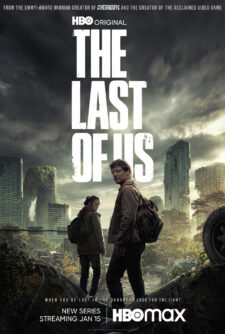
THE LAST OF US: Episode 1.1-3
A well-made apocalypse built on a worldview you can't recommend.
Should You Watch It?
Here is the honest tension. HBO Max's adaptation of the hit video game is skillfully made — well acted, tense, frightening, and at times genuinely moving. If craft alone decided this, we'd be talking differently.
But craft doesn't decide it. Across the first three episodes you get more than fifty obscenities, over thirty of them "f" words, plus extreme, gruesome, graphic violence. And the third episode steps out of the main story to portray — at length and with explicit, admiring detail — the life and death of two homosexual survivalists, complete with implied sodomy, exchanged vows, and a double suicide. The show's own creators have described tricking viewers into watching "a gay love story," and this episode is built as awards bait.
So no. Whatever the series does well, we find these three episodes unacceptable, abhorrent, and too politically correct to recommend. This one is a skip.
The Story
NO SPOILERS — WE KEEP THE SURPRISESIn 2003, a fungal pandemic sweeps the United States and the world, infecting people and turning them into cannibalistic monsters.
Twenty years later, Joel Miller — a combat veteran and hardened survivor — is roped into protecting Ellie Williams, a teenage girl who may be immune to the fungus. In exchange for weapons and supplies that could help him find his lost brother, he agrees to move her out of an authoritarian government compound in Boston and across a ruined country toward a lab that might replicate her immunity. The journey, and Ellie's part in it, prove to be far more than a single rescue.
Is It Any Good?
Three stars, and they're earned on the technical level. The series achieves the original game's tension, jump scares, and intensity while telling its two leads' story with real emotional impact. Joel's loss of his own daughter in the first episode is heartrending, and it makes his rage against the infected completely understandable.
The imagery is a highlight: the infected, what the virus does to a body, this apocalypse's particular strangeness, and the eerie sight of skyscrapers and supercities being reclaimed by nature are all vividly depicted. The show also keeps the game's compelling narrative largely intact.
That the filmmaking is this competent is precisely what makes the content and worldview so regrettable — the skill is real, and it's aimed somewhere we can't follow.
The Worldview
The dominant worldview across these three episodes is strongly humanist. Nearly every character in this post-apocalyptic world is driven by essentially selfish motives, and survival, not any higher good, is the governing law.
There are lighter, better notes woven through it. The series nods repeatedly toward doing the right thing — compassion, and the willingness to risk and even sacrifice your life for another. Joel's grief and Ellie's worth as a life worth saving carry a moral weight the show clearly means us to feel. Those redemptive glimmers are real, but they're mitigating touches, not the foundation.
The third episode is where we part ways with the show entirely. It devotes itself to the story of two homosexual survivalists, from the fungus's arrival in 2003 to the moment Joel and Ellie find they have died by suicide — one man having contracted AIDS, the other choosing to join him, the two exchanging wedding rings and vows before a last meal. The relationship is portrayed explicitly and admiringly, and the series treats it as its emotional centerpiece. Scripture calls such lust what it is, and the show asks us to call it love. We can't. This is where the −4 lives.
Underneath everything is the ache these episodes feel but cannot heal — the longing for a world not ruined, for a home that isn't lost. That longing is real, and it points past this story: "He will wipe away every tear from their eyes, and death shall be no more" (Revelation 21:4).
The Content Guide
The specifics — spoilers included by nature — so you can judge for your own family.
Dominant Worldview and Other Worldview Content/Elements
Strong humanist worldview in three episodes, slightly mitigated by some light moral, redemptive elements promoting doing the right thing, compassion and sacrifice, but the third episode tells a very strong politically correct story about two homosexual survivalists who fall in demonic lust
Foul Language
At least 50 obscenities (including 30 or more “f” words) and five strong profanities in three episodes
Violence
Extreme, graphic, scary action violence includes the following: In Episode 1.1, a young woman steps in a large pool of blood and discovers it flowing from a man’s torn shoulder then discovers an elderly woman chewing on another victim’s neck, when the elderly woman looks up, fungal growth are hanging out of her mouth, and she moves to attack the young girl before a man kills her with a shovel (no blood), many infected people attack others in the streets, a bomb goes off, and the shockwave overturns a truck in which the protagonists are traveling, many infected are seen eating other dead humans, a man is chased by an infected human and is saved when a military man puts a bullet through the creature’s head (blood splatter from the headshot), a young girl is shot in the stomach and dies in her father’s arms (much blood shown around her abdomen before she dies), shots of the burned out and demolished city of Boston with teams tossing dead bodies into massive street bonfires witness, explosives of many kinds go off in many scenes injuring or killing many, a full flowered dead body is plastered on a wall in one scene, a man beats a man to death punching him in the face (blood on face and fist). In Episode 1.2, a nude female body is examined in a biohazard facility (her leg is cut open and plant substance extracted from her throat), three lead characters combat infected with guns and melee weapons and there is much peril, a character is bitten and sacrifices her life to save her companions by blowing up a building while still inside so they can make their escape. In Episode 1.3, a man lays traps for the infected and for some non-infected scavengers, who burn to death in one scene, and man kills many scavengers with shotguns, plus it’s implied a man is dying of AIDS and he and his homosexual lover commit suicide via a drug overdose in some wine
Sex
Two men get in bed together and kiss, one man gets on top of the other, implied oral sex between the two men before the camera cuts away, several other scenes with the men kissing or holding hands, plus some light suggestive dialogue and movements
Nudity
A totally nude female body is examined in a biohazard facility, and upper male nudity when two homosexual kiss in bed and commit sodomy
Alcohol Use
Many characters drink beer or hard liquor at several points
Smoking and/or Drug Use and Abuse
Several characters smoke cigarettes;
Miscellaneous Immorality
Government zones are run like a police state, scavengers prey on non-infected people, and a character says the government murdered people in rural areas to cut down on the numbers of people getting infected.
Talk About It
Questions for the drive home, the dinner table, or the youth group.
In this world, nearly everyone acts to survive first and ask questions later. When the pressure is on, what actually shapes a person's choices — self-preservation, or something higher?
Philippians 2:3–4 · Matthew 16:25Joel's grief over his daughter fuels years of rage. How does Scripture invite us to carry loss without letting it harden into bitterness?
Psalm 34:18 · Romans 12:19The story leans on the willingness to risk and sacrifice one's life for another — even amid so much selfishness. Where does that instinct come from, and where does it find its fullest picture?
John 15:13 · Romans 5:8The series presents as love what Scripture names as sin, and asks its audience to be moved. How do we hold to conviction and compassion at the same time, without surrendering either?
Ephesians 4:15 · 1 Corinthians 13:6The Final Word
There's real skill here — the acting, the tension, the imagery all land. But skill isn't the whole question, and on the whole question this series answers for itself: extreme gore, heavy profanity, and an explicit, glorified storyline we can't endorse. So our answer stands: skip it. Looking for something the whole household can watch instead? Try our latest family-friendly picks.