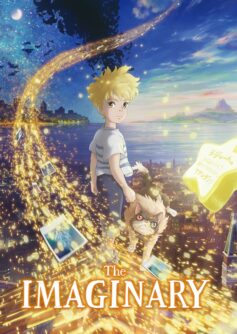
THE IMAGINARY (2024)
Pushing Beyond the Magic Dragon
What You Need To Know
THE IMAGINARY is an animated fantasy adventure on Netflix. It tells the story of Amanda, a young girl with an Imaginary friend she calls Rudger.
What happens, however, when children become aware of their Imaginary friends and the different worlds they inhabit? There is, for example, the classic story of Jacky Paper and Puff the Magic Dragon, where the child grows up, forgets about his make-believe friend, and life continues. Here, however, the story is expanded. When Amanda is hurt, she and Rudger are separated. Rudger, discovers a fantasy world where he can experience the love of a child again, provided it isn’t Amanda. But, can Rudger escape the schemes of the malevolent Mr. Bunting? And, will he be able to sever completely his tie with the girl who imagined him into being?
This Netflix pairing with the Japanese movie studio Ponoc yields some very engaging ideas and artistic renderings. It’s a thought-provoking tale that, while aimed at children, will certainly touch the hearts of many an adult. The theme of children growing out of their need for Imaginary friends is powerful and is capable of illiciting more than just a few tears from both children and adults.
THE IMAGINARY goes beyond the famous, beloved “Puff the Magic Dragon” song by Peter, Paul and Mary. (Paul said that song was not about marijuana, although that is what many users believe it is about.) Thus, THE IMAGINARY makes its imaginary character, Rudger, the active agent in the story. For example, he’s unwilling to part with Amanda and their imaginary adventures altogether, even at the price of his own nonexistence. In this sense, THE IMAGINARY is a “coming of age” story in a deeper sense. The Imaginary friend decides that he would rather choose his reality and remain with one true friend as long as possible rather than travel from one child’s imagination to another ad infinitum.
The animation in THE IMAGINARY is breathtaking and fits the movie’s focus on imagination very well. As with many similar stories such as “Puff the Magic Dragon,” THE VELVETEEN RABBIT, and TOY STORY 2, THE IMAGINARY is a tale of bittersweet storytelling which will affect viewers in much the same way.
THE IMAGINARY has a strong moral, redemptive worldview. It promotes life, courage, devotion, and sacrificial love. However, it’s marred by a false Romantic, postmodern, relativistic philosophy that promotes the idea that the reality people choose to believe is all that matters, not truth. For example, one character says, “Sometimes, it doesn’t matter whether it’s true or not. In life it’s worth believing what one wishes to believe. . . . All that matters is the story you believe.” In the Christian, biblical worldview, life is a real and true story that’s told by a Master Storyteller (see G. K. Chesterton, ORTHODOXY, p. 56). THE IMAGINARY also has some scary images, scenes of dangerous peril, violence, and a scene where a real-life child temporarily turns the imaginary boy into an imaginary girl wearing female clothes and makeup.
So, MOVIEGUIDE® advises caution for older children, including young teenagers.
The Content Guide
The specifics — spoilers included by nature — so you can judge for your own family.
Dominant Worldview and Other Worldview Content/Elements
Moral, redemptive worldview promotes courage, devotion and self-sacrificial love but is marred by a false Romantic, postmodern, relativistic philosophy at the end that promotes the idea that the reality which people choose to believe is all that matters, plus an imaginary boy is forced at one point by a new child friend to transform into a young girl and wears very feminine attire and makeup before turning back into himself
Foul Language
No foul language
Violence
Light violence and scary peril involving an imaginary pale girl character with dark sunken eyes and black hair and dark gray clothes who repeatedly tries to capture an imaginary young boy, a snake on a man’s shirt comes to life, the villain’s mouth opens up as he begins to suck an imaginary boy into himself in several scenes (this scares both the boy and the audience, scaring both the boy and the audience, a girl hits the villain in the head with her bag a few times to save her imaginary friend, a young girl is hit by a car (no impact or blood), a man chases children several times in the hope of devouring one of them, children battle an evil man and a dark Imaginary being in several scenes (no blood); a man tries to constrict a young girl with a giant snake while in her hospital room, people go over a waterfall into an ocean maelstrom in an imaginary world, the pale girl with sunken eyes and black hair seeks to envelope a girl and an imaginary boy, characters are hit and pushed and knocked down, many scenes jump in and out of reality and into several imagined worlds
Sex
No sex
Nudity
No nudity
Alcohol Use
A young mother drinks beer on occasion
Smoking and/or Drug Use and Abuse
No smoking or drugs;