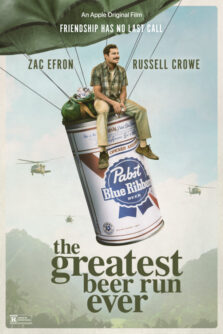
THE GREATEST BEER RUN EVER
A unique but shallow Vietnam journey for discerning adults only.
Should You Watch It?
The Greatest Beer Run Ever has a remarkable true-story premise and some compelling moments. Russell Crowe is especially effective as a journalist photographing the tragedy and chaos of the Vietnam War. The movie also includes positive Christian and morally uplifting elements involving sacrifice, church, and prayer.
But the film is uneven. The dialogue is clunky and dull until the protagonist reaches Vietnam, Zac Efron’s performance is less compelling, and the tone never settles. The movie also contains at least 44 obscenities, strong war violence, sexual references, and morally confusing historical and worldview elements.
This is worth considering only if you are a discerning adult who can weigh those concerns. It is not a family movie or a choice for children and young teens.
The Story
NO SPOILERS — WE KEEP THE SURPRISESIn 1967, merchant mariner “Chickie” Donohue leaves New York City on an unusual mission: bring beer to his childhood friends serving in Vietnam. He joins a cargo ship carrying ammunition, persuades the captain to give him three days’ leave, and crosses Vietnam to find the troops. What begins as a patriotic gesture exposes him to a reality far different from the media and government portrayal of the war.
Is It Any Good?
Three stars means this film has compelling elements but falls short of greatness. Russell Crowe gives the strongest performance as a journalist photographing the war’s tragedy and chaos in Saigon. The story’s unusual character arc also gives the movie some distinction.
Still, the film struggles to get off the ground. Its dialogue is clunky and dull until Donohue arrives in Vietnam. Zac Efron is less compelling as the protagonist, and the movie struggles to find a consistent tone. The result is an uneven historical drama with worthwhile moments.
The Worldview
The film presents a light moral worldview centered on sacrifice, with patriotic themes and Christian elements such as church and prayer. It recognizes that Donohue wants purpose and wants to support troops from home. However, those positive ideas are mixed with superficial pagan morality and a confusing treatment of history.
The movie gives what the review calls the standard liberal critique of the Vietnam War. The review disputes that framing, arguing that the film overlooks America and South Vietnam’s victory in the Tet Offensive, the later consequences of congressional refusal to support South Vietnam, and the broader regional effects of the American presence in Southeast Asia. These historical claims make the film’s perspective revisionist rather than balanced.
The central idea of sacrifice can point beyond patriotic duty to a biblical calling: “present your bodies as a living sacrifice, holy and acceptable to God” (Romans 12:1).
The Content Guide
The specifics — spoilers included by nature — so you can judge for your own family.
Dominant Worldview and Other Worldview Content/Elements
Light moral worldview about the importance of sacrifice, with some patriotic themes and Christian elements like church and prayer, but mixed with light pagan elements and some leftist revisionist history about the Vietnam, War
Foul Language
At least 44 obscenities (including two “f” words), several Jesus profanities, six GD profanities, and 12 light profanities
Violence
Strong war violence throughout, including torture and war injuries, elephants are shown with injuries from napalm, people are shot and bombed, and in a striking scene a soldier loses his arm and walks around in shock
Sex
No sex scenes, but there are several sexual references, which include the protagonist says he got a venereal disease the first time he fornicated
Nudity
No nudity
Alcohol Use
By nature of its title, the movie contains many scenes with people drinking beer and other alcohol, one scene in a pub shows men getting drunk
Smoking and/or Drug Use and Abuse
Several scenes of military personnel smoking cigars and cigarettes, but no drugs;
Miscellaneous Immorality
Due to the movie’s odd tone, some viewers might find it does a disservice to the real-life events for the sake of getting emotional responses from the audience.
Talk About It
Questions for the drive home, the dinner table, or the youth group.
Donohue wants to support people serving far from home. What does sacrificial service look like when it is motivated by love rather than the desire to feel important?
John 15:13 · Philippians 2:3–4The film contrasts public claims about war with the suffering people actually experience. How should Christians respond when they discover that a story they trusted was incomplete?
Ephesians 4:25 · Proverbs 12:22The movie includes patriotic themes alongside Christian elements. How can love of country be honored without becoming more important than loyalty to God?
Acts 5:29 · Philippians 3:20Donohue searches for purpose through a dramatic mission. Where should a Christian seek lasting purpose?
Ephesians 2:10 · Colossians 3:17The Final Word
This film offers a distinctive true-story premise, a strong performance from Russell Crowe, and morally uplifting elements. Its uneven craft, harsh content, pagan morality, and revisionist history make it unsuitable for families. For discerning adults, it is WORTH THE TRIP — ADULTS ONLY. For everyone else, consider these.