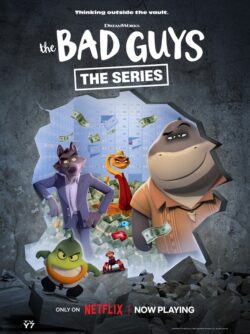
THE BAD GUYS: THE SERIES: Episodes 2.1-2.3
Fun, funny animal thieves — but thieves all the same.
Should You Watch It?
Here's the decision for your family. The second season of Netflix's animated prequel to the BAD GUYS movies opens strong: the five animal thieves are genuinely likable, the plots are well-written, and each episode lands a surprising twist. There's warmth in it too — these friends have each other's backs, the leader owns his mistakes and tries to make things right, and one episode teaches that nobody wins when the team turns on itself.
But the whole premise is that these are thieves who love stealing, and the show rarely pushes back against that compulsion. That's the catch. For a young child, "the good guys are crooks and it's funny" is a message a parent may need to unpack. There's also moderate cartoon violence, some crude gas humor, and a moment in Episode 2 where a character imagines himself with a "husband" and son.
So: if you have older children and you're in the room to talk it through, this is worth a watch at home. Sit with them, enjoy the twists, and use the crime-as-comedy as a conversation. Don't hand it to the youngest and walk away.
The Story
NO SPOILERS — WE KEEP THE SURPRISESWolf, Shark, Snake, Webs, and Piranha are a gang of animal thieves who live a life of crime together — and, more than that, they're friends.
Season 2 picks up right where the last left off. In one episode, the crew wakes up dazed and confused, unable to remember the night before, with little Piranha nowhere to be found. In another, they challenge each other to a contest: who can last twelve hours without committing a single crime? In a third, they thaw out an ancient wolf ancestor Wolf swears was the first animal ever to pull off a heist. What happens next is the fun part — and we'll leave it there.
Is It Any Good?
Three stars, and here's what earns them. The characters are the draw: fun, distinct, and easy to like. The plotlines are well-built, each turning on a twist you don't see coming, and the writing keeps the momentum up across all three episodes.
The animation is the weak spot — it gets a bit choppy in places. But the strength of the characters and the storylines carries past that, and the result is genuinely enjoyable to watch. This is a well-made kids' series that knows how to entertain; the questions it raises are about content and worldview, not craft.
The Worldview
This is a show built on a real tension, and it's worth naming plainly. On one side sit qualities Scripture prizes: loyal friendship, teamwork, a leader who apologizes when he's wrong and works to make things right, and a group that even befriends a former enemy. One episode shows the crew failing to resist temptation but learning, honestly, that no one comes out ahead when friends turn on each other and lie to get their way.
On the other side sits the premise itself. These characters have a compulsion to steal, and the episodes rarely challenge it. Theft is their nature and the running joke, so "the good guys" are also, cheerfully, bad role models — trickling greed, deceit, and throwing each other under the bus in among the loyalty. Older children can enjoy this if a parent supplies the moral frame the show mostly withholds.
One more note for parents: in the second episode, a character daydreams himself into a "normal" life complete with an imaginary "husband" and son. It's brief, but it's there, and you should know before you press play.
The show's best instinct — that a band of friends should be faithful to one another when it counts — points somewhere higher than any heist. "A friend loves at all times, and a brother is born for adversity" (Proverbs 17:17). The same Scripture that praises that kind of love also draws the line these characters won't: "Let the thief no longer steal" (Ephesians 4:28).
The Content Guide
The specifics — spoilers included by nature — so you can judge for your own family.
Content Summary
<span style="font-weight: 400;">(Pa, B, Ho, PC, VV, MM): </span><b>
Dominant Worldview and Other Worldview Content/Elements
</b><span style="font-weight: 400;"> Mixed pagan worldview with some moral elements such as a gang of thieves works to maintain their group’s friendship and work as a team, the leader often apologizes for his mistakes and works to make things right, the characters have a strong friendship and work together to find their missing friend, friendship forms with one of their enemies, the characters struggle with temptation in one episode but fail even though they learn that no one wins while they are fighting among themselves, but the characters have a compulsion to steal things and the episodes rarely push back against that compulsion, plus the shark character pretends to be an accountant to keep his mind off his lust for stealing things but his pretend character has an imaginary “husband” and an imaginary son; </span><b>
Foul Language
</b><span style="font-weight: 400;"> No foul language, but there are some refrenecsreferences and puns about passing gas, such as “blow your butt trumpet” and “squeak between your cheeks,” and a character vomits up another character; </span><b>
Violence
</b><span style="font-weight: 400;"> Moderate cartoon violence and peril throughout, including high-speed chases and reckless driving, a getaway driver speeds recklessly and leaves tire marks and hits another character and then puts him in the trunk, and leaves, characters throw statues at the museum guards’ heads, character crashes into an electrical tower, and scenes include chasing and fights, including one fight using a baguette; </span><b>
Sex
</b><span style="font-weight: 400;"> No sex scenes, but there’s one reference to a male character having a “husband” in an imaginary scenario; </span><b>
Nudity
</b><span style="font-weight: 400;"> No nudity; </span><b>
Alcohol Use
</b><span style="font-weight: 400;"> No alcohol use; </span><b>
Smoking and/or Drug Use and Abuse
</b><span style="font-weight: 400;"> No smoking or drugs (several characters lose their memory and can’t remember the night before due to a food side effect; and, </span><b>
Miscellaneous Immorality
</b><span style="font-weight: 400;"> The characters are always working on their next heist with crimes committed throughout as part of their nature so they are bad role models despite their desire to be good friends and to do right by each other when it counts, the characters still often throw each other under the bus and trick each other for their own desires, and there are also depictions of greed.</span> <br style="font-weight: 400;" />
Talk About It
Questions for the drive home, the dinner table, or the youth group.
The crew is fiercely loyal to each other — but they steal for a living. Can real friendship be built on doing wrong together? What does true, faithful friendship look like?
Proverbs 17:17 · Proverbs 13:20In "The Con Test," the gang can't last a single day without committing a crime, and they end up lying and sabotaging each other. When have you felt the pull to do something you knew was wrong — and what helps you resist it?
1 Corinthians 10:13 · James 1:14–15The show treats stealing as a funny habit that's just "their nature." What does the Bible say about that habit — and about what should replace it?
Ephesians 4:28 · Exodus 20:15When the team turns on each other, they learn that nobody wins from all the infighting. Why does Scripture warn so strongly against tearing each other down?
Galatians 5:15 · Ephesians 4:29The Final Word
The Bad Guys are as fun as ever — clever, warm, and full of surprises — and that's exactly why the crime-as-comedy needs a grown-up nearby to name it for what it is. For older kids watching alongside a parent, this one is a wait and see: enjoy it at home, talk it through, and don't leave the littlest ones to sort out the message alone. Looking for something simpler for family night? Try our family-friendly picks.