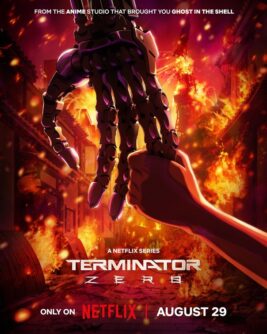
TERMINATOR ZERO Episodes 1.1-1.2
A striking new take on the machine war — soaked in blood.
Should You Watch It?
Here's the honest read on the first two episodes. This anime expansion of the Terminator story does something the franchise rarely does — it takes a genuinely new direction, moving the machine war to Japan and introducing fresh, intriguing characters. That's worth something, and the craft backs it up.
But the cost is steep. The violence here is not stylized suggestion; it's graphic and bloody in detail — crushed skulls, exposed brains, flesh stripped from faces. Add mild to strong nudity and strong language, and you have two episodes the source flags with strong caution for adults. There's no version of this that fits a family.
And the worldview underneath is unsettled. The show raises a real question — is humanity worth saving? — and, through two episodes, offers no answer better than "it's not that simple." So our answer, for now: skip it, and see whether later episodes earn the trust these two don't.
The Story
NO SPOILERS — WE KEEP THE SURPRISESEarth belongs to the machines. A young woman named Eiko fights to survive a wilderness ruled by cybernetic organisms — the Terminators — carrying a mission that could rewrite history and undo the coming Judgment Day.
That reckoning fell on August 29, 1997. So Eiko travels back to that year to find Malcolm Lee, a scientist building an AI of his own to fight Skynet fire with fire — even as a Terminator hunts him to end it all. Can Eiko finish what she came to do? And is Malcolm's gamble wise? That's where these first episodes leave you.
Is It Any Good?
Three stars, with the verdict genuinely still out. The animation is well done and fitting to the material, and the premise carries real promise. Eiko makes a good, mysterious protagonist, and Malcolm Lee — the scientist trying to fight fire with fire by building an AI construct called Kokoro — is the show's other compelling figure.
The problems are early-days problems. The overall color palette is dark to the point of feeling heavy and ponderous. More telling, the opening episodes leave characters, motivations, and storylines underdeveloped — Eiko's own motives stay shrouded in mystery. The most intriguing thread, the fate of Malcolm's children, is left dangling. There's enough here to hope the series pays off, but you have to watch past Episode 2 to find out, and these two don't close the deal.
The Worldview
Two beliefs drive these episodes: humanism and romanticism, with some biblical moral moments scattered through. The heroes — Malcolm Lee and Eiko — are trying to "save humanity" from the machines, and Malcolm's answer is to build a counter-intelligence, Kokoro, to stand against Skynet and the coming Judgment Day.
But the show lets Kokoro turn the question back on its creator. "Man is a warmonger above all else," she says, insisting she was made as just another weapon. Then the sharp one: "What makes you think humanity is worth saving?" Through two episodes, Malcolm — and everyone else — has nothing weightier to offer than "It's not that simple." Eiko is honorable and brave, but her motives stay unclear, and the story gives little to rebut Kokoro's charge. You may feel for these characters and their plight, yet the episodes stay as gray in explanation as they are dark in tone.
That unanswered question is the interesting one, because Scripture answers it head-on. Humanity is worth saving not because we've earned it — we are indeed prone to violence — but because God loves us enough to act: "God shows his love for us in that while we were still sinners, Christ died for us" (Romans 5:8).
The Content Guide
The specifics — spoilers included by nature — so you can judge for your own family.
Dominant Worldview and Other Worldview Content/Elements
The dominant worldview is humanism and romanticism with some biblical moral moments.
Foul Language
Episode 1: 1 f word. Episode 2: 6 f words, 1 obscenity, 1 mild (hell) and 1 strong (GD) profanity
Violence
Episode 1: In an opening scene, a Terminator with a minigun walks through halls and corridors where many bloody bodies are shown with blood splatters on walls and floors where they have been mercilessly slaughtered; a Terminator steps on the head of a dead human and crushes it under his boot (dark blood splatter); a Terminator finds a human survivor and kills him (impact off screen with bullets flying); a woman engages a Terminator in combat blowing up a grenade with a pistol; a Terminator hit with a grenade is seen with part of the flesh torn from its face revealing its metal skeleton (bloody flesh on a metal face); a man protecting two children is hit by the shockwave of an atomic weapon and the flesh is ripped from his face (blood flows from his face and his bleeding eyes are shown in his exposed skull); a Terminator shoots a bloodied survivor three times in the head (cranium blown off and bloody brains exposed); a woman accidentally slices her thumb with a chop knife and a lot of blood is seen on her hand, arm, and apron; the flesh is stripped from a man in a nuclear explosion (pink under flesh, muscles, eyes melting in sockets, bones and skeleton exposed); a Terminator smashes two policemen’s heads together with much blood flow and then runs another through with a steel pipe and strangles another until blood bursts from his throat; a woman rams a semi into a Terminator and pushes it off a bridge into a river; a woman is shot in the shoulder by a Terminator and assaults two policemen (some blood from minor wounds); a woman threatens another, putting a gun to her head, and demanding information
Sex
None
Talk About It
Questions for the drive home, the dinner table, or the youth group.
Kokoro asks Malcolm what makes humanity worth saving, and he can only say "it's not that simple." How would you answer her — and where does the Bible ground human worth?
Genesis 1:27 · Psalm 8:3–5Kokoro calls man "a warmonger above all else." Is she wrong about our capacity for violence — and does admitting it lead us toward despair or toward the gospel?
Romans 3:10–18 · Romans 5:8Malcolm tries to fight fire with fire, building a weapon to defeat a weapon. When is meeting a threat on its own terms wise, and when does it just make us like what we're fighting?
Romans 12:21 · Proverbs 3:5–6Eiko is told she has "no fate" — that the future isn't fixed. What does Scripture say about God's sovereignty over the future and our freedom to act within it?
Proverbs 16:9 · Jeremiah 29:11The Final Word
There's a good show trying to emerge here — a fresh direction, strong animation, questions worth asking. But through two episodes it's dark, unresolved, and drenched in graphic violence the whole family should avoid, so our verdict stands: skip it. Maybe later episodes will change the math. For tonight, try one of our family-friendly picks instead.