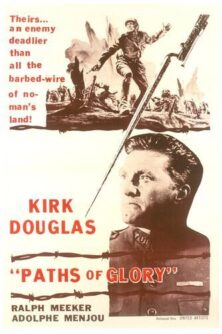
PATHS OF GLORY
Kubrick's furious, unforgettable indictment of war — and the men who trade lives for status.
Should You Watch It?
Here is the decision. Stanley Kubrick's WWI drama is a four-star film — moving, expertly written, and anchored by an excellent Kirk Douglas performance. It shows the hardships of war honestly, and it draws a sharp line between the men who stay desensitized to death and the ones who hold fast to their beliefs.
The content is mild for the weight of the subject. There are dramatic battle scenes, but with minimal blood; a single obscenity; brief upper male nudity; and alcohol and cigarettes throughout. The film's honesty about how power corrupts is its great strength, but it's also why younger viewers need a parent's guidance here.
So: if you're an adult who loves serious drama and stories of conscience under fire, this one rewards you. Watch it with older children only, and be ready to talk about what you see.
The Story
NO SPOILERS — WE KEEP THE SURPRISESIn the trenches of World War I, French General Broulard dangles a promotion, and General Mireau — who knows better — agrees to send his men to take "the Anthill," a heavily defended position the Germans hold.
Colonel Dax, a criminal defense lawyer in civilian life, reluctantly leads the charge, certain it cannot succeed. When the attack fails, his superiors demand someone pay for it — and Dax finds himself defending his own men against a charge that could cost them their lives.
Is It Any Good?
Four stars, and they're earned. This is a moving period drama that showcases the hardships of war — and, more pointedly, how some men become desensitized to the death around them while others refuse to. Kirk Douglas gives an excellent performance as Colonel Dax, and the script is well-written from first scene to last.
Kubrick stages dramatic battle sequences with gunfire and explosions, but the film's real tension lives in a courtroom — a trial with no witnesses, no formal indictment, and a court that refuses to hear evidence that might acquit. That's where the movie's outrage burns hottest, and where its craft is most quietly devastating.
The Worldview
PATHS OF GLORY carries a mixed worldview, and the mix is the point. Colonel Dax is its moral spine: committed to defending his men, arguing against a suicide mission he knows will fail, and finally offering to die in his soldiers' place. Against him stand Generals Broulard and Mireau, whose pagan fixation on rank and reputation leaves them with no regard for human life at all — and, tellingly, no real consequences for their actions.
The film also holds an honest Christian thread. A priest prays with the men condemned to die, telling one self-professed unbeliever that God is always ready to hear our prayers, and he accompanies them to the execution to pray over them. It's a small mercy in a merciless story, and the movie lets it stand.
Around these poles turn smaller betrayals — a soldier who falsifies a report to hide an accidental killing, then sends the one witness to the firing squad to protect himself. The film sees these compromises clearly and names them as the rot they are.
Beneath the whole story runs a question Scripture answers plainly: what does it profit a man to gain status while trading away his soul and the lives entrusted to him? "What does it profit a man to gain the whole world and forfeit his soul?" (Mark 8:36).
The Content Guide
The specifics — spoilers included by nature — so you can judge for your own family.
Dominant Worldview and Other Worldview Content/Elements
Mixed worldview, featuring moral, pagan, and Christian elements. Colonel Dax is dedicated to his men and argues against the mission to take the Anthill, as he knows it is a suicide mission. When some of his soldiers are accused of cowardice and ordered to go in front of the firing squad, Dax even offers to sacrifice himself and die in his troops’ place. However, Generals Broulard and Mireau display pagan focus on maintaining and/or furthering their military status and show no regard for human life. There is one scene that features a priest praying with the men sentenced to death and he tells a self-professed not-religious soldier that God is always ready to hear our prayers. He also accompanies the men to the execution and prays for them before they are shot
Foul Language
One obscenity
Violence
Several scenes of action violence, involving gunfire, explosions, and other loud noises, as well as a scene that shows the three condemned soldiers being shot to death by the firing squad. Wounded soldiers are seen, but with minimal blood shown. A few dead bodies are shown on the battlefield, but no blood is seen
Sex
No sex
Nudity
One scene features brief upper male nudity as a character puts on shirt
Alcohol Use
Soldiers drink alcohol throughout the movie, one character is called a drunk by his fellow soldiers and frequently drinks to excess
Smoking and/or Drug Use and Abuse
Soldiers are shown smoking cigarettes in several scenes;
Miscellaneous Immorality
One character, Roget, falsifies a report so that no one finds out he accidentally killed a fellow soldier and, when another soldier finds out and confronts him, Roget later chooses him to die in the firing squad to protect himself. Dax attempts to blackmail Broulard, telling him he will tell the world that Mireau ordered the artillery fire on their own troops if he doesn’t free the condemned men.
Talk About It
Questions for the drive home, the dinner table, or the youth group.
Colonel Dax offers to die in his men's place. Where else have you heard of one man laying down his life for others, and what makes that kind of love so rare?
John 15:13 · Romans 5:8Generals Broulard and Mireau chase status at the cost of human lives — and face no earthly consequences. What does Scripture say about power that answers to no one, and about justice that seems delayed?
Psalm 73:1–20 · Ecclesiastes 8:11A priest tells a soldier who claims he isn't religious that God is always ready to hear his prayers. Do you believe that's true, even for the person who has ignored Him for years?
Psalm 145:18 · Luke 23:42–43Roget hides his guilt with a lie, then sends the only witness to die. How does one covered-up sin so easily grow into a greater one?
Numbers 32:23 · Proverbs 28:13The Final Word
Kubrick made a wartime classic with a conscience — expertly acted, well-written, and unflinching about the cost of trading lives for rank. The battle scenes and the drinking mean younger viewers need a parent alongside, but for adults this is a film that repays close attention. Our answer stands: worth watching.