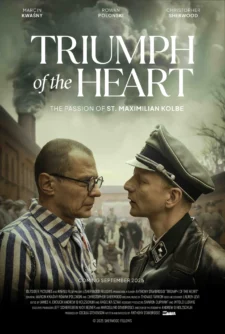
TRIUMPH OF THE HEART
A gut-wrenching, beautiful true story of hope that outlasts a death camp.
Should You Watch It?
Yes — and expect to be moved. This is the true story of St. Maximilian Kolbe, a Polish Catholic priest who took a condemned man's place in an Auschwitz starvation bunker and spent his final days pointing nine other prisoners toward hope in God rather than despair. Movieguide calls it inspiring, gripping, and beautiful, with a lead performance from Marcin Kwaśny that's described as incredible, and a script that gives Kolbe both spiritual depth and genuine humanity rather than a holier-than-thou sheen.
The cost of seeing it: this is Holocaust drama, so the violence is real and sometimes bloody, there are a handful of obscenities, and the film includes content about the Virgin Mary — including an image of Mary crushing a serpent — that many Protestants will read as blurring Christ's unique role as Savior.
For teens and adults able to weigh that theological point for themselves, this is a film worth your evening. For younger children or sensitive viewers, wait — or watch it together and talk it through.
The Story
NO SPOILERS — WE KEEP THE SURPRISESAlbert tells his wife, Margaret, the story that gives the film its shape: his time as a prisoner in Auschwitz. When an inmate escapes, camp commander Karl Fritzsch orders ten men confined to a bunker with no food or water until the fugitive is found. One of the condemned men pleads that he has a family — and Father Maximilian Kolbe steps forward to take his place. What follows, told largely within the walls of that bunker, is a test of what nine desperate strangers can still hold onto when everything else has been taken from them.
Is It Any Good?
Four stars means this one is firing on every cylinder, and the source review backs that up in full: direction, writing, acting, cinematography, and emotional impact are all singled out as excellent. Marcin Kwaśny's performance as Kolbe carries the film — a portrayal that could easily have tipped into sanctimony but instead plays as a man genuinely curious about, and patient with, the strangers suffering beside him.
The structure invites a comparison to 12 Angry Men: most of the drama unfolds in one confined space, with one man working to talk the others back from despair toward hope. The review calls it nearly impossible to watch without crying, because the ache Kolbe answers — the need to be loved, the longing for a better life — is one almost anyone can recognize.
The Worldview
This is, at its core, a deeply Christian film, and it earns that description honestly. Kolbe leads the men in prayer, hears their confessions, forgives a man who wronged him, and asks forgiveness for his own failures. He quotes Christ's cry from the cross — "why have you forsaken me" — to a suffering friend, and under his example, strangers become brothers who lift each other up. The film also carries strong, positive patriotic themes: Polish songs, a folk dance, a man defending his country against an insult — all set against a story that is unambiguously and forcefully opposed to Nazism. Good triumphs over evil here, and the physical struggle in that bunker plays as a visible sign of a spiritual one underneath it.
One element deserves a clear flag for Protestant viewers: Kolbe and another prisoner sing the Salve Regina, a prayer addressed to Mary rather than Christ, and the film includes an image of Mary crushing a serpent — a visual claim on the Genesis 3:15 promise that many Protestants understand as pointing to Christ alone. Viewers should know this before watching, and weigh it according to their own convictions.
What the film gets right, though, is the deepest thing: that hope in God outlasts even a starvation bunker. "We know that suffering produces endurance, and endurance produces character, and character produces hope" (Romans 5:3–4).
The Content Guide
The specifics — spoilers included by nature — so you can judge for your own family.
Dominant Worldview and Other Worldview Content/Elements
Very strong Christian, biblical worldview where hero references God and the importance of maintaining hope in God during suffering, hero quotes Scripture in reference to Christ suffering on the Cross, priest prays during moments of despair and hears other men’s confessions, hero/priest forgives someone who wronged him and asks forgiveness for his own transgressions, hero inspires other men to become friends with him and each other, men encourage and lift each other up, and good triumphs over evil, but some references to the Virgin Mary, including two where Mary seems to replace the role of Jesus Christ, may bother Protestants, plus very strong patriotic themes with several characters singing in Polish, one character stands up for his country of Poland after another character insults it, and there is also a Polish dance, and the movie is strongly opposed to National Socialism
Foul Language
Five obscenities (all “s” words), four light profanities
Violence
Strong and light violence includes bloody scenes of National Socialists shooting people and beating people with clubs, man bashes another man’s face into the ground with some blood shown from his face, two dead men lie on the ground, but no blood, a bloodied hand is shown, two instances of bite marks on men’s stomachs, National Socialists push people with force, prisoners push each other, man gets beaten up, a bloodied forehead and head on pavement, one character coughs blood, man cuts his wrist with stone, and blood pours out, woman punctures her finger, and blood comes out, Jesus sits on a stone bench with the crown of thorns on his head as he sheds blood everywhere including his head, and a father slaps his son on the cheek
Sex
No sexual immorality, but a fully clothed married couple embrace and lean in for a kiss, and it cuts to them lying down and hold a pen in his hand and gently places it on the woman’s neck, wife turns the man on his back and is on top of him, but they just talk, and a National Socialist puts his arm around a woman and walks
Nudity
Very brief scene of partial rear male nudity as man runs to formation with other prisoners, man gazes at a nude painting where the person’s back part is exposed, and several instances of upper male nudity
Alcohol Use
A man drinks alcohol, another man holds two bottles with a clear substance at a party as people clap and dance
Smoking and/or Drug Use and Abuse
Some reference to smoking tobacco, but no drugs
Miscellaneous Immorality
Evil National Socialist actions and other bad behavior, but rebuked, National Socialists force women to carry bags, but rebuked, and one character says God is dead, but this gets rebuked throughout the rest of the movie.
Talk About It
Questions for the drive home, the dinner table, or the youth group.
Kolbe takes a condemned man's place so a father can live for his family. What does this kind of sacrifice teach us about laying down our lives for others?
John 15:13Under terrible suffering, the men in the bunker move from refusing to get along to becoming true friends. What does it take for suffering to draw people together instead of apart?
Romans 5:3–4The film includes prayers to Mary and an image of her crushing a serpent — content many Protestants see as blurring Christ's unique role as Savior. How would you explain to your family why that distinction matters?
1 Timothy 2:5 · Genesis 3:15Kolbe forgives someone who wronged him and also asks forgiveness for his own failures. Why is it often harder to ask for forgiveness than to give it?
Matthew 6:14–15The Final Word
This is a film that earns its tears honestly — a true story of hope refusing to die even in a starvation bunker at Auschwitz, carried by a performance and a script Movieguide calls excellent in every category. It also carries real weight: bloody violence, a few obscenities, and Marian content that Protestant families should know about going in. Our answer stands: worth the trip — teens and adults.