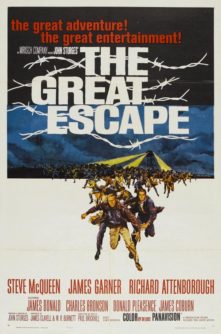
THE GREAT ESCAPE
Classic, suspenseful wartime adventure with a strong moral heart.
Should You Watch It?
Yes. Led by Steve McQueen, Richard Attenborough, and James Garner, this classic adventure offers patriotism, playful comedy, high stakes, and tremendous suspense. Its eerie score fits the danger, its cast is excellent, and its moral center is unusually strong.
The nearly three-hour runtime never feels dull, though some viewers may be uncomfortable with tight underground spaces and one character’s panicked claustrophobia. The film also includes wartime violence, brief foul language, smoking, and drinking.
For older children and adults, this is essential classic viewing. Younger children may need to wait. WORTH THE TRIP — OLDER CHILDREN AND ADULTS is the practical answer.
The Story
NO SPOILERS — WE KEEP THE SURPRISESDuring World War II, Allied prisoners are placed in a new German POW camp designed for inmates who are experts at escape. Led by determined officers and aided by men with specialized skills, the prisoners begin planning a daring escape.
Their plan depends on digging three underground tunnels while German National Socialist soldiers keep them under close watch. Every failed attempt brings new danger, but the POWs continue longing for freedom beyond the camp’s walls.
Is It Any Good?
Four stars means this is classic, masterful entertainment. THE GREAT ESCAPE has a wonderful cast, iconic performances from Steve McQueen and James Garner, and an eerie score that perfectly fits the story’s high stakes and jeopardy.
The film offers beautiful scenery that mirrors the style of its 1963 release, playful comedy, and iconic motorcycle moments for McQueen. Its suspense remains strong throughout its nearly three-hour runtime. This is a carefully made, memorable adventure with tremendous energy and heart.
The Worldview
THE GREAT ESCAPE presents a very strong moral and patriotic worldview. Its Christian, redemptive elements appear through sacrifice, helping others, and characters working for the benefit of the group as a whole. The POWs’ longing for freedom is set against the evil of German National Socialist soldiers, including the SS, and the film clearly presents those officers as villains.
The story exalts courage, comradeship, sacrifice, and loyalty. It also strongly opposes totalitarianism and socialism. At one point, the POWs sing the Christian carol “O Come All Ye Faithful,” giving the film an explicit Christian moment within its wartime story.
The film’s central longing is freedom, but its moral vision shows that freedom is not merely personal escape. It also involves sacrifice and helping others. “Let each of you look not only to his own interests, but also to the interests of others” (Philippians 2:4).
The Content Guide
The specifics — spoilers included by nature — so you can judge for your own family.
Dominant Worldview and Other Worldview Content/Elements
Very strong moral, patriotic worldview set during World War II, with very strong Christian, redemptive elements and very strong anti-totalitarian, anti-socialist themes include characters sing “O Come All Ye Faithful,” characters exhibit comradery and doing things to help benefit a group as a whole and sacrifice for the sake of allowing others to have freedom, and German National Socialist soldiers say, “Heil Hitler” and deliberately murder POWs a few times but they are definitely the evil villains of the piece
Foul Language
Two “d” obscenities, two “h” obscenities, three light profanities (including OMG and “good God”), and one character says, “I hope to God,” plus some British “bloody” epithets, and two lines of “What the Devil?”
Violence
Strong action violence during wartime include German characters shoot guns, officer uses pitchfork to finding hiding inmates, but no one gets hurt, characters get into a tussle, wrestle and slap each other, shoving, character gets shot and dies while trying to climb over a barbed wire fence, motorcycle chase while guns fire, character shoots a villain in his chest, and they both die, but no blood depicted, character kicks a German in the face and drags him out of sight, plane crashes, and fire depicted, character gets shot in the back, blood depicted on character’s face, character skids into barbed wire on motorcycle, and blood shown on his person, characters shoot pedestrians at a restaurant, panicked claustrophobic POW almost smothers while trying to dig a tunnel, several dozen POWs deliberately shot dead by German National Socialists, but the scene isn’t shown, only heard
Sex
No sexual content
Nudity
Upper male nudity when character takes a shower
Alcohol Use
Characters drink alcohol, characters make and give out homemade moonshine to celebrate the 4th of July, character comments to someone to “get stoned” off it, quick mention of brandy, mention of a bar
Smoking and/or Drug Use and Abuse
Smoking but no drug references
Miscellaneous Immorality
Deception, trickery and stealing.
Talk About It
Questions for the drive home, the dinner table, or the youth group.
The prisoners work together and sacrifice so others can have freedom. What does Scripture teach about looking beyond your own interests?
Philippians 2:4 · Galatians 6:2The film presents totalitarian soldiers as evil villains. How should Christians respond when power is used to oppress rather than protect?
Micah 6:8 · Proverbs 31:8–9The POWs continue working toward freedom after repeated failures. Where do you need faithful endurance, and what does it mean to hope in God while waiting?
Romans 5:3–5 · Psalm 27:14The prisoners sing “O Come All Ye Faithful.” How can worship strengthen people facing fear, hardship, or uncertainty?
Acts 16:25–26 · Colossians 3:16The Final Word
THE GREAT ESCAPE is masterful classic entertainment with suspense, patriotism, comedy, and a strong moral vision. Younger children may need to wait because of violence, brief foul language, smoking, drinking, and claustrophobic scenes. For older children and adults, it is WORTH THE TRIP — OLDER CHILDREN AND ADULTS.