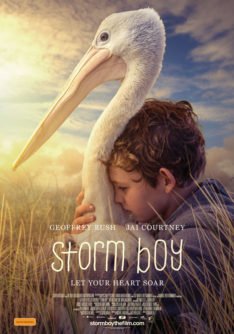
STORM BOY (2019)
A beloved pelican tale buried beneath political advocacy.
Should You Watch It?
The original Storm Boy is a tender story about a lonely boy, his father, and three baby pelicans. This reboot preserves some touching scenes and features good performances, especially from Finn Little and Geoffrey Rush. It also offers a welcome plea for families to value relationships above political disagreements.
But the movie surrounds that heartwarming material with an environmentalist political narrative. The story becomes advocacy about capitalism and the planet, while pagan spirituality is treated positively and lying is presented as a fair way to advance an important cause. The film also adds unrealistic plot elements and moves too slowly.
The result is a disappointing update with serious spiritual and moral concerns. For your family, the practical answer is simple: skip it.
The Story
NO SPOILERS — WE KEEP THE SURPRISESIn 1950s Australia, young Michael Kingley lives in remote Coorong with his antisocial widowed father. After meeting an Aboriginal man named Fingerbone, Michael adopts three baby pelicans whose mother was killed by hunters and raises them as his own.
Years later, an elderly Michael faces a conflict involving his family’s corporation and the pelicans’ nesting grounds. His granddaughter Maddie’s environmental activism has also damaged her relationship with her father.
Is It Any Good?
Two stars means Storm Boy has worthwhile pieces but does not come together as a satisfying film. The performances are universally good, especially those by Finn Little and Geoffrey Rush. The beautiful Coorong, South Australia, provides an enticing backdrop, and the family-reconciliation scenes can be touching.
The direction needs more speed. Scenes of little consequence linger, and the modern environmentalist plot waters down the emotion of the original story. The reboot also makes an already unrealistic moment harder to believe and adds other dubious elements.
The Worldview
Storm Boy transforms a coming-of-age story about childhood and nature into environmentalist political advocacy. Its new narrative presents capitalism as a threat to the future of the planet and portrays businesses as indifferent to that future. A pagan ceremony involving “talking to the land” appears twice in a positive light. Lying is also treated as an acceptable way to promote an important cause.
The film does contain positive elements. Compassion for vulnerable creatures remains central, and Michael gently urges Maddie to put her relationship with her father ahead of political disagreements. The story also includes regret and a plea for peace.
The film’s environmental concerns are connected to real stewardship responsibilities, but its spiritual framework departs from a biblical view by presenting earth-based spirituality positively. Scripture calls people to care for creation under God’s authority, not to treat the land as a spiritual power: “The earth is the LORD’s and the fullness thereof” (Psalm 24:1).
The Content Guide
The specifics — spoilers included by nature — so you can judge for your own family.
Dominant Worldview and Other Worldview Content/Elements
Strong slightly mixed pagan worldview where an environmentalist plot transforms the coming-of-age parts of the original story into political advocacy, mixed with some positive elements of compassion and reconciliation, an aborigine’s pagan custom of “talking to the land” is repeated twice, plus some anti-capitalist elements where businesses are shown as being indifferent to the future of the planet
Foul Language
One “h” word and four profanities take the Lord’s Name in vain
Violence
Hunters are shown killing a pelican, boat capsizes in a storm, a gun is pointed at a child
Sex
No sexual content
Nudity
Brief upper male nudity during an aborigine dance
Alcohol Use
Light use of alcohol by characters, including implied illegal teenage drinking
Smoking and/or Drug Use and Abuse
No smoking or drugs
Miscellaneous Immorality
Children are shown being unforgiving and inappropriately spiteful toward their parents and grandparents, although a character also says he regrets this and urges peace later in the movie, plus lying is depicted as a good way to advance an important cause.
Talk About It
Questions for the drive home, the dinner table, or the youth group.
The film places political disagreements inside a family. What does Scripture teach about pursuing peace when convictions divide people?
Romans 12:18 · Ephesians 4:1–3Caring for animals and the natural world can be good. What does it mean to care for creation as something belonging to God?
Genesis 1:26–28 · Psalm 24:1When might someone be tempted to lie for an important cause? Why does Scripture reject that reasoning?
Proverbs 12:22 · Ephesians 4:25How should compassion and reconciliation shape the way a family handles conflict?
Colossians 3:12–14 · Matthew 5:9The Final Word
Storm Boy has good performances, beautiful scenery, and a gentle call to put family relationships first. But its political advocacy, positive treatment of pagan spirituality, slow pacing, and moral confusion make this reboot a lost opportunity. For your family, our answer is SKIP IT. For better choices, see.