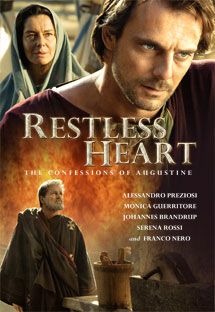
RESTLESS HEART: THE CONFESSIONS OF SAINT AUGUSTINE
A bold, well-acted epic that lets the Gospel speak for itself.
Should You Watch It?
This is a big, ambitious epic in the mold of Jesus of Nazareth, and it earns the comparison more than most religious dramas try to. It tells the story of Augustine — brilliant, ambitious, conscienceless lawyer turned one of Christianity's greatest theologians — with real production value, sharp dialogue, and a Gospel message stated so clearly that "every believing Christian can agree" with it, in the source's own words.
It also handles the moral rot of the late Roman world with real discretion. The debauchery is present but not indulged; the violence is used to make a point, not to entertain. The cost is content older children should be ready for: battle bloodshed, drunkenness, and sexual suggestion (never shown, always implied).
The film's real weakness is pacing, not conviction — a second storyline that runs long and a few characters, like Augustine's son, who simply vanish from the plot. If you can watch this as a family with older kids, or alone as an adult wanting a serious Christian epic, it rewards the time.
The Story
NO SPOILERS — WE KEEP THE SURPRISESAugustine is the best lawyer in the late Roman Empire — brilliant, ambitious, and entirely without conscience, willing to win any case by any means. When his career pulls him into a direct confrontation with Bishop Ambrose of Milan, one of the greatest orators of the age, Augustine expects an easy victory. What he doesn't expect is what watching the cost of that confrontation will do to him.
Is It Any Good?
Three stars means this is a genuinely good production held back from greatness by editing, not vision. The source praises the big-budget scale, the excellent dialogue, and a script that "captures the viewer's attention" even while depicting a decadent society — handled, notably, with discretion rather than spectacle.
Where it stumbles: this began as a two-part TV miniseries, and it shows. The first half — Augustine's road to conversion — is called fascinating and better than most religious epics. The second half, built around debates with the Donatists, runs weaker and less pointed, and loose threads (an entire vanished character) never get tied off. Tighter editing, the source argues, would make this a four-star film outright.
The Worldview
This film sets out to preach, and it does. Its Gospel is stated plainly enough that believers across denominational lines can nod along: Bishop Ambrose tells Augustine that no one finds Truth — Truth, the person of Jesus Christ, finds you. Prayers are answered. Miracles happen. And none of it comes easily. The film also does real work rebutting the false teachings of its era — Manichaeism's denial of personal responsibility, Arianism, Donatism, paganism, emperor worship — arguments that remain useful against similar ideas in our own time.
The film carries a slight Catholic accent worth naming plainly, once: it refers to the Bishop of Rome as "the pope" and uses "catholic" to describe the universal church, language accurate to the era's meaning but likely to catch some Protestant and Orthodox viewers off guard. Neither choice undermines the film's Gospel clarity — both are explainable in historical context — but you should know they're there.
Augustine's own restlessness — a brilliant, hungry man who cannot outrun his own conscience until Christ catches him — is the oldest story Scripture tells about the human heart. "As the deer pants for the water brooks, so my soul pants for you, O God" (Psalm 42:1).
The Content Guide
The specifics — spoilers included by nature — so you can judge for your own family.
Content Summary
Very strong evangelistic Christian worldview with a slight Catholic tint set in the pagan world of the declining Roman Empire, with heretical Arianism and Donatism being rebuked; one obscenity; strong violence includes the start of a Caesarian birth never finished, battle scenes, Roman soldiers attack Christians with blood and death, and discussions of violence, nothing excessive but one man dies with blood coming out of his mouth; suggestions of sexual situations but no visual activity except kissing, girls dancing, Romans lie with women on benches, and protagonist discusses his wanton behavior; upper male nudity and voluptuous women with low-cut tunics and dresses; lots of alcohol use and some drunkenness; no smoking or drugs; and, serious discussions of Manichaeism rebuked, paganism rebuked, lying, cheating, and emperor worship.
Talk About It
Questions for the drive home, the dinner table, or the youth group.
Augustine spent years believing he could win any argument and escape blame for what he did. What finally pricked his conscience, and what does that tell us about how God works even through guilt?
Psalm 51:3 · Romans 2:14–15Bishop Ambrose tells Augustine that no one finds Truth — Truth, the person of Jesus Christ, finds you. How is that different from the way our culture usually talks about "finding yourself"?
John 14:6 · John 15:16Augustine's mother, Monica, prayed for her son for years before she saw an answer. Is there someone you've been praying for without seeing change yet?
1 Timothy 2:1 · 2 Peter 3:9The film shows several false teachings — Manichaeism, Arianism, Donatism — being argued and refuted. Why does it matter to test what we believe against Scripture rather than accept whatever sounds spiritual?
Acts 17:11 · 1 John 4:1The Final Word
This is a serious, well-made attempt at telling one of the great conversion stories in church history, and it largely succeeds — clear on the Gospel, careful with hard material, let down only by an overlong back half. Our answer stands: worth the trip — older children and up. If you're weighing it for younger viewers, our answer is the same one we opened with, and we'd point you instead to our latest family-friendly picks.