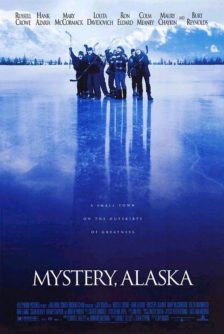
MYSTERY ALASKA
An underdog hockey story buried under adult content.
Should You Watch It?
Mystery Alaska has a good heart. Its underdog hockey team works against impossible odds, while John Biebe stands out as a man of virtue and integrity. The story values courage, loyalty, family, and standing by your spouse. It also builds toward the warm feelings expected from a small-town sports movie.
But the film places that heart inside an R-rated world. The source review counts 74 obscenities and 18 profanities, including a three-year-old whose use of the F-word entertains nearly everyone except his father. It also includes sexual activity, adultery, alcohol use, hockey violence, and other immoral behavior.
The result is a decent sports story compromised by adult content. Watch at home only if you are a discerning adult who wants to weigh those competing elements; do not choose it for children or young teens.
The Story
NO SPOILERS — WE KEEP THE SURPRISESIn Mystery, Alaska, a hockey-loving town of only 633 people, almost everyone learns the game young. John Biebe is the most stable member of the town’s Saturday hockey game, played with four men on each side, no boards, and few rules.
When an expatriate writer arranges a match between the local team and the New York Rangers, the town sees a chance to become famous. John worries that the opportunity could instead expose and embarrass the community he loves.
Is It Any Good?
Three stars means the film has genuine strengths but is seriously compromised. At its center is a familiar underdog sports story: a team works extremely hard against impossible odds, and the community gathers around the chance to reach the big time.
The film’s strongest qualities are its “good heart” and its characters who stand for courage, integrity, and loyalty. John is described as a bright light of virtue, while Judge Walter Burns has the town’s best interests at heart. The film’s weaknesses are also central: it closely resembles The Mighty Ducks, and its attempt at a cutting-edge adult tone relies heavily on foul language, sexual material, and immoral behavior.
The Worldview
The film presents a moral worldview with strong pagan elements. It finds entertainment in characters who use foul language and indulge in foul deeds, yet it also includes moral figures and choices. Judge Walter Burns and the sheriff stand for values. The sheriff’s wife refuses adultery, and the story ends with warm feelings. The review also notes a little Christian content.
The film exalts courage, integrity, loyalty, and commitment within marriage. John objects when his three-year-old son curses, setting him apart from teammates who treat foul language as funny. His wife eventually stands by him rather than leaving with a man who has always had a crush on her.
At the same time, the movie removes much of the decency from its small-town setting. An adulterous mayor’s wife, a sexually exploitative player, foul language, alcohol use, violence, and other immoral elements make the community difficult to embrace. Its moral center is present, but it is surrounded by behavior the review finds deeply troubling.
The film’s respect for marital faithfulness aligns with Scripture’s command: “Let marriage be held in honor among all” (Hebrews 13:4). Its good values are real, but they are not enough to make its adult content suitable for children or young teens.
The Content Guide
The specifics — spoilers included by nature — so you can judge for your own family.
Content Summary
Moral worldview with strong pagan elements & characters who provide much of the movie's alleged entertainment, with moral elements including judge & sheriff stand for values, wife of sheriff refuses adultery & warm fuzzy ending, plus a little bit of Christian content; 74 obscenities, 18 profanities & little three-year-old boy uses F-word several times to everyone's amusement except his father; hockey violence, person hit with shovel, person shot in foot, person punched in nose, & other scuffles; depicted fornication, young girl propositions boyfriend to have sex but he comes prematurely which is supposed to be funny, man tries to get married woman to leave town with him, descriptions of sex with grotesgue sound effects, & fornicator who supposedly can't help himself; alcohol use; and, adultery & other immoral elements.
Talk About It
Questions for the drive home, the dinner table, or the youth group.
John objects when his young son uses foul language, even though others find it funny. How should a family respond when a culture treats harmful speech as entertainment?
Ephesians 4:29 · Colossians 3:8John’s wife ultimately stands by her husband rather than leaving with another man. What does faithfulness require when marriage is tested?
Hebrews 13:4 · Matthew 19:6The town receives a chance to prove itself against a major professional team. When does courage mean accepting a challenge, and when does wisdom mean recognizing the cost?
Proverbs 3:5–6 · James 1:5The movie places good values alongside foul language, sexual behavior, and violence. How can a story contain moral lessons while still being unwise for children to watch?
1 Corinthians 10:23 · Philippians 4:8The Final Word
Mystery Alaska has a sincere moral center and a familiar underdog appeal, but its explicit language, sexual activity, violence, and other immoral elements overwhelm its family value. For discerning adults who still want to consider it, WAIT FOR HOME — ADULTS ONLY. Families seeking a cleaner sports story should choose something else.