LUTHER
A compelling portrait of faith that changed history.
Should You Watch It?
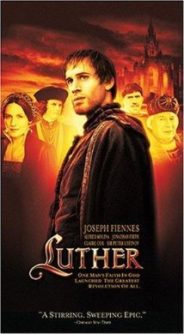
Yes. LUTHER is a wonderful, entertaining historical drama that shows how one man’s faith in God changed the history of the world. Its central concern is the authority of Scripture, and Luther’s refusal to recant unless convicted by Scripture and plain reason gives the film its strongest dramatic force.
The film also presents Luther honestly enough to show his regrets. He recognizes that he may have been too harsh toward some Roman Catholic leaders and painfully regrets that his actions and the zealotry of some supporters contributed to deaths during the peasant revolt.
The movie contains some profanity, religious conflict, and brief, non-graphic images of violence. It also tells the story from a Lutheran, Protestant viewpoint that may offend Roman Catholics. For teenagers and adults, the answer is clear: this is worth seeing.
The Story
NO SPOILERS — WE KEEP THE SURPRISESDuring a violent thunderstorm, Martin Luther cries out to St. Anne and vows to become a monk. At the monastery, guilt and fear leave him feeling unholy before a just God.
His studies eventually lead him deeply into Scripture. As a theology teacher, Luther begins challenging the corruption he sees in the Roman Catholic Church and teaching about God’s mercy and compassion. When church authorities accuse him of heresy, he must decide whether he will renounce his writings.
Is It Any Good?
Four stars means this is one of the strongest films in the source review. LUTHER is engrossing throughout, with powerful drama surrounding Luther’s refusal to recant. The historical portrayal is described as factually reliable, and the movie compellingly captures the settings and atmosphere of 16th-century Germany and Italy.
Eric Till does a marvelous job directing the film. Joseph Fiennes gives an excellent performance as Luther, while Peter Ustinov provides enjoyable support as Prince Frederick the Wise. The second half does not match the power of the first half’s climax, but the result remains an entertaining, powerful portrait.
The Worldview
The film presents a strong Protestant and Lutheran Christian worldview centered on Martin Luther, the Protestant Reformation, God’s mercy, and the authority of the Bible. Luther’s study of Scripture convinces him that the Church has lost sight of central truths of the faith, and his conscience becomes captive to God’s Word.
The movie criticizes the selling of forgiveness and release from Purgatory, while mocking some Roman Catholic leaders who oppose Luther. It presents Pope Leo X as a failed leader in comparison with Luther and suggests that Luther’s influence helped spread religious freedom. The source review notes that this emphasis may be exaggerated, especially because religious wars followed the Reformation for roughly 150 years.
The film also has limitations. It says little about the Protestant teaching that people are justified by God’s grace through faith rather than works. It correctly stresses faith in God through Jesus Christ, but does not fully develop that other foundational belief.
The film’s central longing is for people to recognize God’s mercy and remain faithful to truth. Scripture says, “For we hold that one is justified by faith apart from works of the law” (Romans 3:28).
The Content Guide
The specifics — spoilers included by nature — so you can judge for your own family.
Content Summary
Very strong Protestant Christian and Lutheran Christian worldview extolling Martin Luther, the founder of the Lutheran Church and the Protestant Reformation with some support of and some mocking of other religious figures, especially Roman Catholic priests and cardinals who support the practice of indulgences and who attack Luther and his supporters for heresy, and movie presents Pope Leo X as a failed leader, especially when compared to Luther in one scene, as well as a possibly politically correct emphasis of the Luther’s impact on the concept of religious freedom, which may seem exaggerated at several points toward the end; nine obscenities, one light exclamatory profanity, and several anguished cries to God and Jesus; peasants riot in several scenes and some images of burned bodies and dead people, including one man whose arm was cut off, but nothing gory or excessive; Roman Catholic priests in Rome are seen going into buildings with prostitutes, brief talk about the marriage bed when Martin Luther decides to marry and crisis interrupts amorous married couple lying clothed in bed; pencil drawing mocks Cardinal who has a harp stuck in his rear end; no drinking; no smoking; and, religious zealotry leads to violence among Roman Catholics and nascent Protestants, ecclesiastical corruption in the Roman Catholic church, Roman Catholic leaders sew spiritual fear so they can sell salvation and release from Purgatory to poor peasants, a representative from the Roman Catholic pope tries to bribe a German prince with a relatively cheap golden rose, and friends of Luther kidnap him before Roman Catholic supporters can murder him.
Talk About It
Questions for the drive home, the dinner table, or the youth group.
Luther says he will not recant unless convicted by Scripture and plain reason. What does it mean for your conscience to be captive to God’s Word?
Psalm 119:105 · 2 Timothy 3:16–17The film shows Luther regretting that his actions and his supporters’ zealotry contributed to deaths. How should Christians respond when zeal for truth produces sinful harm?
James 1:19–20 · Romans 12:18The movie emphasizes God’s mercy toward people who feel unholy before Him. How does Scripture describe the relationship between God’s justice and His mercy?
Psalm 103:8–12 · Ephesians 2:4–9The film says little about justification by faith rather than works. What does the Bible teach about how a person is declared righteous before God?
Romans 3:28 · Ephesians 2:8–10The Final Word
LUTHER is an engrossing, historically compelling drama about Scripture, conscience, mercy, and the cost of reform. It has some flaws and presents the conflict from a Protestant viewpoint, but its faith-filled central portrait is powerful and entertaining. For teenagers and adults, this is WORTH THE TRIP.