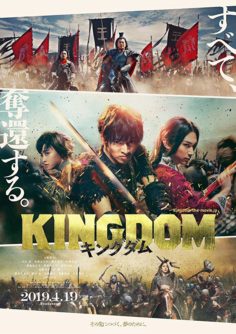
KINGDOM
A spectacular Chinese historical epic for discerning adults.
Should You Watch It?
KINGDOM is a visually impressive, rousing historical epic. Its battles are detailed and energetic, its production design is spectacular, and several twists keep the story moving. The film also offers a friendship between a young soldier and a king as they struggle against a murderous coup.
But this is not suitable family entertainment. Frequent battle scenes include extreme violence, and the film contains 15 obscenities. Its central power struggle remains focused on a secular kingdom and does not question China’s long history of all-powerful military dictatorships.
If you are a discerning adult who can engage those concerns, KINGDOM may be worth your time; for children and young teens, choose something else.
The Story
NO SPOILERS — WE KEEP THE SURPRISESIn Ancient China, Xin, an orphan sold into slavery, dreams of becoming a great military leader. His path changes when he meets Zheng, the young king of the Qin Province, whose half-brother has staged a coup and seized the throne.
To reclaim his kingdom, Zheng needs soldiers. Xin agrees to help him, and the two begin a dangerous journey toward a fortress controlled by the king’s brother. Their campaign may depend on winning the help of a mountain clan.
Is It Any Good?
Three stars means KINGDOM is a good but imperfect film. It holds the viewer’s interest throughout, with spectacular photography and production design. The movie does an amazing job detailing the many battles involved in restoring the king to his throne, and several nice twists propel the plot.
The weaknesses are also clear. Some battle scenes are repetitious or could be shortened. Even so, the film succeeds as a rousing historical epic and an entertaining fictionalized account of the first part of Zheng’s campaign to unite China.
The Worldview
KINGDOM presents a light humanist worldview mixed with light moral and patriotic elements. It portrays the “good” king as a leader who befriends a young soldier and works to defeat his villainous brother. The story values loyalty, courage, friendship, and rising above slavery through military achievement.
The film’s central conflict is a power struggle between two brothers of noble blood who want control of a secular kingdom. It treats the campaign to unite China primarily as an ancient political and military achievement. The filmmakers never question the morality behind China’s long history of all-powerful military dictatorships, represented today by the “socialist market economy” controlled by China’s atheist communist party and its top leaders.
The story is based on real historical figures, but it is designed as entertainment rather than a bona fide history lesson. The film’s longing for order and righteous rule points beyond human rulers to the biblical truth that God alone is the lasting King: “The LORD is king forever and ever” (Psalm 10:16).
The Content Guide
The specifics — spoilers included by nature — so you can judge for your own family.
Dominant Worldview and Other Worldview Content/Elements
Light humanist worldview mixed with some light moral, patriotic elements about how a “good” king running a provincial kingdom in Ancient China befriends a young soldier who helps the king defeat the king’s villainous brother when the brother stages a murderous coup (the story is based on the real provincial king in China and one of his greatest generals who later helped the king become the first emperor of a unified China)
Foul Language
15 obscenities and no profanities
Violence
Some extreme battle violence with blood mixed with lots of strong battle violence as armies and groups of men and soldiers, which includes two women, repeatedly battle one another over control of a provincial kingdom in Ancient China, with lots and lots of sword fighting and use of battle axes (people are stabbed, etc.), along with the use of platoons of archers (many soldiers are pierced by arrows during the battle scenes) (the hero is an expert swordsman who’s often able to perform amazing leaps as he fights), plus the villain’s soldiers are ordered to wipe out a whole village in one scene, but that event is not shown
Sex
No sexual content in the movie (the original Japanese comic book on which the movie is based apparently does contain some romantic subplots)
Nudity
Some upper male nudity
Alcohol Use
No alcohol use
Smoking and/or Drug Use and Abuse
No smoking or drugs;
Miscellaneous Immorality
Brother betrays his half-brother, the king, a character mentions the idea of fate, the plot contains several power struggles (one powerful general, for example, may decide to tip the scales one way or another), two women become soldiers in the struggle between two armies, the hero sometimes relies on memories of his dead friend to give him strength, and two orphaned boys sold into slavery decide the only way to rise above their station in life is to become great military men, especially generals.
Talk About It
Questions for the drive home, the dinner table, or the youth group.
Xin and Piao believe military greatness is the way to rise above slavery. What paths to honor and purpose does Scripture commend instead?
Micah 6:8 · Mark 10:43–45The film centers on a struggle between brothers for a kingdom. What makes a ruler righteous, and why does human power always need accountability?
Deuteronomy 17:18–20 · Psalm 72:1–4KINGDOM portrays loyalty between a king and a young soldier. Who has God placed in your life to encourage faithfulness and courage?
Proverbs 27:17 · Hebrews 10:24–25The story pursues unity through conquest. How is biblical unity different from unity imposed by force?
Ephesians 4:1–6 · Matthew 5:9The Final Word
KINGDOM offers discerning adults spectacular design, stirring battles, and a compelling friendship at the heart of a historical power struggle. Its extreme violence, obscenities, and unexamined humanist politics make it unsuitable for children and young teens. Our answer is WORTH THE TRIP — ADULTS ONLY. For other options, see.