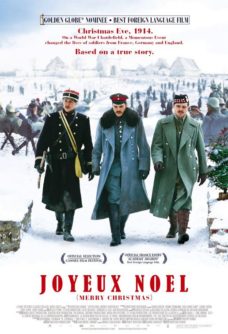
JOYEAUX NOEL (MERRY CHRISTMAS)
A luminous Christmas truce reveals brotherhood amid the horrors of war.
Should You Watch It?
This is a four-star movie for a reason. The Christmas scenes are among the most beautiful and powerful ever put on film, bringing French, Scottish, and German soldiers together in Christian brotherhood during World War I. The singing, the Christmas trees, the shared family pictures and food, and the Catholic mass create moments of sublime joy.
The movie also takes war seriously. Its soldiers have been emotionally scarred, and the conflict eventually intrudes on the truce. Brief foul language, an intimate bedroom scene, and ideas favoring total pacifism or rebellion against authority require discernment. The bishop’s portrayal is especially troubling, though the film rejects his blasphemous teaching.
If you are choosing for teenagers or adults, this is worth seeing for its moving Christian vision and extraordinary Christmas sequences.
The Story
NO SPOILERS — WE KEEP THE SURPRISESDuring World War I in 1914, French, Scottish, and German soldiers face one another across the trenches. Among them are a Scottish priest, a French lieutenant, a German Jewish officer, and two married Dutch opera singers separated when the husband is called to the front.
On Christmas Eve, an unexpected act of music and courage leads soldiers on both sides to lay down their weapons for a celebration of Christ’s birth. But the war has not ended, and its authorities will not easily accept what has happened.
Is It Any Good?
Four stars means this is an exceptional film despite a few shortcomings. Its photography is absolutely beautiful, and the Christmas sequences combine intense drama, sublime joy, and magnificent eloquence. The performances and music make the truce deeply moving.
The film is slow at times because it is shot in a straightforward, sometimes stodgy way. Still, it becomes incredibly compelling as the story unfolds. The tragedies that follow gain greater poignancy because of the brotherhood established during the Christmas celebration.
The Worldview
The movie presents Christmas as the true meaning of the season and treats Christian brotherhood as a force capable of crossing national and military boundaries. Its central Christian vision is strong: soldiers recognize one another’s humanity, worship together, and reject the idea that an enemy is simply evil.
The film also carries pacifist, antinomian, and anti-clerical ideas. An honorable Catholic priest is set against a venal, blasphemous bishop, and the bishop’s misuse of Jesus’ name is clearly rejected. However, the movie’s response can suggest rebellion against authority, total pacifism, or opposition to organized religion more broadly.
The film’s central conviction is that people divided by nation, ethnicity, and military allegiance can still be one in Christ. As the source review puts it, “There is neither Jew nor Greek, slave nor free, male nor female, for you are all one in Christ Jesus” (Galatians 3:28).
The Content Guide
The specifics — spoilers included by nature — so you can judge for your own family.
Content Summary
Very strong Christian worldview with very strong moral elements that focuses on the true meaning of Christmas and that includes Christmas carols about Jesus, a statue of Mary with Jesus as a child, a Catholic mass with references to Jesus and the Crucifixion and the Resurrection, woman sings "Ave Maria," a soldier rejects another soldier's atheist mockery of a Christmas worship service in brief dialogue, but with a few antinomian, Romantic elements suggesting rebellion against authority, pacifism and anti-clerical sentiments where an honorable Catholic priest and his venal, blasphemous bishop have an argument that causes the priest to quit his priestly vocation but not necessarily his Christian calling; 13 light obscenities, three strong profanities and Catholic bishop blasphemes the Gospel by basically telling new military recruits in World War I that they must kill enemy soldiers for Jesus; some light war violence such as soldiers storm trenches, machine-gun mows down soldiers, soldiers shoot at one another, and explosions, but violence is reminiscent of older war pictures during the Golden Age of Hollywood; man and wife depicted in bed together having implied intercourse under covers, with woman's naked shoulders and man's naked back exposed; upper male nudity; alcohol use; smoking; and, light suggestions of total pacifism and rebellion in movie could lead some viewers argue in favor of total rebellion against authority in time of real war, military desertion or protests against any and all use of military force.
Talk About It
Questions for the drive home, the dinner table, or the youth group.
The soldiers discover brotherhood across enemy lines. What does it mean to see people from another nation as made in God’s image?
Galatians 3:28 · James 3:9The film connects Christmas with peace and shared worship. How should Christ’s birth change the way we treat people who oppose us?
Luke 2:14 · Romans 12:18The bishop uses Jesus’ name to justify killing. How can we recognize when someone is misusing Scripture or spiritual authority?
Matthew 7:15–20 · Acts 17:11The priest must decide how to respond when church authority acts wrongly. What is the difference between honoring authority and obeying God?
Acts 5:29 · Hebrews 13:17The Final Word
JOYEAUX NOEL is a beautiful, powerful Christmas film with a strong Christian heart and several moments of extraordinary grace. Its war setting, brief strong language, intimate scene, and troubling ideas call for discernment. For teenagers and adults, our answer is WORTH THE TRIP — TEENAGERS AND ADULTS.