
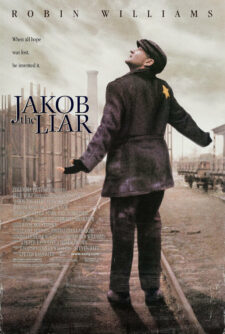
JAKOB THE LIAR
An emotional Holocaust drama best suited to thoughtful home viewing.
Should You Watch It?
Jakob the Liar is highly emotional, poignant, and moral. It follows a Polish Jew who gives hope to fellow Jews trapped in a Nazi ghetto, and it includes affection for a persecuted people, prayers, references to God, and quotations from Scripture.
But the film comes with a difficult moral question: Is lying justified when it gives hope to people facing death? Jakob’s decision is moving, yet the movie does not make the issue simple. It also resembles Life Is Beautiful too closely, has less entertainment value and credibility, and feels somewhat manufactured despite adept production work.
Because of its mature themes and violence, this is best saved for home viewing with older teenagers and adults.
The Story
NO SPOILERS — WE KEEP THE SURPRISESJakob is a Polish Jew trapped in a ghetto during the final years of World War II. After he learns that the Soviet military is approaching, his fellow prisoners assume he has a hidden radio.
Unable to take away their hope, Jakob begins sharing fabricated but hopeful news about the war. Soon, the whole ghetto hangs on his words, while the Nazi authorities try to discover the source of the information.
Is It Any Good?
Three stars means this is a worthwhile but limited film. Robin Williams is tender, kind, powerful, and humorous, and the story contains touching moments, including a subplot involving a small Jewish girl. A scene in which Jakob pretends to be a radio behind her back is particularly poignant.
The production credits are adept and sharp, and the art direction is accurate and drab. Still, the film lacks the credibility and entertainment value of the previous year’s Life Is Beautiful. The setting can feel manufactured, and the movie’s close resemblance to that Italian film makes it less affecting.
The Worldview
The film presents a strong moral worldview centered on a man who tries to impart hope to his doomed Jewish people. It shows affection for a persecuted people and ultimately points toward victory over evil. The movie also includes prayers, references to God, quotations from Scripture, and a quotation from Isaiah.
Its central moral difficulty is the propagation of lies. Jakob tries to come clean at first, but his anxious listeners do not want to believe that he has no radio. Later, he has an opportunity to admit the truth, yet he refuses because he believes preserving hope serves a greater purpose. Christians and Jews may disagree about whether lying was appropriate in this situation. The story leaves viewers with a serious question about whether a good purpose can justify a wrong action.
The film’s worldview is also shaped by its Holocaust setting, where tyranny and threatened death make ordinary moral decisions painfully difficult. Its longing for hope in the face of suffering connects with Scripture’s call to trust God: “Why are you cast down, O my soul, and why are you in turmoil within me? Hope in God” (Psalm 42:5).
The Content Guide
The specifics — spoilers included by nature — so you can judge for your own family.
Content Summary
Strong moral worldview of man who tries to impart hope to his doomed Jewish people that ultimately results in victory over evil, with Old Testament book of Isaiah quoted, prayers & references to God but an immoral plot device where lies are propagated & very brief scene of a seance; 5 mostly mild obscenities; moderate violence including threats of violence, threats of suicide, torture scene including beating & near drowning; no sex but some kissing & implied fornication; no nudity but a woman in very sheer nightgown; alcohol use; smoking; and, lying & tyranny.
Talk About It
Questions for the drive home, the dinner table, or the youth group.
Jakob gives people hope by telling them news that is not true. Can a good purpose make a dishonest act right? What does Scripture say about speaking truthfully?
Exodus 20:16 · Ephesians 4:25The people in the ghetto face fear, tyranny, and the threat of death. Where can people turn when circumstances seem hopeless?
Psalm 46:1–3 · Romans 15:13Jakob’s choices affect an entire community, not just himself. How should we think about the effect our decisions have on others?
Philippians 2:3–4 · Romans 14:13The film includes prayers and references to God amid suffering. What does it mean to hope in God when deliverance is not immediate?
Psalm 42:5 · Isaiah 40:31The Final Word
Jakob the Liar offers tenderness, moral seriousness, and a moving story of hope, but its troubling treatment of lying and its weaker credibility make it better for thoughtful home viewing than a theatrical trip. Choose it for older teenagers and adults prepared to discuss its questions. Our answer is WAIT FOR HOME. For other options, see.