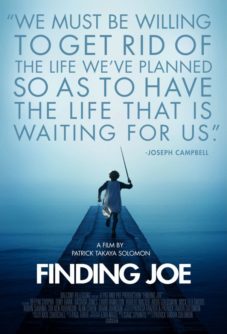
FINDING JOE
An engaging, thoughtful documentary worth the trip for older viewers.
Should You Watch It?
FINDING JOE is a well-made documentary that makes Joseph Campbell’s ideas about storytelling, personal growth, courage, vocation, and self-expression accessible and often inspiring. Its interviews and illustrations can encourage you to examine yourself honestly, face your fears, and recognize the gifts and interests that shape your life.
The cost is its worldview. The film promotes personal expression without God or the Gospel of Jesus Christ. Its “follow your bliss” message offers practical wisdom at points, but it lacks a solid moral and ethical foundation and focuses more on the individual than on serving others or God.
You can appreciate the film’s craft and useful observations while testing its ideas against Scripture. For older children and adults, FINDING JOE is worth the trip with discernment.
The Story
NO SPOILERS — WE KEEP THE SURPRISESFINDING JOE explores the teachings of literary scholar and comparative-religion thinker Joseph Campbell. It explains his three-act “Hero’s Journey”—Separation or Departure, Initiation, and Return—through clips from popular films, skits, and interviews with scholars, artists, athletes, and other successful people.
A recurring skit follows a young boy who leaves home, encounters obstacles and frightening figures, and searches for a “holy grail.”
Is It Any Good?
Four stars means this documentary is engaging, absorbing, and very well structured and directed. It gives viewers a clear, involved summary of Campbell’s inspirational ideas, using film clips, skits, and interviews to make its subject accessible.
The personal stories are particularly striking, including accounts from Akiva Goldsman, Tony Hawk, Laird Hamilton, and Norman Ollestad. The movie can even be truly inspiring at times, though its pop psychology and New Age aphorisms occasionally verge on psychobabble.
The Worldview
FINDING JOE presents Joseph Campbell’s ideas as a guide to personal expression, personal growth, finding a vocation, choosing hobbies, facing fears, and pursuing the things one loves. It encourages viewers not to accept limits imposed by others and not to be too hard on their negative traits. The film also briefly cautions that “follow your bliss” does not mean pursuing hedonism, selfishness, greed, money, power, or constant sexual pleasure.
The documentary’s central weakness is that it promotes a Romantic, humanist way of life without God. It does not meaningfully address God, Jesus Christ, the Bible, Christianity, Judaism, sacrificial love, or the Gospel. It also converts religious stories and mythology, including pagan concepts associated with Hinduism and Buddhism, into material for New Age psychology. The film leaves behind Campbell’s more contentious and bigoted comments against Christianity, Judaism, and the Bible rather than dealing with them.
Biblically, personal gifts and growth belong within loving service to God and other people. Scripture says believers should “present your bodies as a living sacrifice, holy and acceptable to God” (Romans 12:1).
The Content Guide
The specifics — spoilers included by nature — so you can judge for your own family.
Content Summary
Very strong Romantic worldview supporting self-expression without God with some humanist leanings because this is mostly a psychological self-help kind of documentary, plus some strong false (or at least inadequate) New Age pagan concepts and light Hindu pagan and Buddhist pagan references (including one about the Christ and Buddha “principle” but placed in the context of the movie’s basic Romantic, humanist ideals and psychological, self-help worldview), plus a moral comment that rejects immoral hedonism and selfishness but another comment that implies a rejection of morality and ethics, and a couple light but oblique anti-capitalist comments; one “s” word; some light pretend violence with blood in a couple scenes to describe the basic pattern of many religious and cultural myths, legends and folktales using the model of a hero being slain by a monster and slaying a monster, so there are images of a boy being slain by a character wearing a demonic mask, boys fighting people in demon masks playing dragons, man lightly but emotionally describes death of his father and father’s girlfriend, and a scene where a boy sees one of the dragon characters take off a mask and shows another boy inside, which is meant to reflect the idea that in some stories the hero is not just battling monsters or antagonists, he’s also battling himself and needs to face and ultimately transcend his own inner demons or dragons, plus light action scenes from popular movies; no sex scenes but a very light reference against seeking only pure sexual pleasure and man mentions past child abuse but doesn’t go into any details; upper male nudity; no alcohol use; no smoking or drugs; and, some moral relativism and lack of any ethical concerns, plus a narcissistic focus purely on the personal rather than other people, much less God.
Talk About It
Questions for the drive home, the dinner table, or the youth group.
The film encourages people to face their fears and pursue meaningful work. How can courage and wise self-examination serve God rather than only self-expression?
Proverbs 15:32 · 2 Timothy 1:7What is missing when personal gifts and dreams are discussed without sacrificial love or service to others?
1 Corinthians 12:4–7 · 1 Corinthians 13:1–3The documentary asks viewers to examine the stories that shape their lives. How should Christians test ideas that sound inspiring?
1 Thessalonians 5:21 · Romans 12:2What does it mean to become the person God intends you to be, rather than simply following every personal desire?
Ephesians 2:10 · Galatians 2:20The Final Word
FINDING JOE is engaging, well-directed, and sometimes genuinely inspiring. Its practical observations may help older viewers think honestly about fear, vocation, and personal growth. But its Romantic self-expression has no foundation in God, Scripture, or sacrificial love. For older children and adults who can practice discernment, the answer is WORTH THE TRIP — OLDER CHILDREN AND ADULTS.