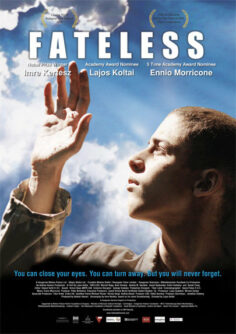
FATELESS
A harrowing Holocaust drama for discerning adults.
Should You Watch It?
FATELESS is a serious, harrowing film about the Holocaust as experienced by a 14-year-old Jewish boy in Budapest. Marcell Nagy gives an extraordinary performance as Gyuri, especially during the scenes of suffering in the labor camps. The film also recognizes the moral importance of helping people in need during persecution.
But the movie keeps you at a distance. Gyuri’s coldly philosophical response to his suffering may perplex or disturb viewers, including Holocaust survivors. The film’s violence is sudden and brutal, though not extremely bloody, graphic, or excessive. Strong language and images of nude male corpses add to the burden.
If you are an adult seeking a difficult, artistically serious Holocaust drama, FATELESS may be worth your time; families with children or young teens should choose something else.
The Story
NO SPOILERS — WE KEEP THE SURPRISESIn Budapest near the end of World War II, 14-year-old Gyuri’s father is sent to a labor camp by Adolf Hitler’s National Socialists. Gyuri initially seems strangely unaffected by his father’s departure and by the persecution surrounding him.
That changes when Hungarian officials pick him up and the Germans send him toward the labor camps. The film follows a teenager forced to confront persecution, survival, and the shattering of his ordinary life.
Is It Any Good?
Three stars means FATELESS is a strong, memorable film with real artistic accomplishment, though its emotional distance keeps it from being fully accessible.
Marcell Nagy is absolutely brilliant as Gyuri, giving what the source calls one of the greatest performances ever given by an adolescent. The filmmaking focuses intensely on Gyuri’s face and the faces of fellow sufferers, creating the feeling of a Jewish passion play. The film’s suffering is intense, but its violence is not extremely bloody, very graphic, or excessive.
The Worldview
FATELESS presents a light humanist, existential view of the Holocaust. It contains strong moral elements about helping others in need during intense persecution, along with references to Jewish ethical monotheism, including a Hebrew prayer and a small synagogue service in a concentration camp.
The film’s central concern is whether people are trapped by what happens to them or can still shape their lives afterward. Its title suggests that Jews should not remain eternal victims of persecution, but become creators of their own lives. Yet Gyuri does not truly understand or connect with what it means to be Jewish, including the religious dimensions of that identity. His response to the Holocaust is also notably cold and philosophical, which may distance viewers.
The film includes an apparent revisionist historical element when Gyuri says he never saw mass executions in gas chambers and therefore cannot comment on them. It also rebukes anti-Semitism and fascist totalitarianism, though perhaps not as forcefully as other Holocaust films.
The story’s moral concern with suffering and helping others aligns with Scripture’s call to bear one another’s burdens: “Bear one another’s burdens, and so fulfill the law of Christ” (Galatians 6:2).
The Content Guide
The specifics — spoilers included by nature — so you can judge for your own family.
Content Summary
Light humanist, existential worldview of the Holocaust, with strong moral elements about helping others in need during intense persecution and a few references to Jewish ethical monotheism, including a Hebrew prayer and a small synagogue service in a concentration camp, but teenage Jewish protagonist doesn't really understand or connect what that culture is all about and he refuses to accept the persecution which that culture historically has suffered or tie his personal fate into it, plus some apparent revisionist history when boy tells people he never really saw mass executions in gas chambers during Holocaust in World War II, so he can't comment on it; about 11 or 12 obscenities (including three "f" words) and brief vomiting; strong violence includes images of nude male corpses during Holocaust scenes, guards slap prisoners a few times causing some blood, boy falls on railroad track and badly hurts his knee, infected and swollen knee shown, guard roughly places heavy sacks on teenage boy terribly weakened by starvation diet and hard labor, people faint from long exposure to the elements, and fascist guards herd people like cattle; no sex, but one kiss between teenagers and prisoner makes a derogatory comment about one guard's apparent or alleged homosexuality; no sexual nudity but upper male nudity and scenes of full male nudity where dead and near-dead Holocaust victims are shown; no alcohol; smoking; and, anti-Semitism rebuked, but perhaps not as forcefully as other Holocaust movies do, stealing food, forced labor, a couple references to exterminations of Jews, and fascist totalitarianism rebuked.
Talk About It
Questions for the drive home, the dinner table, or the youth group.
Gyuri seems emotionally distant from the persecution around him. Why might suffering make a person withdraw, and how can we respond with compassion?
Psalm 34:18 · Romans 12:15The film shows people trying to survive while enduring persecution. What does it look like to help someone in need when circumstances are frightening?
Galatians 6:2 · Hebrews 13:3Gyuri wants to think about his future after the camps. How can hope help a person move forward without pretending the past did not happen?
Romans 5:3–5 · Philippians 3:13–14The film raises questions about Jewish identity and religious understanding. Why should Christians listen carefully to the history and suffering of the Jewish people?
Romans 11:28 · Zechariah 8:23The Final Word
FATELESS is difficult, serious, and at times remarkably powerful, especially because of Marcell Nagy’s performance. Its intense suffering, strong language, nude male corpses, and emotionally distant worldview make it unsuitable for children and young teens. For discerning adults, it is WORTH THE TRIP — ADULTS ONLY. For a gentler family choice, see.