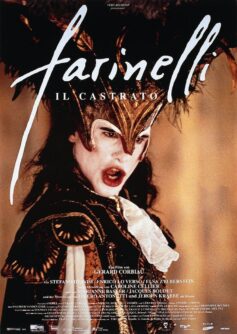
FARINELLI
Sumptuous opera, deeply corrupted lives, and no good reason to attend.
Should You Watch It?
FARINELLI has real artistic strengths. Its sets are astonishing, its costumes gorgeous, and its musical soundtrack is sublime. The story also raises serious questions about talent, excellence, and the meaning of art.
But those strengths are overwhelmed by the film’s moral corruption. The story depicts nearly every sort of vice, and its quality lurches from the sublime to the depraved. The convoluted structure, Italian and French dialogue, and scanty subtitles also make this historical drama difficult to follow.
The answer is clear: skip FARINELLI and choose a film whose beauty does not come wrapped in such pervasive depravity.
The Story
NO SPOILERS — WE KEEP THE SURPRISESBased on a true story, FARINELLI follows two Italian brothers with a tortured relationship. Riccardo is a second-rate composer, while his younger brother Carlo becomes Farinelli, the most famous castrato singer of the 18th century.
Through flashbacks, the film traces incidents in Farinelli’s extraordinary life, including his rise to opera fame and his complicated musical partnership with Riccardo. Their pursuit of excellence eventually brings them into conflict with the composer Handel.
Is It Any Good?
Two stars means FARINELLI has striking craft but fails as a satisfying whole. The film offers astonishing sets, gorgeous costuming, and a sublime musical soundtrack. Its “morphed” singing voice, created by combining the voices of a countertenor and a soprano, is especially notable.
The film is also complex and occasionally incoherent. Its convoluted flashback structure, Italian and French dialogue, and scanty subtitles make it hard to follow. The result is sumptuous historical drama that repeatedly lurches from the sublime to the depraved.
The Worldview
FARINELLI treats talent and the meaning of art as central concerns. It presents Farinelli’s extraordinary voice and musical excellence as powerful forces, while also showing the tortured relationship between the singer and his composer brother.
Yet the film places these artistic questions inside a world marked by corruption. The pursuit of excellence does not cleanse the lives surrounding it. Instead, beauty and musical achievement exist alongside pervasive vice, leaving the film’s moral vision deeply distorted.
The film can remind viewers that artistic gifts are powerful but not self-justifying. Scripture calls people to direct every gift toward God’s glory: “So, whether you eat or drink, or whatever you do, do all to the glory of God” (1 Corinthians 10:31).
The Content Guide
The specifics — spoilers included by nature — so you can judge for your own family.
Content Summary
Romantic worldview featuring revisionist history, homosexuality & rampant sexual immorality; several profanities in French & Italian; suicide, attempted suicide & castration; graphic adultery & fornication with multiple partners; frontal female nudity & partial male nudity; alcohol use; opium use; and, gambling, theft & blackmail.
Talk About It
Questions for the drive home, the dinner table, or the youth group.
The film places artistic talent alongside serious moral corruption. Can beauty or excellence make sinful choices acceptable?
1 Corinthians 10:31 · Philippians 4:8What responsibilities come with a gift or talent, and how can a person use that gift for others rather than personal glory?
1 Peter 4:10–11 · Matthew 25:14–30Why is it important to judge entertainment by more than its music, acting, costumes, or visual beauty?
1 Thessalonians 5:21–22 · Romans 12:2How should Christians respond when a work contains genuine artistic skill but also celebrates or depicts grave immorality?
1 Corinthians 6:12 · Philippians 4:8The Final Word
FARINELLI offers beautiful music, lavish production, and serious questions about art. But its confusing structure and pervasive corruption make the decision plain: SKIP IT. Choose something more excellent and morally sound instead.