
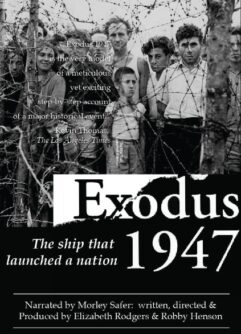
EXODUS 1947
A convincing documentary about Israel’s founding and obedience.
Should You Watch It?
EXODUS 1947 makes a strong case for the Jewish underground group Haganah’s effort to bring Holocaust survivors to Palestine. Its script is powerful and well written, while Morley Safer’s subtle, professional narration gives the documentary authority. Understated home-movie footage and fuzzy black-and-white stills add authenticity.
The film also raises a serious question for Christian viewers. It presents illegal immigration as a force that helped break British control of Palestine, but the source review warns that Scripture teaches obedience to ruling authorities unless they violate God’s Law. The documentary is convincing, yet its moral conclusion deserves discernment.
Adults who can engage that question thoughtfully should watch it. For a younger family audience, choose something else.
The Story
NO SPOILERS — WE KEEP THE SURPRISESIn 1947, Haganah buys the 330-foot President Warfield and converts it into a ship for 4,554 Jewish World War II Holocaust survivors seeking passage to Palestine.
The documentary follows this massive illegal immigration effort, the British authorities who oppose it, and the movement’s connection to the founding of modern Israel. At its center is a question of justice, authority, and the right way to help a persecuted people return to their promised land.
Is It Any Good?
Three stars means this is a good, persuasive documentary with notable strengths. Its script is powerful and well written. Morley Safer’s narration is subtle, professional, and convincing, and the understated home-movie footage and fuzzy black-and-white still shots add authenticity.
The film’s case is argued very convincingly. Its limitation is not a lack of craft, but the need to assess its conclusions carefully, especially its treatment of civil disobedience and government authority.
The Worldview
The documentary presents a romantic view of individual people opposing civilization and government. It treats the Haganah’s illegal immigration effort as a compelling answer to the plight of Holocaust survivors and connects Jewish immigrants’ return to Palestine with biblical ideals concerning the Promised Land.
The source review finds the filmmakers’ case very convincing, but questions whether civil disobedience was the best way to help the Jews obtain their own land. The film’s worldview also includes a mock blessing of a crowd as if by Jesus Christ, along with a doctrine of unrestricted immigration. These ideas require discernment rather than automatic acceptance.
Christian viewers should weigh the film’s sympathy for oppressed people alongside Scripture’s teaching about authority and obedience. Jesus said, “Render unto Caesar the things which are Caesar’s, and to God the things which are God’s” (Mark 12:17).
The Content Guide
The specifics — spoilers included by nature — so you can judge for your own family.
Content Summary
Romantic worldview of the goodness of individual man & the evil of civilization & government with a mock blessing of a crowd as if by Jesus Christ; 2 obscenities & 2 profanities; brief still shots of Holocaust skeleton in oven & men fight aboard ship; naturalistic nudity; and, politically correct doctrine of unrestricted immigration, biblical ideals of Jewish immigrants coming back to their Promised Land and Anti-biblical elements of civil disobedience
Talk About It
Questions for the drive home, the dinner table, or the youth group.
When should a Christian obey governing authorities, and when might obedience to God require refusing an order?
Mark 12:17 · Acts 5:29How should we respond when people who have suffered great injustice seek safety and a homeland?
Leviticus 19:33–34 · Hebrews 13:2What is the difference between a persuasive historical argument and a biblical conclusion?
1 Thessalonians 5:21 · Acts 17:11How can Christians show compassion for refugees while still thinking carefully about laws and authority?
Matthew 25:35 · Romans 13:1–7The Final Word
EXODUS 1947 is a powerful, authentic documentary with convincing narration and a serious moral question at its center. Adults interested in Israel’s founding should consider it, while weighing its treatment of civil disobedience and immigration. For other family viewing, begin with. WORTH THE TRIP — ADULTS ONLY.