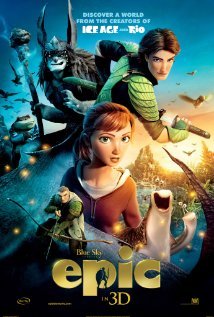
EPIC
Tiny Epic — a fast, funny adventure with light worldview concerns.
Should You Watch It?
EPIC delivers what its title promises in spirit: a big, colorful adventure set in a tiny world. It moves quickly and balances plenty of laughs and tears with characters who display loyalty, honor, self-sacrifice, and forgiveness. Those redemptive qualities give the story a strong moral center.
The concern is the film’s worldview. Its setting openly promotes Mother Nature and the “balance of nature,” though the pagan elements remain light. The action can also be scary for young children, and the parallel plotlines may be confusing.
Older children and adults can enjoy EPIC, especially if parents explain the film’s view of nature beforehand. For younger children, choose something less intense and simpler to follow.
The Story
NO SPOILERS — WE KEEP THE SURPRISESMK, short for Mary Katherine, returns to the father she has never known. Her father is obsessed with finding a hidden, tiny world in another dimension.
MK discovers that world and is drawn into a conflict between the Leaf people and the Rot people. With two Leaf warriors, she must help protect the future of the natural world while her father searches frantically for her.
Is It Any Good?
Four stars means this is highly entertaining filmmaking with substantial strengths. EPIC is fast-paced, with plenty of laughs and tears. Its animated action-adventure setting gives the story energy, while the Leaf people’s loyalty, honor, self-sacrifice, and forgiveness provide emotional and moral weight.
The film is not quite as good as the previous ICE AGE movies by Blue Sky. Its two parallel plotlines are slightly confusing, especially for younger viewers. Still, the combination of humor, emotion, action, and morally uplifting qualities makes EPIC a strong family entertainment choice for older children and adults.
The Worldview
EPIC presents a conflict between the Leaf people and the Rot people, but its spiritual framework is overtly monistic and centered on Mother Nature. It extols the “balance of nature” and presents nature as an interconnected whole. The film’s moral qualities—loyalty, honor, self-sacrifice, forgiveness, and the struggle between good and evil—suggest a Christian story, but the setting promotes a different understanding of reality.
The film also includes an overt faith element suggesting that only someone special would die for those in another world. Its environmentalist viewpoint is kept light, so families may enjoy the movie if parents explain the truth before watching with older children.
The film gets real moral truths right, especially the value of sacrifice and forgiveness. But nature is not divine, and creation is not God. Scripture says, “The earth is the LORD’s and the fullness thereof, the world and those who dwell therein” (Psalm 24:1).
The Content Guide
The specifics — spoilers included by nature — so you can judge for your own family.
Content Summary
Conflicting monistic, polytheistic, Gaia, environmentalist worldview with redemptive, moral, sacrificial, good versus evil plotline, with overt faith instance that says only someone special would die for those in another world, and lots of references to we are all one, the leaves are many but there’s only one tree, which doesn’t make sense; no foul language; lots of animated action violence as the Leaf people fight against the Rot people, people falling on spears, people get beaten, tortured or killed, people grabbed by birds or attacked by mice; no sex, but the love interests kiss one another; no nudity; no alcohol; no smoking or drugs; and, father too preoccupied to pay attention to his daughter and a boy runs away from his responsibility, but both issues are resolved at the end.
Talk About It
Questions for the drive home, the dinner table, or the youth group.
The Leaf people show loyalty, honor, self-sacrifice, and forgiveness. Which of these qualities is hardest to practice, and why?
Philippians 2:3–4 · Colossians 3:12–13The film presents nature as one connected whole. How can we care for creation without treating creation as God?
Genesis 1:27–28 · Psalm 24:1MK’s father is too preoccupied to pay attention to his daughter. What does faithful attention look like in a family?
Deuteronomy 6:6–7 · Ephesians 6:4The story includes characters who must face responsibility. What helps a person move from avoiding responsibility to accepting it?
Luke 9:23 · Galatians 6:5The Final Word
EPIC is fast, funny, and morally uplifting, with light worldview concerns and some scary action for young children. With a little guidance, it is WORTH THE TRIP for older children and adults.