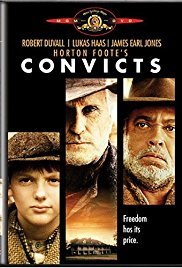
CONVICTS
An austere Ecclesiastes drama best reserved for discerning adults.
Should You Watch It?
CONVICTS has a serious idea at its center: earthly riches and toil cannot finally save anyone from death. Its story illustrates the lament of Ecclesiastes, and Robert Duvall gives an excruciatingly accurate performance as a demented alcoholic. James Earl Jones and the other cast members also offer credible work.
But the film struggles to turn that idea into compelling drama. The plot is nearly absent, and the result produces more boredom than insight. Its heavy profanity further weighs down a movie already built around despair and futility.
Because the film has some meaningful themes but is weak overall and unsuitable for younger viewers, adults should wait to watch it at home, if they choose to watch it at all.
The Story
NO SPOILERS — WE KEEP THE SURPRISESOn Christmas Eve in 1902, Soll Gautier, a crazed alcoholic who owns a sugar cane plantation, wanders around with a shotgun. Ben Johnson, a sensible Black sharecropper, manages the plantation, while 13-year-old Horace Robedaux tends Soll’s store and waits for his unpaid wages. A gang of Black convicts works the cane fields as cheap, volatile labor. As Soll’s paranoia worsens, the household moves toward a reckoning.
Is It Any Good?
Two stars means CONVICTS has worthwhile elements but falls short as a satisfying film. Robert Duvall’s portrayal of a demented alcoholic is remarkably accurate, and the performances from the cast are credible. The cinematography is moody and supports the film’s somber atmosphere.
Unfortunately, the movie has a virtual absence of plot and storyline. That lack of narrative momentum turns its meditation on earthly futility into an experience that is more boring than insightful. The performances and central idea cannot overcome the thin dramatic structure.
The Worldview
CONVICTS presents the dark side of Ecclesiastes: earthly pursuits are vanity, whether one is a king of Israel or a plantation owner. Wealth, ambition, labor, and earthly accomplishment all end in death. The film’s funeral reflection emphasizes that everyone ultimately ends up in the ground.
That message aligns with Ecclesiastes’ warning that worldly achievement cannot provide lasting meaning. At the same time, the film is described as presenting the bad news of Ecclesiastes, without offering a fuller hope beyond earthly futility. Its worldview is therefore serious and biblically connected, but notably bleak.
Scripture says, “Vanity of vanities, says the Preacher, vanity of vanities! All is vanity” (Ecclesiastes 1:2). The film’s central warning is that earthly toil cannot bear the weight of ultimate hope.
The Content Guide
The specifics — spoilers included by nature — so you can judge for your own family.
Content Summary
An attempted dramatization of Ecclesiastes weighted down by 10 obscenities & 45 profanities. Also, a man is shot to death and alcoholism & intoxication.
Talk About It
Questions for the drive home, the dinner table, or the youth group.
The film presents earthly work and ambition as ultimately unable to defeat death. What good purposes can work serve, and why can’t work become our ultimate hope?
Ecclesiastes 2:10–11 · Matthew 6:19–21How should a person respond when wealth, achievement, or status fails to provide lasting meaning?
Ecclesiastes 12:13–14 · Mark 8:36Alcoholism and intoxication affect the film’s central character. What does Scripture teach about sobriety and self-control?
Ephesians 5:18 · 1 Peter 5:8The story’s reflection on death can feel bleak. Where does the Christian hope of resurrection change the way we face the grave?
John 11:25–26 · 1 Corinthians 15:20–22The Final Word
CONVICTS has credible performances, moody cinematography, and a serious Ecclesiastes theme. But its lack of plot and heavy profanity make it a poor family choice. For discerning adults who remain interested, WAIT FOR HOME — ADULTS ONLY. For other options, see.