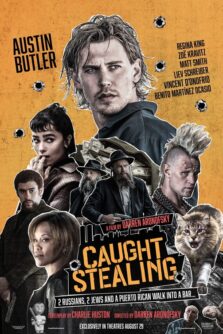
CAUGHT STEALING
A well-made thriller drowned in blood and profanity.
Should You Watch It?
Here's the honest decision. Darren Aronofsky has made a raucous, often funny, well-crafted thriller — the action sequences land, the pacing knows when to breathe, and there's a real attempt underneath it all to say something about trauma, ego and redemption. Somewhere in this movie is a story about taking responsibility for your actions and realizing what matters.
But it's buried. Buried under more than 150 "f" words, under graphic and bloody violence, under heavy drinking and drug use and a backstory that never feels well explained. The characters are hard to like — including Hank himself — and by the end it's difficult to say the film offers anything of real value.
The moral turn arrives too late to redeem the noise around it. So even for the mature adults it's aimed at, our answer is to skip it — the cost far outweighs what little the movie manages to say.
The Story
NO SPOILERS — WE KEEP THE SURPRISESHank was a high school baseball phenom, once bound for the first round of the MLB draft. Now he's a New York bartender nursing an obsession with the San Francisco Giants, an alcohol problem, and a loyal but flawed girlfriend he hides from his mother.
Then his mohawked British neighbor, Russ, asks him to cat-sit while he races back to London. It turns out Russ is a drug dealer who owes dangerous people a great deal of money — the Russian mob, a wannabe thug named Colorado, and two murderous Hasidic Jews. They come looking for the cash. What they find is a clueless Hank who has no idea where it is.
Is It Any Good?
Three stars, and they're earned in the craft. This is a high-stakes, comic thriller with genuine energy — good humor, well-built action sequences, and a story that careens through its plot like a ballplayer rounding the bases. Aronofsky slows the pacing just enough to let you breathe, so you never quite feel like your head's been spun around on a bat.
The trouble is that it's a lot to take in, and the messy, poorly explained backstory makes it hard to enjoy any of the characters — Hank included. The attempt at meaning is real, but it's shrouded by the violence and drinking, and the emotional change comes too late to fully land. It's a decent movie for the audience it wants. It's also one the noise nearly buries.
The Worldview
This is a film that worships things. Baseball and alcohol both function as objects of devotion, and around them the movie builds its major themes: egotism, selfishness, and a man pining after a failed future he can't let go of. For most of its runtime nothing shifts — Hank is more grieved by his ruined leg and lost career than by the friend who died in the crash that ended both. Only near the end does he move toward responsibility and toward seeing what actually matters.
There are light redemptive elements, then, but they arrive faintly and late. There's also a Romantic streak — a relationship that hinges on sexual passion and rejects proper authority — running underneath.
The film's treatment of its Hasidic Jewish mobsters deserves a word: they're shown viewing violence as somehow aligned with their faith, saying "God willing" over the hoped-for outcome of a violent act even while strictly keeping the Sabbath. It's a muddled, unflattering picture of religion, and worth naming as false theology rather than fact.
Underneath Hank's story is a longing every viewer knows — to be more than our worst decisions, to have the wreckage behind us made right. The gospel answers what this movie can only gesture toward: "If we confess our sins, he is faithful and just to forgive us our sins" (1 John 1:9).
The Content Guide
The specifics — spoilers included by nature — so you can judge for your own family.
Dominant Worldview and Other Worldview Content/Elements
Very strong, slightly mixed pagan worldview including the indirect worshipping of various things like baseball and alcohol, alongside major themes of egotism and selfishness, though there are some light redemptive elements, plus some light Romantic elements, including a relationship hinging on sexual passion and the rejecting of proper authority, and some light false theology as the Jewish mobsters appear to view killing and other violence as somewhat aligned with their religious viewpoints, including saying “God willing” when discussing the hopeful “positive” outcome of a violent act, but they are strict upholders to their practice of the Sabbath
Foul Language
More than 150 “f” words, 22 “s” words (including one written), at least six other obscenities, one GD profanity, an obscene gesture, there’s a clogged toilet that heavily overflows, a litter box is filled with fake feces , a character vomits all over a window (later seen dried), there is a joke about periods, a female product gets stuck up a character’s nose to stop bleeding, and superglue is used to seal up a wound
Violence
Very strong and strong violence includes multiple instances of gun violence including killings and maiming, knife wielding, hitting people and objects with a bat as well as stabbing someone with a shard of one, a character gets beat up, two big car accidents that kill people, lots of depictions of blood including head, neck, chest and leg wounds, taking stitches out with pliers as a form of torture, dead bodies with blood visible, people are killed or tortured as a form of proving a point, and the threat of using grenades
Sex
Implied fornication with some passionate kissing, grinding against one another and making out, and scantily-clad women dance in a club
Nudity
Upper female nudity during implied fornication and kissing, make-out scene, woman flashes a man where you can see through her bra, a male character is shirtless and sometimes pants-less for much of the movie, man and woman undress to their underwear, a naked male appears for a few seconds but nothing’s visible, and one scene show scantily clad female dancers
Alcohol Use
Heavy drinking throughout including multiple bar scenes, intoxication and drinking while driving, alcoholism is both encouraged and discouraged, relapse occurs, with apparent redemption in the end
Smoking and/or Drug Use and Abuse
Several instances of smoking, drugs are discussed, and cocaine is snorted
Miscellaneous Immorality
Very strong miscellaneous immorality is prominent throughout, including revenge, greed, deceit, stealing, blackmail, questionable or downright heinous morals, and the issues of using violence and threats as solutions to problems are a major theme.
Talk About It
Questions for the drive home, the dinner table, or the youth group.
Hank spends the film grieving his lost career more than the friend who died — the wrong loss. When have you found yourself mourning the wrong thing, and what does true repentance look like instead?
2 Corinthians 7:10 · Psalm 51:17The movie shows people who worship things — baseball, alcohol, their own image. What do we make into idols without noticing, and what does Scripture say competes for that place in our hearts?
Exodus 20:3 · Colossians 3:5Nearly every character reaches for violence and threats as the answer to their problems. How does that compare to the way Jesus tells us to respond to those who wrong us?
Matthew 5:38–44 · Romans 12:19The film gestures at redemption but arrives there too late for it to mean much. What does Scripture say makes real change possible — and why is it never too late for the God who offers it?
1 John 1:9 · Ezekiel 36:26The Final Word
There's a decent thriller in here — funny, well-shot, reaching for something about trauma and second chances. But it's smothered by relentless profanity, brutal violence, and a wreck of a moral center that only sobers up at the last minute. For every audience, the cost is simply too high. Our answer is to skip it. Looking for something worth your evening instead? Try our latest family-friendly picks.