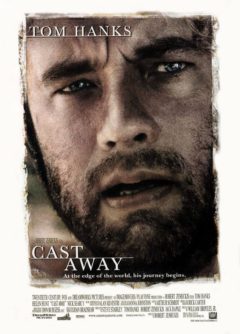
CAST AWAY
A beautiful, flawed island drama better watched at home.
Should You Watch It?
You may want to like Cast Away. Tom Hanks gives a superb performance, the cinematography is beautiful, and the special effects are superb. The film also has a good heart and wants to make moral points, especially about the limits of a life ruled by work.
But the movie is easy to criticize. The plot does not run smoothly, some minor characters are stilted, and much of the story seems like an advertisement for Federal Express. Its slight Christian hints never become a substantial Christian vision, while the ending leans toward existential fatalism.
The content is serious enough for family discernment, especially because of violence, nudity, profanity, and worldview concerns. Watch it at home if you choose it, where you can discuss what it gets right and where it falls short.
The Story
NO SPOILERS — WE KEEP THE SURPRISESChuck Noland is an international troubleshooter for Federal Express who believes time is everything. When his plane crashes over the Pacific Ocean, he becomes the only survivor and reaches a deserted island.
There, Chuck must survive against the elements and improvise tools from the FedEx packages that wash ashore. A Wilson basketball becomes a totemistic friend as Chuck faces hunger, isolation, and the question of whether he can ever leave.
Is It Any Good?
Three stars means Cast Away is entertaining and worthwhile in places, but noticeably uneven. Tom Hanks gives a tour de force in a demanding solo performance. The cinematography is beautiful, and the special effects are superb.
The weaknesses are significant. Some minor characters are slightly stilted, and the plot does not run smoothly. Several problems are solved by deus ex machina, including a whale that revives Chuck in critical moments and the Wilson totem that seems to help him create fire. The Federal Express focus can also feel like a long commercial.
The Worldview
Cast Away presents a vaguely moral worldview with very slight Christian content. Chuck often makes the right decision, including rejecting adultery, although his heart is not always in it. The film’s central lesson is that there is more to life than work, but it also recognizes that there is more to life than having no work on a deserted island.
The Christian hints are slight: recurring angel wings and what could be construed as a cross that Chuck plants on the highest point of the island. Alongside those images are totemism, humanism, and existential fatalism. The ending’s phrase, “what the tide can bring,” summarizes its uncertainty about meaning and destiny.
The film’s central longing is for a life larger than schedules, productivity, and survival. Scripture likewise says, “He has put eternity into man’s heart” (Ecclesiastes 3:11).
The Content Guide
The specifics — spoilers included by nature — so you can judge for your own family.
Content Summary
Vaguely moral worldview with very slight Christian content, as well as some totemism, humanism & existential fatalism; 5 lightweight exclamatory profanities, such as “my God,” & 4 obscenities; action violence including frightening storm, flight attendant gets hit on head producing copious amounts of blood, plane sinks into ocean, man rides out storm, man gets cut & bruised, man gashes leg on coral, & man knocks out his own impacted tooth with a rock & an ice skate; no sex, but kissing; upper male nudity & man in underwear; drinking, smoking; and, man takes pride that he stole or borrowed a little child's bike to complete his Federal Express delivery, man lies about his wife & man talks to totem that he creates.
Talk About It
Questions for the drive home, the dinner table, or the youth group.
Chuck is ruled by the clock before the crash. What does your schedule reveal about what you value, and how might you make room for what matters most?
Matthew 6:19–21 · Ecclesiastes 3:1The film suggests there is more to life than work. How can work be a good gift without becoming your master?
Colossians 3:23–24 · Matthew 6:24Chuck makes some right decisions even when his heart is not in them. Why does God care about both our actions and our hearts?
1 Samuel 16:7 · Matthew 5:8The story includes a cross-like image but also totemism and fatalism. How does biblical trust differ from leaving life to chance or “what the tide can bring”?
Proverbs 3:5–6 · James 4:13–15The Final Word
Tom Hanks and the film’s beautiful craft make Cast Away worth considering, but its uneven plot, content concerns, and fatalistic worldview make it better experienced with conversation at home. For your family, our answer is WAIT FOR HOME. Looking for a clearer choice? Try.