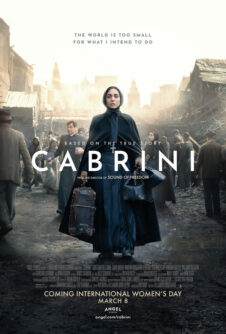
CABRINI
One nun, an ocean of need, and a faith that won't take no for an answer.
Should You See It?
Here is the decision. CABRINI tells the true story of Mother Cabrini, the Italian immigrant who came to America in 1889 to serve orphans and the poor, and who would become the first U.S. citizen canonized a saint. It is a powerful, beautifully made film with a strong Christian, moral worldview in a Roman Catholic context — faith over fear, love stronger than violence, prayer and Scripture woven throughout.
It also earns its PG-13. This is a story set in the slums and sewers of Five Points, and the hard realities show: children in danger, a girl forced into prostitution and beaten, a fatal stabbing, a factory disaster, parents dying of illness. The violence is intense but not gory, and it feels true to the times — but it may be too much for younger children.
So: if you're an adult or you're choosing for older children who can weather hard history, take the trip. This is an inspiring, superbly crafted film worth your time — just weigh the youngest members of your family before you go.
The Story
NO SPOILERS — WE KEEP THE SURPRISESIn Lombardy, Italy, Mother Cabrini feels God calling her to expand her mission to the world's poor and vulnerable. Her repeated requests to serve in China are denied — until a summons to Rome that turns out to be less than she hoped.
But Cabrini refuses to accept a no from anyone below the Pope himself. She demands a meeting, and Pope Leo XIII, taken with her candor, sends her not to China but to New York City, to aid the impoverished immigrants living in its slums. In 1889, she and six of her Missionary Sisters set sail into a city that has no welcome for them.
Is It Any Good?
Four stars, and here is why. CABRINI is very well directed, with astounding cinematography, a well-paced story, and a truly compelling central performance by Cristiana Dell'Anna that keeps viewers engaged from beginning to end. The screenwriter builds real jeopardy and orchestrates the storyline skillfully, so the danger and stakes always feel present.
It isn't flawless. There are a few didactic moments, some stereotyping, and frequent name-calling. Some Church authorities are drawn very negatively in their opposition to Cabrini, and some New Yorkers are sharply anti-Italian. But the film handles these tensions honestly, and Cabrini answers them by opening eyes to the truth. The result is an inspiring, richly made portrait of a real-life saint.
The Worldview
CABRINI carries a very strong Christian, moral, biblical worldview from a Roman Catholic perspective, and it wears that faith openly. Cabrini's whole aim is to show Christ's love to the poor and vulnerable, and the film is rich with Catholic imagery — churches, crosses, prayer, and the reciting of God's Word. Its central convictions are ones Scripture affirms: that faith overcomes fear, and that love is stronger than violence.
The film also leans into the historical fact that Cabrini was a woman working in a Church and a world dominated by men. Some of the language echoes the politically correct phrasing of today, but within the true story it serves Cabrini's story rather than a political agenda — used to contrast her heart for the lowly against the coldness of those in power. Weigh it as you will; here it works in service of the history.
What CABRINI honors most is a life poured out for the afflicted — orphans in sewers, immigrants in slums, the sick and forgotten. That is the heart of the gospel Cabrini carried across an ocean: "Religion that is pure and undefiled before God the Father is this: to visit orphans and widows in their affliction" (James 1:27).
The Content Guide
The specifics — spoilers included by nature — so you can judge for your own family.
Very strong Christian, moral, biblical worldview from a Roman Catholic perspective, the importance of the Gospel is emphasized, Cabrini’s main goal is to show Christ’s love to the poor and vulnerable, and there is plenty of Catholic imagery and elements, such as churches, crosses, prayer, and Scripture
One SOB obscenity, plus there are some racist names for immigrants from Italy, Ireland and Poland, as well as Jewish immigrants
The environment of Five Points is dirty and perilous for children, orphans live in sewer systems, one immigrant girl is forced to work as a prostitute, and her employer beats her frequently, a man is stabbed with a knife and killed, a young boy shoots a man in the leg, both implied and explicit examples of children’s parents dying due to illness, a scene of arson, a boy dies in a coal factory accident, a scene shows many men were injured in factory explosion, brief pans across gruesome injuries, and the violence is intense, but not gory, though it feels true to the times
No sex, although several scenes imply prostitution, in one scene a government official recognizes one of Cabrini’s orphans who was previously a prostitute
No nudity; Alcohol Use/Abuse: There is alcohol throughout, plus a few scenes take place in a bar where men are clearly drunk
Characters smoke throughout, as was the norm for the time;
Some stereotyping and name calling, some authorities in the Catholic Church are very negative in their opposition to Mother Cabrini, and some New Yorkers are very Anti-Italian.
Talk About It
Questions for the drive home, the dinner table, or the youth group.
Cabrini refused to accept "no" from anyone but the Pope himself. When does persistence become faithful courage rather than mere stubbornness — and how do we tell the difference?
Luke 18:1–8 · Galatians 6:9Her whole mission was to show Christ's love to orphans and the poor. Who are the "orphans and widows" in your own community, and what would it cost you to visit them?
James 1:27 · Matthew 25:40The film insists that faith overcomes fear and love is stronger than violence. Where have you seen that proved true — and where is it hardest to believe?
1 John 4:18 · Romans 12:21Cabrini met sexism, racism, and cold authority by "opening their eyes to the truth" rather than returning cruelty. How does Scripture call us to answer those who oppose us?
Matthew 5:44 · Romans 12:14The Final Word
CABRINI is that rare thing: a beautifully made film about a real saint, honest about the darkness she waded into and radiant about the faith that carried her through it. So here is our answer, the same one we opened with: worth the trip — ages 10 and up. Just weigh the hard scenes before you bring the youngest along.