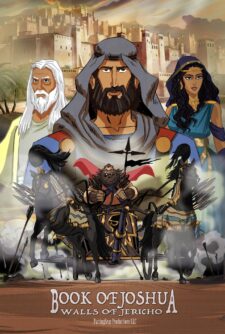
BOOK OF JOSHUA: WALLS OF JERICHO
A faithful, exciting retelling of Jericho's fall — mind the battle scenes.
Should You Watch It?
This one earns its four stars. BOOK OF JOSHUA: WALLS OF JERICHO takes an interesting animation style and puts it to real use, building suspense scene by scene as Joshua leads Israel toward the Promised Land. It doesn't soften the biblical story or dress it up as something else — it trusts the source material, and that trust pays off.
The cost is real, too. This is a battle-heavy film: stabbings, whippings, a death by fire, a man struck for begging bread. There's also a passing reference to Israelite soldiers "laying" with temptresses sent to seduce them, and a dance scene with women in revealing outfits. None of it is graphic in the way live action might make it, but it's frequent enough that younger or more sensitive viewers should sit this one out.
For older children and adults ready for an honest, faith-filled war epic: this is worth the trip.
The Story
NO SPOILERS — WE KEEP THE SURPRISESMoses has led Israel out of Egypt, and the Promised Land is close. When two Israelite messengers seek safe passage through a foreign king's land, they're refused and beaten — sparking a battle that changes Israel's fortunes. Soon Moses appoints a successor: Joshua. When Israel's enemies gather in the fortified city of Jericho, Joshua sends spies to scout it — and finds an unlikely ally waiting inside its walls.
Is It Any Good?
Four stars means this film does what it sets out to do, and does it well. The animation style is distinctive and holds attention, and the battle sequences are staged with real suspense rather than just spectacle for its own sake. It's a faithful adaptation — the film trusts the biblical account enough to let it play out largely as written, rather than reshaping it for modern sensibilities.
That fidelity is also its strength as storytelling: prayer and faith aren't decoration here, they're the engine of the plot, from Moses's final instructions to Joshua's prayer for guidance before the walls come down. For a VOD biblical epic, this is craftsmanship worth noticing.
The Worldview
This film exalts what Scripture exalts: prayer, obedience, and trust in God even when the odds — and the walls — look insurmountable. Joshua doesn't take Jericho by cunning or strength; he takes it by following God's strange instructions to march and wait. The film lets faith drive the plot rather than treating it as backdrop, and that's rare and worth commending.
The film doesn't flinch from the story's harder edges either — the cruelty of the kings Israel faces, the violence of ancient warfare, and the moral complexity of Rahab, a woman on the wrong side of the wall who chooses to help God's people and is spared for it. These aren't worldview problems; they're the text.
The one caution worth naming: a brief reference to Israelite soldiers being seduced by Midianite women, and a dance scene with women in revealing dress. These moments are handled without graphic detail, but they are present, and parents of older children should know they're there.
At its heart, this is a story about walls that fall not by human strength but by obedient trust — a fitting picture of "for we walk by faith, not by sight" (2 Corinthians 5:7).
The Content Guide
The specifics — spoilers included by nature — so you can judge for your own family.
Dominant Worldview and Other Worldview Content/Elements
Very strong biblical worldview, as the movie’s events are either directly from, or heavily based on, scenes from the Bible, characters are shown praying and speaking with God, as well as submitting to His will and relying on their faith as they battle nonbelievers
Foul Language
No foul language
Violence
Many violent scenes, as the Israelites battle other groups, people are stabbed and slashed, and blood is shown, two Israelites are whipped and tortured in one scene, a man is pushed off the wall of Jericho to his death, but his body is not shown, a man hits a woman begging for food for her child, a soldier from Jericho looks into the Ark of the Covenant and burns to death
Sex
Israelite soldiers are said to “lay” with temptresses sent by the Midianites
Nudity
No explicit nudity, but Rahab and her sister perform as dancers in one scene and wear bra-like tops and skirts that reveal much of their legs, and there are other women in the scene wearing similar outfits
Alcohol Use
Men drink wine in one scene
Smoking and/or Drug Use and Abuse
No smoking or drugs;
Miscellaneous Immorality
The kings of the cities the Israelites fight are evil and attack civilians in a sneak siege on the Israelite camp, a woman sees the Israelite spies are being helped by Rahab and tips them off, later, that same woman steals Rahab’s money and necklace.
Talk About It
Questions for the drive home, the dinner table, or the youth group.
Joshua takes Jericho not by military cunning but by obeying a strange command — march, wait, and shout. Where has God asked you to trust an instruction that didn't make sense at the time?
Joshua 6:2–5 · Proverbs 3:5–6Rahab chooses to help God's people even though she's part of a city under judgment. What does her story teach about God's willingness to redeem unlikely people?
Joshua 2:1–14 · Hebrews 11:31The film shows soldiers tempted by pagan women sent specifically to lead them astray. What does this suggest about the dangers of compromise, even in small doses?
Numbers 25:1–3 · 1 Corinthians 10:12–13Moses doesn't get to enter the Promised Land, but he faithfully hands leadership to Joshua. What does faithful succession — passing the baton well — look like in your own family or church?
Deuteronomy 31:7–8 · 2 Timothy 2:2The Final Word
This is a faithful, well-crafted telling of one of the Bible's most dramatic victories — the kind of film that takes Scripture seriously and lets it do the work. It also earns its caution, with frequent battle violence and a brief nod to temptation that parents of younger kids should know about going in. Our answer: worth the trip — older children and adults.