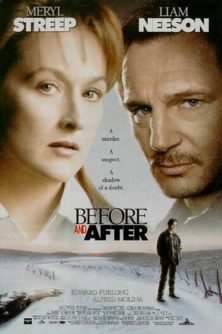
BEFORE AND AFTER
A grim family drama where truth is better faced at home.
Should You Watch It?
Before and After begins with a strong moral crisis. A family faces the possibility that its son is connected to a murder, and the parents respond by trying to conceal evidence. The children, however, show a stronger sense of right and wrong than their parents, wanting the truth brought into the open rather than living a lie.
The film is realistic and suspenseful in its first half, but it loses steam and meanders through the second. Its bleakness is not balanced by hope or a clear moral position, and the source review finds the performances from Meryl Streep and Liam Neeson unimpressive.
Because the film carries adult-level content and offers little encouragement, wait to watch it at home—if you choose to watch it at all.
The Story
NO SPOILERS — WE KEEP THE SURPRISESThe Ryans appear to be a normal American family. Carolyn is a pediatrician, Ben is a successful artist, and their son Jacob is suddenly connected to the murder of a young girl who was once Carolyn’s patient—and Jacob’s girlfriend.
As the sheriff searches for Jacob, the family must decide how far it will go to protect him. The central question is whether they will continue living behind deception or face the consequences of the truth.
Is It Any Good?
Two stars means this is a flawed, disappointing drama with a promising beginning. The first half is suspenseful as the family confronts the murder investigation and the consequences of its choices.
The film then loses momentum and meanders through its second half. The source review also finds Streep and Neeson’s performances unimpressive, despite their reputations as quality actors. Realism alone cannot carry a film that offers neither much hope nor a clear moral position.
The Worldview
The film presents a pagan worldview, with some prayer and misrepresentations of Scripture. Its moral center is troubled: the parents lack a moral compass and choose deception, while Jacob and his sister recognize that the family should bring the truth into the open and accept the consequences.
The story therefore shows how a tragic circumstance can bring out the worst in people. It also places the strongest sense of right and wrong in the children rather than the parents. The source review describes a moral conclusion, yet judges the movie as lacking a clear moral position.
The film’s central choice is between living a lie and facing the truth. Scripture says, “Whoever walks in integrity walks securely” (Proverbs 10:9).
The Content Guide
The specifics — spoilers included by nature — so you can judge for your own family.
Content Summary
Pagan worldview with some prayer and misrepresentations of Scripture & a moral conclusion; 7 obscenities, 3 vulgarities & 5 profanities; brief but bloody violence of a pregnant woman accidentally murdered & eye gouged out; implied sex between married couple, implied sex between young unmarried couple & sexual suggestiveness; alcohol use implied; and, lying & destroying evidence
Talk About It
Questions for the drive home, the dinner table, or the youth group.
The parents try to protect their son by destroying evidence. Why can hiding wrongdoing create greater harm?
Proverbs 28:13 · Luke 12:2–3Jacob and his sister want the truth brought into the open. Why is accepting consequences part of honest repentance?
Psalm 32:5 · 1 John 1:9How can fear make good people choose deception? What helps us respond to fear faithfully?
Psalm 56:3–4 · 2 Timothy 1:7The film asks whether a family can live with a lie. What does Scripture teach about integrity in ordinary decisions?
Proverbs 10:9 · Ephesians 4:25The Final Word
This is a realistic but bleak family drama with a suspenseful opening and a disappointing second half. Its adult content, deception, and lack of hope make it a poor family choice. Our answer is WAIT FOR HOME — ADULTS ONLY. For a more constructive family viewing option, see.