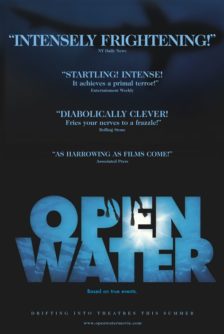
OPEN WATER
A well-crafted thriller best left for adults at home.
Should You Watch It?
OPEN WATER is an effective confrontation with basic human fear. Its stranded couple’s ordeal feels uncomfortably real, and the film makes you empathize with their struggle against terror, isolation, and the possibility that no rescue will come.
The filmmaking is thoughtful. The low-budget approach, digital cameras, lack of a consistent musical score, and island-type hymns create a documentary-like, haunting experience. But the movie also leaves you feeling slightly cheated, and its claim to be “Based on True Events” is misleading. It is fiction based on the possibility that something like this may have happened.
The content is not suitable for children or young teens. Adults who are intrigued by realistic survival horror should wait to watch this at home, where they can control the experience.
The Story
NO SPOILERS — WE KEEP THE SURPRISESSusan and Daniel take a much-needed diving vacation in a tropical island setting. After diving at a coral reef, they surface and discover that their dive boat has mistakenly left them behind in open water.
As the hours pass without rescue, the couple faces fear, blame, apologies, expressions of love, and the threat of sharks circling nearby.
Is It Any Good?
Two stars means OPEN WATER has real strengths but does not fully satisfy. The film is sensitive, terrifying, and captivating in its focus on human beings confronting danger without any assured victory.
Its craft supports that realism. The filmmakers avoid special effects and a consistent musical score, while digital cameras subtly enhance the documentary feel. The island-type hymns are especially effective in creating haunting and foreboding emotions.
The experience is weakened by the misleading “Based on True Events” claim and by the sense that the film ultimately cheats the audience. It is a well-crafted thriller, but only an uneven one.
The Worldview
OPEN WATER presents a humanist struggle in which a couple must face terror, isolation, and the limits of human strength. It values courage, protecting loved ones, and persevering against impossible odds. The film’s central concern is survival, but it offers no assured victory.
Faith receives only a brief and unconvincing treatment. In a moment of desperation, one character utters part of the Lord’s Prayer, but the gesture feels like weak lip-service rather than a meaningful confrontation with God. The story suggests that surviving extreme circumstances is difficult on your own strength, yet it does not develop that idea into a robust biblical understanding of dependence.
The film recognizes how small human beings are within creation’s food chain and how quickly confidence can give way to terror. Scripture points beyond fear and self-reliance to the Lord as the true source of help: “My help comes from the LORD, who made heaven and earth” (Psalm 121:2).
The Content Guide
The specifics — spoilers included by nature — so you can judge for your own family.
Content Summary
Humanist worldview in which a couple must survive being stranded in shark-infested waters, with moral themes of courage and protecting loved ones, and Christian element where one character utters part of the Lord’s Prayer; 23 obscenities (with 15 “f-words”), nine strong profanities, implied scene of woman vomiting from seasickness, and countless exclamations of “Oh God” or similar references; implied violence with sharks and other fish biting limbs, blood in water, screams of terror, and images of shark being cut up by fishermen, and implied “giving up” (possible suicide) by one character after long ordeal; couple kisses in bed; full female and male nudity; adults drink and smoke; and, nothing else objectionable. GENRE: Thriller
Talk About It
Questions for the drive home, the dinner table, or the youth group.
The couple faces danger they cannot overcome through strength alone. Where do you tend to rely on yourself instead of seeking God’s help?
Psalm 121:1–2 · Proverbs 3:5–6The film presents courage and protecting loved ones as moral goods. What does biblical courage look like when fear is real?
Joshua 1:9 · Psalm 56:3–4One character utters part of the Lord’s Prayer in desperation. What is the difference between genuine prayer and merely using religious words in a crisis?
Matthew 6:9–13 · Psalm 34:17–18How should Christians think about stories that invite us to be fascinated by terror?
Philippians 4:8 · 2 Timothy 1:7The Final Word
OPEN WATER is a frightening, well-crafted thriller with a realistic documentary feel, but explicit nudity, strong language, and a thin treatment of faith make it unsuitable for younger viewers. Its uneven experience is better managed at home by discerning adults. Our verdict is WAIT FOR HOME — ADULTS ONLY. For other options, see.