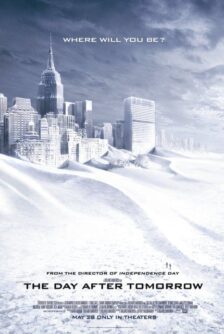
THE DAY AFTER TOMORROW
A climatologist races across a frozen America to save his son from a sudden ice age.
Should You Watch It?
Yes, with discernment. From the director of INDEPENDENCE DAY, this 2004 disaster blockbuster swaps an alien invasion for a sudden global freeze. At the center is a father who risks his life to reach his teenage son, stranded in New York as a new ice age takes hold.
At its heart, the movie delivers several moral messages. A father puts his child ahead of his career. Friends sacrifice their lives for one another, a mother refuses to abandon a dying child, and a teenager survives because he listens to his father. Parents who watch with teens can use these elements as conversation starters.
However, the movie's larger message deserves a closer look. It presents an abrupt ice age as a real scientific threat, poses skeptical politicians as villains, and portrays the catastrophe as nature's punishment for modern industry. God receives a brief mention, but the conversation quickly dismisses faith. Instead, the story places its hope in humanity's ability to recognize past mistakes and save itself.
The PG-13 disaster scenes pack quite a punch, with widespread destruction, frozen corpses, and a bloody wolf attack. Some foul language and a mildly suggestive scene also warrant caution. Younger children should skip this one. Older teens may appreciate the spectacle, but parents should follow up with a conversation about the movie's skewed science.
The Story
NO SPOILERS — WE KEEP THE SURPRISESPaleoclimatologist Jack Hall warns world leaders that melting polar ice could throw Earth's climate off balance. They dismiss his warning, but soon a string of disasters hits cities worldwide. Giant hailstones pound Tokyo, tornadoes rip through Los Angeles, and a massive wave floods Manhattan.
Jack's teenage son, Sam, is in New York for an academic competition when the temperatures suddenly drop. He takes refuge in the public library with a group of survivors as the city freezes around them. With his son trapped in the city, Jack leaves Washington and heads north through the frozen landscape to bring him home.
Is It Any Good?
Three stars for an entertaining disaster thriller with impressive effects and a surprisingly touching father-son story. The massive wave that engulfs Manhattan and the city’s sudden deep freeze make for some unforgettable scenes. The action moves along at a good pace, and Dennis Quaid brings plenty of heart to his role as Jack. Jake Gyllenhaal and Emmy Rossum also deliver strong performances.
However, the science is far from credible, and some characters seem to travel impossible distances in remarkably little time. Several side stories feel like excuses for more action rather than meaningful additions to the plot. The supporting characters also lack depth, and some dialogue sounds more like a science lesson than natural conversation.
Disaster movie fans will enjoy the ride, as long as they don't expect scientific accuracy. However, the intense peril and violence make this a tough choice for younger viewers.
The Worldview
THE DAY AFTER TOMORROW carries a strong Romantic, environmentalist worldview. Nature strikes back against an industrial civilization that has pushed beyond its limits. Government officials who dismiss scientific warnings become the villains, while the experts who predict the disaster prove right. Americans flee south into Mexico as refugees. The new president eventually admits his mistake.
The movie touches on the biblical call to care for God's creation. However, it turns that duty into a political argument and relies on questionable science. Humanist elements also suggest mankind's survival depends on learning from its own mistakes, rather than looking to God. Its portrayal of humanity's role in the disaster leaves out an important biblical truth: mankind stands accountable to its Creator.
Thankfully, moral themes bring balance. Jack's journey is about more than saving the world. He wants to repair his relationship with his son and puts family ahead of his career. One colleague gives his life rather than endanger the others. Sam's mother refuses to abandon a young cancer patient, and Sam risks his life to find medicine for Laura. These choices honor family, loyalty, courage, and sacrifice. They echo Jesus's words in John 15:13 about laying down one's life for friends.
Faith receives a much colder reception. An atheist protects a Gutenberg Bible but sees it only as a symbol of human reason, and no one challenges his view. Jack mentions prayer, but the movie ultimately puts its hope in mankind's ability to save itself. The characters show courage and selflessness, but the bigger message leaves God out of the picture. Humanity may damage creation, but it can't save itself.
The Content Guide
The specifics — spoilers included by nature — so you can judge for your own family.
Content Summary
Dominant Worldview and Other Worldview Content/Elements
Strong Romantic, environmentalist worldview where nature punishes a careless industrial society and stubborn political leaders who ignore the scientists, with politically correct climate alarmism and dubious science presented as fact; humanist elements as the story suggests mankind’s survival depends on learning from its own mistakes, and an atheist protects a Gutenberg Bible only as a symbol of human reason while dismissing God, without being challenged; strong moral elements soften the worldview, including self-sacrifice, a father’s devotion to his son, a son’s obedience to his father, compassion for the sick, and a leader’s public repentance
Foul Language
Two “sh” words, one “f” word, several abuses of God’s name, including "GD", use of the "d" word, "b" word, and "h" word
Violence
Disaster violence throughout. Tornadoes rip apart buildings and sweep away a TV reporter, a bus crushes a man in a sports car, giant hail strikes people on the head, a flood surge pours through Manhattan, planes and helicopters crash, a man flash-freezes, a man falls to his death in Antarctica, a colleague falls through a glass roof, frozen bodies are discovered, and escaped wolves attack teenager, biting a boy’s leg and leaving a bloodstain on a window
Sex
A man and woman kiss on a couch and he begins unbuttoning her sweater before they’re interrupted, and two teenagers kiss
Nudity
Upper male nudity of a teenage boy seen only in his underwear
Alcohol Use
Two characters drink liquor but not to excess
Smoking and/or Drug Use and Abuse
No smoking or drug use
Miscellaneous Immorality
A desperate teen breaks into a vending machine for food, survivors burn books to stay warm, and the environmental message paints government skeptics in an unfavorable light.
Talk About It
Questions for the drive home, the dinner table, or the youth group.
Jack risks everything to keep his promise to his son. What does his journey say about a father’s responsibility to his children? How does it reflect God’s faithfulness to keep His promises to us? Numbers 23:19
The atheist protects the Bible, but only as a symbol of human reason. Why do you think the movie never answers his claim? How would you respond if someone told you the Bible is just an important old book? 2 Timothy 3:16-17
The movie ends by saying mankind will survive by learning from its mistakes. God calls us to care for His creation, but where does true hope and deliverance come from? Genesis 2:15
The Final Word
THE DAY AFTER TOMORROW delivers an exciting disaster ride with a moving father-son story and plenty of examples of courage, loyalty, and self-sacrifice. However, its heavy environmentalist message twists the biblical call to care for creation into a political argument and ultimately puts its hope in humanity rather than God. Add intense peril and foul language, and parents have some things to consider. This one is for older teens and adults, with a parent ready to talk through the worldview.