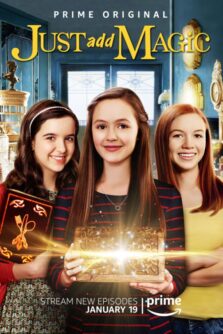
JUST ADD MAGIC Season 3 Episodes 1-3
Warm friendships, sharp storytelling — and a spellbook at its center.
Should You Watch It?
Here's the decision plainly. This is a well-made show. The production values are strong, the storylines move, and the three young leads — Olivia Sanabia, Abby Donnelly, and Aubrey Miller — carry it with real charm. On craft alone, it earns every one of its four stars, and its heart is in a good place: friendship, community, and looking out for the people around you.
But the whole engine of the series is magic — a spellbook, spells and curses, magic herbs, even time travel and talk of "trapping" people inside the book. That's not a passing element; it's the premise. There's no bad language and nothing explicit, so this isn't a matter of shielding kids from vulgarity. It's a matter of what magic is treated as normal and good in a story your children may want to imitate.
So: if you have older children and you're ready to watch alongside them and talk it through, this is one to preview and weigh. Watch it at home first, with the remote and the conversation in your own hands.
The Story
NO SPOILERS — WE KEEP THE SURPRISESSeason three picks up in the fallout of everything the girls set in motion before. Kelly, Darbie, and Hannah use their magic to regrow their garden — but the garden comes with strings attached.
Then a thief slips in and makes off with some of their magic herbs. It quickly becomes clear this isn't simple mischief: whoever took them has something far more sinister in mind. What that plan is, and who's really behind it, is what these first three episodes set out to uncover.
Is It Any Good?
Four stars, and here's what they reflect. The first three episodes are well-made across the board, with good production value and storylines that keep each episode's plot moving forward instead of stalling. Nothing sags; every episode has a hook and pays it off.
The three lead actresses — Olivia Sanabia, Abby Donnelly, and Aubrey Miller — give good performances, and they're the reason the friendships at the center feel real rather than scripted. This is confident, competent family television that knows exactly what it's doing. On the level of craft, there's little to fault.
The Worldview
At its best, this show believes in something worth believing in. Its dominant worldview is strongly moral: friendship, helping others, and community carry the whole series. The girls work together, encourage each other, and repeatedly turn their attention to helping townspeople who've been hurt by magic — cleaning up messes, undoing curses, checking that a hidden cellar holds nothing harmful before others handle it. That instinct to protect and serve others is genuinely good.
The trouble is where the story locates its power. Magic isn't a villain here; it's the toolkit. Spells, curses, spellbooks, and magic plants drive nearly every plot, alongside time travel and talk of "trapping" people inside the spellbook. Scripture doesn't treat magic as a neutral resource to be used for good ends — it names sorcery and spell-work as things God's people are called out of, not into. That's why a show this well-crafted still warrants caution for older children.
Small ethical cracks show too: Kelly lies to her dad, the villain steals, and the girls break into a cellar to search it. The series doesn't celebrate these, but they're worth naming as you watch.
The show's true north — loyal friends helping one another — points past itself to a better source: "A friend loves at all times, and a brother is born for adversity" (Proverbs 17:17).
The Content Guide
The specifics — spoilers included by nature — so you can judge for your own family.
Dominant Worldview and Other Worldview Content/Elements
A strong moral worldview, with emphasis on friendship, helping others, and community. Kelly, Darbie, and Hannah focus on helping any townspeople that have been affected by magic in Episode 2, and in Episode 3, they sneak into the magic cellar to make sure there’s nothing harmful in it before the town’s historical society catalogs its contents. However, there are many references to fantasy and magic, including spells, curses, spellbooks, and magic plants, as well as time travel and discussion of “trapping” people inside the spellbook
Foul Language
No foul language
Violence
No violence
Sex
No sex
Nudity
No nudity
Alcohol Use
No alcohol use
Smoking and/or Drug Use and Abuse
None;
Miscellaneous Immorality
Kelly lies to her dad about who the 1975-version of Grandma Quinn is in Episode 1, in the same episode, Kelly’s alternate-timeline dad takes enjoyment from firing someone, in Episode 2, Erin steals magic plants from the girls, in Episode 3, the girls break into the hidden cellar.
Talk About It
Questions for the drive home, the dinner table, or the youth group.
The girls are quick to help anyone hurt by magic — cleaning up messes and undoing harm. Where in your own life could you go out of your way to help someone the way they do?
Galatians 6:9–10This show treats magic as a normal, even good tool. How does the Bible talk about magic and spell-work, and why do you think God draws such a firm line there?
Deuteronomy 18:10–12 · Acts 19:18–20Kelly lies to her dad, and the girls break into a locked cellar for a good reason. When we want to do the right thing, does a good goal make a wrong step okay?
Proverbs 12:22 · Romans 12:21The heart of the show is three friends who stick together through everything. What makes a friendship that lasts, and how can you be that kind of friend?
Proverbs 17:17 · John 15:13The Final Word
This one is genuinely well-made — polished, warm, and rooted in friendship and community. But the magic isn't a detail; it's the whole premise, and that's why our answer is wait and see. Preview it at home, watch with your older kids, and keep the conversation going. Want something to enjoy without the caveats? Try our latest family-friendly picks.