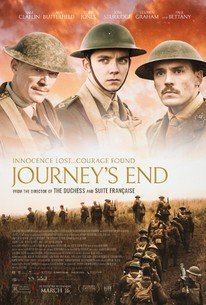
JOURNEY’S END
An intense, restrained war drama for discerning adults.
Should You Watch It?
JOURNEY’S END is less interested in battlefield spectacle than in what war does to the human spirit. Its quiet tension builds as British soldiers wait in a trench for a German attack, while fear, grief, alcoholism, and exhaustion wear down their resolve.
The film is comparatively restrained for a war drama. Violence is moderate rather than graphic, but the emotional pressure is intense, and the story includes foul language, smoking, alcohol abuse, vomiting, urination, and a brief image of a naked woman. The film offers compassion, sacrifice, and moral seriousness, but the content is not suitable for children or young teens.
If you are an adult seeking a thoughtful war drama and can handle its mature material, it is worth the trip. For a family movie night, choose something else.
The Story
NO SPOILERS — WE KEEP THE SURPRISESIn early 1918, Britain’s C Company waits in a trench in Northern France for an expected German attack. Raleigh, a 20-year-old officer fresh out of school, asks to join the company because his old friend Captain Stanhope is serving there.
But war has changed Stanhope into a cynical, war-weary alcoholic. As Raleigh faces his first experience of combat, Stanhope and the other soldiers struggle with their own private battles while preparing for the larger one approaching them.
Is It Any Good?
Three stars means JOURNEY’S END is a good, purposeful drama with some flaws. Its greatest strength is its psychological focus. Each main character has a distinct personality, family, and personal struggle, and the film makes viewers nervously anticipate the attack alongside the soldiers.
The movie remains a drama until late in the story, so viewers expecting constant combat may find it slow in places. Still, it is never truly boring, and its restraint helps emphasize the mental scars of war rather than only the physical ones.
The Worldview
The source describes JOURNEY’S END as containing a light, moral, redemptive worldview. The film presents compassion and sacrifice, and it includes scenes in which inappropriate behavior is reprimanded.
Its central concern is the damage war inflicts on the human spirit. Rather than concentrating on graphic fighting, the movie examines fear, grief, alcoholism, courage, leadership, and the emotional cost of sending people into battle. It treats the soldiers’ suffering seriously and gives attention to the personal turmoil behind the larger historical conflict.
The film’s moral vision is not described as explicitly biblical, but its emphasis on compassion and sacrifice can prompt Christian reflection. Jesus says, “Greater love has no one than this, that someone lay down his life for his friends” (John 15:13).
The Content Guide
The specifics — spoilers included by nature — so you can judge for your own family.
Dominant Worldview and Other Worldview Content/Elements
Light moral, redemptive worldview contains some compassion, sacrifice and scenes where inappropriate behavior is reprimanded
Foul Language
13 obscenities (some “f” words, several uses of the British “bloody”), one depiction of vomiting on screen, soldiers urinate in the trench
Violence
Fatal injuries during battle are depicted with blood, soldiers are depicted dying from their injuries, one shot shows many dead soldiers lying in a trench, it is implied that a cook is about to cut the throat of a chicken for dinner, one shot shows a bunch of dead rats hanging on a rack, dialogue says dead soldiers are buried in the trench walls for fortification
Sex
None
Nudity
A picture of a naked woman is seen hanging on a wall
Alcohol Use
Alcohol is used in several scenes over meals, one soldier is an alcoholic and is seen drunk a few times
Smoking and/or Drug Use and Abuse
Several soldiers smoke cigarettes and pipes throughout the movie;
Miscellaneous Immorality
One scene depicts a soldier lying to another and invading privacy and a few scenes depict intense arguments between soldiers.
Talk About It
Questions for the drive home, the dinner table, or the youth group.
The soldiers carry different kinds of psychological wounds. How can we notice and support people who are suffering quietly?
Galatians 6:2 · Romans 12:15The film highlights compassion and sacrifice. What makes sacrifice loving rather than merely heroic or self-serving?
John 15:13 · Philippians 2:3–4Stanhope struggles with alcoholism as he tries to endure war. How should Christians respond to someone whose coping method is destructive?
Galatians 6:1–2 · Ephesians 5:18The soldiers face fear while waiting for danger they cannot control. What does faithful courage look like when fear does not immediately disappear?
Psalm 56:3–4 · 2 Timothy 1:7The Final Word
JOURNEY’S END is a thoughtful, restrained war drama about the wounds carried inside. Its mature content makes it unsuitable for children and young teens, but discerning adults may find its compassion and sacrifice worth considering. Our answer is WORTH THE TRIP — ADULTS ONLY. For family viewing, see.