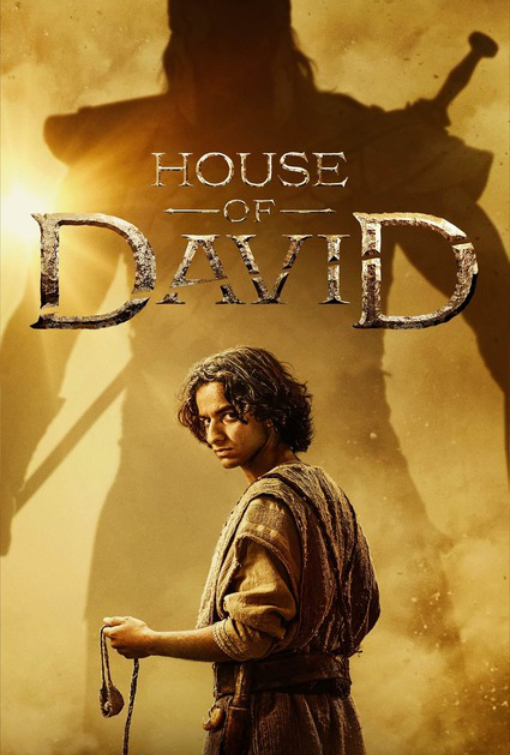

HOUSE OF DAVID: Episode 201: “A Tale of Two Swords”
A masterfully shot, faith-soaked battle premiere — best for teens and up.
Should You Watch It?
Here's the short version: this is a strong hour of television with real conviction behind it. The season premiere picks up right after David's defeat of Goliath and throws you into the war that follows, and the battle sequences are shot and choreographed with real craft — this isn't cheap biblical filmmaking. It never loses you.
What earns the caution flag is intensity, not immorality. There's no language, no sex, no nudity, nothing you'd need to fast-forward past for content reasons — just hard, sustained battle violence, including beheadings, stabbings, and characters pulling weapons out of their own wounds. It's not gratuitous, but it is a lot for younger viewers.
Set against that is a genuinely biblical spine: characters lean on their faith in the fight, family members risk themselves searching for one another, and the story is faithful to the text it's drawn from. For teens and adults, this is well worth your time. For younger kids, wait.
The Story
NO SPOILERS — WE KEEP THE SURPRISESSeason two picks up moments after David's defeat of Goliath, as that single blow ignites a full-scale war between the Israelites and the Philistines. King Saul, his son Jonathan, David, and David's brothers all enter the fight together — and are quickly scattered by the chaos of battle. Elsewhere, Saul's daughters find their camp overrun and must find their own way to safety. That's where we'll leave it.
Is It Any Good?
Four stars means this episode does what it sets out to do about as well as it can be done. The battle scenes are the standout — suspenseful, masterfully shot, and choreographed with a clarity that keeps a large, chaotic conflict easy to follow. The story is thoroughly engaging throughout, and the episode faithfully renders the biblical narrative it's adapting rather than taking liberties with it. For a season premiere built almost entirely around one extended battle, that's a real achievement, and it's why the quality rating sits at the top of the scale.
The Worldview
This episode is built on a strong biblical, moral foundation. Its heroes discuss their faith openly in the middle of battle, reassuring one another that God is present with them in the fight — a picture Scripture itself gives us: "the battle is the LORD's" (1 Samuel 17:47). Family runs through the story as well, with characters risking themselves to find and protect brothers, sisters, and daughters amid the chaos. There's a note of patriotism too, as David and the Israelites stand for their country alongside their faith — a pairing the episode treats as complementary, not competing.
The one shadow in the story belongs to King Saul, who is shown wrestling with the demons of his own past even as he leads his people into war. The episode doesn't resolve that struggle here, but it's honest about it — a king's private torment set against a nation's public fight.
Underneath the battlefield noise is a very old truth: God's people are not asked to win by their own strength, but to trust that He fights with them. "Fear not, nor be dismayed... for the battle is not yours, but God's" (2 Chronicles 20:15).
The Content Guide
The specifics — spoilers included by nature — so you can judge for your own family.
Content Summary
<p class="p1"><span class="s1">(BBB, PP, VV, M):<span class="Apple-converted-space"> </span><b>
Dominant Worldview and Other Worldview Content/Elements
</b><span class="Apple-converted-space"> </span>Very strong biblical, moral worldview telling the biblical story of a battle between the Philistines and Israelites, with an emphasis on family (including many characters working to find and protect their family members on the battlefield), as well as strong patriotism, as David and the Israelites stand up for their country and their faith; <b>
Foul Language
</b><span class="Apple-converted-space"> </span>No foul language; <b>
Violence
</b><span class="Apple-converted-space"> </span>Strong violence includes many scenes showing violent acts, such as beheadings, stabbings and being shot with arrows, little blood is shown and many of the violent acts are not explicitly shown, but there are several intense scenes, including two that show characters pulling arrows and swords out of themselves after being stabbed, plus another scene shows a female character being attacked by a soldier but her sister tries to stop the soldier; <b>
Sex
</b><span class="Apple-converted-space"> </span>No sex; <b>
Nudity
</b><span class="Apple-converted-space"> </span>No nudity; <b>
Alcohol Use
</b><span class="Apple-converted-space"> </span>No alcohol use; <b>
Smoking and/or Drug Use and Abuse
</b><span class="Apple-converted-space"> </span>No smoking or drugs; and, <b>
Miscellaneous Immorality
</b><span class="Apple-converted-space"> </span>King Saul is haunted by the demons of his past.</span></p>
Talk About It
Questions for the drive home, the dinner table, or the youth group.
Characters in this episode remind each other that God is with them in the middle of the fight. What does it look like to remember that in your own hard moments, not just in battle?
1 Samuel 17:47 · Joshua 1:9Several characters risk themselves to find and protect their family members in the chaos. What does that tell us about how God calls us to love and look after our own?
1 Timothy 5:8King Saul is shown wrestling with demons from his past even while leading his people. Why is it so hard to fight external battles while carrying unresolved internal ones?
Psalm 32:3–5The episode pairs loyalty to God with loyalty to country. How do we hold both without letting one crowd out the other?
Matthew 22:21 · Romans 13:1The Final Word
This is a season premiere that earns its craft and its convictions in equal measure — a faithfully told, beautifully shot piece of biblical drama that just happens to be too intense for young children. Our answer stands: worth watching — teens and adults. — [Reviewer Name], for the Movieguide team