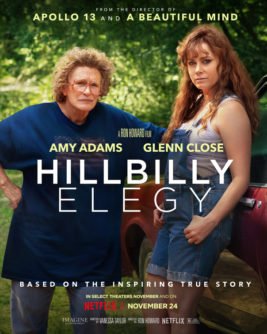
HILLBILLY ELEGY
Powerful family drama with strong Christian themes, for adults only.
Should You Watch It?
HILLBILLY ELEGY is a powerful, sobering drama about a family trying to overcome poverty, addiction, anger, and generational dysfunction. The acting is phenomenal, Ron Howard’s direction is sensational, and the movie offers a strong moral worldview with poignant Christian moments.
The film also earns its adult-only warning. It contains frequent strong foul language, depictions and references to drug abuse, smoking, violence, and difficult family behavior. Those concerns are woven into a story that still believes people can love one another, accept responsibility, forgive, and pursue a better life.
If you are an adult or older teenager prepared for those issues, this is worth seeing for its performances, moral seriousness, and emotional force; do not choose it for children or young teens.
The Story
NO SPOILERS — WE KEEP THE SURPRISESJ.D. Vance is studying to become a lawyer when his sister calls to say that their mother, Bev, is in the hospital after a heroin overdose. He returns home to help his family while trying to protect an important opportunity for his future.
The movie moves between 2011 and J.D.’s childhood in Southern Ohio during the 1990s. His grandmother cares for him when Bev becomes belligerent, while his sister Lindsay tries to protect him and keep healthy boundaries with their mother.
Is It Any Good?
Four stars means this is a thoroughly accomplished film with powerful dramatic impact. Amy Adams and Glenn Close deliver phenomenal performances as Bev and Mamaw, while Gabriel Basso’s portrayal of J.D. helps create deep empathy for the family.
Hans Zimmer and David Fleming’s score works well with the setting and cinematography. The makeup and costuming are top-notch. Ron Howard’s direction and production bring the memoir’s family story to the screen with exceptional quality and emotional force.
The Worldview
HILLBILLY ELEGY presents a strong moral worldview with overtly positive references to Christianity and the New Testament. Its characters love one another despite relational dysfunction and want younger generations to succeed and build better lives. Forgiveness and taking responsibility for one’s actions are constant themes, and the opening and closing sequences feature a pastor on the radio and a reading from 1 Corinthians 13:12. The film also includes positive references to God’s creation.
The movie affirms family loyalty, military service, patriotism, hard work, and the desire to achieve the American Dream despite difficult circumstances. It also portrays the social problems affecting many people in Appalachia, Southern Ohio, Kentucky, the Midwest, and the Rust Belt, including poverty, addiction, and the disappearance or decline of low-paying physical jobs. There is a subtle instance of political correctness when a young man corrects another man who calls his family rednecks.
The film’s cultural setting has also been discussed more broadly. The memoir on which it is based was praised by some commentators for explaining why many people in the Rust Belt were attracted to Donald Trump’s social and economic solutions during the 2016 presidential election.
The movie’s emphasis on forgiveness, responsibility, and love reflects Scripture’s moral vision, even as its family story shows how deeply sin damages relationships. “For now we see only a reflection as in a mirror; then we shall see face to face” (1 Corinthians 13:12).
The Content Guide
The specifics — spoilers included by nature — so you can judge for your own family.
Dominant Worldview and Other Worldview Content/Elements
Strong moral worldview with overt positive references to Christianity and the New Testament where characters love one another despite their relational dysfunction and want them to be the best versions of themselves so that they can be successful and have a better life than the generation before, the opening and closing sequences feature a pastor speaking on the radio and then a reading from 1 Corinthians 13:12, there are positive references to God’s creation, and forgiveness and taking responsibilities for one’s actions are a constant theme, plus overt Pro-American, patriotic elements as a young man enters into military service, and his family is proud of him for doing so and young man seeks to achieve the American Dream despite his family background and circumstances, and there’s a subtle instance of political correctness when young man corrects another man who calls his family rednecks, which is a bit ironic considering the book upon which the movie is based and the movie’s title
Foul Language
At least 98 obscenities (including many “f” words), 24 profanities (including several GDs and Jesus profanities), depicted urination, and a couple obscene gestures
Violence
Moderate and light violence, such as mother hits hit children across the face twice, woman has a gun in her purse but doesn’t use it, children break and enter into someone’s property and take bats to assorted goods, teenagers almost drown one of their peers, and there’s a bit of blood shown when an adult hits one of the teenagers in defense, man angrily yells at his wife, and wife sets husband’s bottom on fire, but it’s quickly put out
Sex
An angry boyfriend makes a crude reference to a woman having oral sex with anyone who’s near her, and a dating couple kisses and embraces
Nudity
Upper male nudity in a few swimming scenes
Alcohol Use
Social alcohol use
Smoking and/or Drug Use and Abuse
Smoking throughout, mention of a heroin overdose that lands a woman in a hospital, but she’s not seen shooting up until later in the movie, same woman struggles with an addiction to pills, and teenagers smoke marijuana twice but it’s not condoned;
Miscellaneous Immorality
Lying, intense dysfunctional family portrayals, grandmother frequently makes empty physical threats, and some name-calling.
Talk About It
Questions for the drive home, the dinner table, or the youth group.
The family keeps struggling with anger, addiction, and broken relationships. What does taking responsibility look like when people you love have hurt one another?
Galatians 6:5 · James 5:16J.D. and Lindsay want a better life than the generations before them. What habits and choices help a family break destructive patterns?
Deuteronomy 6:6–7 · Proverbs 22:6The movie presents forgiveness as a constant theme. How can forgiveness coexist with wise boundaries and truth?
Ephesians 4:31–32 · Proverbs 4:23The film opens and closes with Christian references and a reading from 1 Corinthians 13:12. What does it mean to love people patiently in the middle of family dysfunction?
1 Corinthians 13:4–7The Final Word
HILLBILLY ELEGY is exceptionally well-acted, well-directed, and morally serious. Its strong language, drug abuse, and family dysfunction make it unsuitable for children and young teens, but adults and older teenagers prepared for those concerns may find its message of love, responsibility, and forgiveness worthwhile. WORTH THE TRIP — ADULTS ONLY. For a gentler family choice, see.