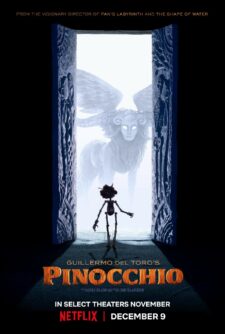
GUILLERMO DEL TORO’S PINOCCHIO
A beautifully animated Pinocchio with Christian themes, grief, and courage.
Should You Watch It?
Guillermo del Toro’s stop-motion adaptation is a serious, imaginative, and deeply moving take on the classic Pinocchio story. It explores grief, family struggle, courage against fascism, and sacrifice for the people we love. Its strong Christian imagery and moral themes give the story a meaningful center.
The movie is also dark. War, tragedy, death, cartoon peril, adult themes, and a prolonged scene of drunkenness may be difficult for younger viewers. Lighthearted musical numbers and child humor balance the weight without removing it.
If your family includes older children who can handle those themes, this is worth watching together on Netflix; use discernment with younger children.
The Story
NO SPOILERS — WE KEEP THE SURPRISESDuring Benito Mussolini’s fascist reign in Italy, Geppetto creates a wooden boy after the death of his son, Carlo. A woodland spirit brings Pinocchio to life, but Geppetto initially sees him as a burden rather than a replacement for his lost child.
Naive about the world’s dangers, Pinocchio is deceived by a traveling circus manager who wants to profit from him. Hoping to prove his worth to Geppetto, Pinocchio begins a journey across wartime Italy.
Is It Any Good?
Four stars means this is an excellent film, not merely a worthwhile message wrapped in animation. Del Toro creates a dark world filled with endearing characters, touching musical numbers, and a score that echoes those songs.
The movie successfully explores war, tragedy, fascism, grief, and sacrifice through the lens of a fairytale. Its child humor and heartfelt music balance the heavier material, while the characters’ emotional struggles give the story lasting weight.
The Worldview
The film presents a strong Christian worldview through Christian and redemptive themes. A church and crucifix, both built by Geppetto, provide visible Christian imagery. The story champions obedience, love, overcoming grief, and sacrifice, while also offering a strong message about courage against fascist leaders.
The movie treats war, tragedy, and fascism seriously. It also emphasizes that we have one short life to live with the people we love and asks how we should live honorably. Its fairytale world includes a blue spirit resembling a biblical angel and another spirit who returns Pinocchio to the land of the living after he dies.
The film’s central longing is for love to survive grief and for sacrifice to give life meaning. Jesus says, “Greater love has no one than this, that someone lay down his life for his friends” (John 15:13).
The Content Guide
The specifics — spoilers included by nature — so you can judge for your own family.
Dominant Worldview and Other Worldview Content/Elements
Strong Christian worldview with Christian, redemptive themes (including images of church and a crucifix) and champions the moral virtues of obedience, love, overcoming grief, and sacrifice, and other themes central to the original story, plus has a strong message about courage against fascism
Foul Language
Some light foul language like OMG, “crap” and some course humor about flatulence
Violence
Movie deals with war and death throughout, a boy dies after a bombing, Pinocchio is able to die but come back to life, he is hit by car but does not die, a man abuses his circus animals, children are forced to practice war simulations but using paintball guns, a man falls to his death, a son stands up to his evil father, and his father is killed in the process, Geppetto, Cricket and Pinocchio are swallowed by a sea monster and must escape
Sex
No sex
Nudity
No nudity
Alcohol Use
One scene of strong alcohol drunkenness; Geppetto builds Pinocchio in a drunken stupor, the scene is fairly graphic for a children’s movie
Smoking and/or Drug Use and Abuse
No smoking or drugs;
Miscellaneous Immorality
Pinocchio lies on occasion and his nose grows.
Talk About It
Questions for the drive home, the dinner table, or the youth group.
Geppetto struggles to love Pinocchio while grieving Carlo. How can grief affect the way we treat the people still with us?
Psalm 34:18 · Romans 12:15Pinocchio faces pressure from people who want to use him. What does courage look like when powerful people demand that we do wrong?
Acts 5:29 · Proverbs 29:25The story presents sacrifice as a way of loving others. What is the difference between selfish ambition and loving sacrifice?
Philippians 2:3–4 · John 15:13The film asks how to live an honorable life when life is short. What choices help us love God and others with the time we have?
Ephesians 5:15–16 · James 4:14The Final Word
This is a beautiful, serious, and heartfelt retelling with a strong Christian moral center. Its darkness means younger viewers need parental discernment, but older children and adults may find much to discuss and treasure. For that audience, the answer is WORTH THE TRIP — OLDER CHILDREN AND ADULTS.