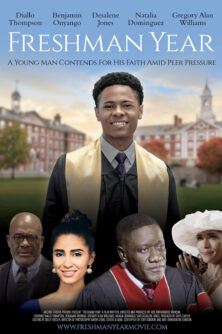
FRESHMAN YEAR
A pastor's son falls hard — and grace catches him.
Should You Watch It?
Here's the decision. Faith-based movies rarely wade into the temptations and sins of college life, and this one does it with courage and craft. It's the story of C.J., a pastor's son whose upbringing meets a state university's party culture — and who, after one drinking binge and its lasting consequence, has to renew his faith to keep his word.
What sets it apart is honesty. The film shows the fall plainly and then shows grace plainly: prayer, family, a pro-life conviction that costs something, and parents who respond the way you'd pray your own would. It earns its emotion.
The caution is modest. There are scenes of drinking and drunkenness, a party scene, and frank talk about sex outside marriage — the movie's central issue. Nothing here is glorified, but younger children aren't the audience.
So: if you have older children, teens, or simply want a moving Christian drama done well, see it. Just preview it before the youngest in the house.
The Story
NO SPOILERS — WE KEEP THE SURPRISESC.J. is a faith-filled pastor's son, fresh out of a private Christian high school and idealistically bound for a state university. Then the residence hall, the parties, and the pressure start wearing his convictions down.
A partying roommate, a faith-averse sociology professor, and a hard-drinking basketball captain all pull at him. So does Marcella, whom he keeps running into everywhere — in class, at tryouts, at the coolest party in town. One night, matching vodka shots he never should have taken, C.J. crosses a line he can't uncross. Where it leads him — and what he decides to do about it — is the heart of the film.
Is It Any Good?
Four stars, and they're earned. This is a skillful, well-rounded script that covers hard subject matter comprehensively without preaching past it. The acting is believable, the direction careful, and the production values top-notch — cinematographers put you inside every scene.
The love story between C.J. and Marcella is its quiet triumph: innocently irresistible and profoundly serious at once, which makes the whole film an endearing watch. The screenplay's finest moment may be a private conversation between C.J.'s parents as they weigh their feelings about their son's situation — the kind of honest, adult scene most faith films never attempt. The result is soulful, sensitive, and exceptional.
The Worldview
This is a very strong Christian, biblical, pro-life film from start to finish — and it doesn't fake the strength. It opens with a Scripture-laced valedictorian speech at a Christian high school and closes in a worship service, where C.J.'s father preaches on Proverbs 24:16: the righteous man who falls seven times and rises again. In between, the movie honors prayer, Bible reading, and the keeping of one's commitments.
Its central conviction is the sacredness of human life. C.J.'s pro-life stance is unshakable, but the film is wise enough to know that stance doesn't transform a heart by itself — it's the candid, grace-filled conversations with parents on both sides that move Marcella. One mother's confession of her own past temptation and gratitude, and one family's overwhelming generosity, are what finally lead to a choice for life.
The film also honors the reality it's set in. The two leads are surrounded by a pagan hedonism — parties, drinking, a humanism-promoting professor — that the story never pretends away. And it weaves in a rich picture of American ethnicity, with C.J.'s Nigerian family and congregation meeting Marcella's Hispanic family in a shared faith.
Underneath it all is the promise the closing sermon names: that falling isn't the end. "The righteous falls seven times and rises again" (Proverbs 24:16).
The Content Guide
The specifics — spoilers included by nature — so you can judge for your own family.
Dominant Worldview and Other Worldview Content/Elements
Very strong Christian, biblical, moral, pro-life worldview, illustrated by a Scripture-laced valedictorian graduation speech at a Christian
Foul Language
No foul language, but there are two vomiting scenes
Violence
No depicted violence, but some threats of violence from a slightly over-protective brother
Sex
Implied intercourse after talk of showering together results in an unwed pregnancy, the movie’s main issue, and there’s some talk about sex outside of marriage
Nudity
No depicted nudity, but there’s implied nudity when an unmarried couple showers together
Alcohol Use
Alcohol use and abuse is depicted as undesirable through Christian commitment, but alcohol use and drunkenness are depicted in social situations
Smoking and/or Drug Use and Abuse
No smoking or drugs;
Miscellaneous Immorality
Lead female’s older brother is over-protective of his sister and exhibits some anger issues.
Talk About It
Questions for the drive home, the dinner table, or the youth group.
The closing sermon is built on Proverbs 24:16 — falling seven times, rising seven times. Where in your own life has God lifted you back up after a fall?
Proverbs 24:16 · Micah 7:8C.J. steps up immediately to take responsibility for Marcella and the baby, even in the first shock. What does keeping our commitments look like when they're costly?
Psalm 15:4 · Matthew 5:37Marcella's heart is changed not by argument but by candid, loving conversations with parents who choose grace. How does the way we speak the truth shape whether it's received?
Ephesians 4:15 · Proverbs 15:1The movie treats every human life as sacred, right from the womb. What does Scripture say about how God knits us together and knows us before birth?
Psalm 139:13–16 · Jeremiah 1:5The Final Word
This is a rare thing: a faith-based film that tells the truth about temptation and then tells the truth about grace, and does both with real craft. It's honest, moving, and beautifully made. So here's our answer, the same one we opened with: worth the trip — older children and up. Preview it for the youngest, then watch it together.