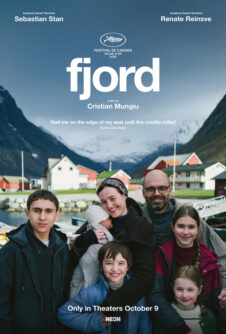
FJORD
Unfair treatment of a family for holding Christian beliefs and conservative views.
Should You Watch It?
Save this weighty, layered story for home, where mature Christian adults can watch with prayer, a discerning heart, and a remote close at hand. The story follows the Gheorghiu family, a Christian conservative household that clashes with Norway's culture and its Child Protective Services.
The movie portrays Norway's culture and CPS as progressive, and their views collide with the family's beliefs. This culture sees no value in Christianity for the formation of the person or society, and it shows little understanding for the family's religious and cultural differences. As a result, the Gheorghius face fierce opposition and what they consider unfair treatment, even in court.
Through it all, the family holds fast to its faith and values as they fight to stay together and live in peace. The movie also contains other worldviews and content that may concern Christian viewers and call for caution. Adults who choose to watch should approach it thoughtfully, with eyes wide open to its tough themes and content.
The Story
NO SPOILERS — WE KEEP THE SURPRISESA Romanian Christian family settles into a new life in Norway, where they soon discover that their faith and conservative values clash with the culture around them. Their situation takes a devastating turn when school staff notice bruises on one of the children and suspect abuse. After CPS removes the children from their parents’ care, the Gheorghius face a difficult fight to prove their innocence, protect their family, and bring their children home.
Is It Any Good?
Four stars for a powerful drama with a talented cast, a well-developed structure, and plenty to keep viewers invested. The actors do an excellent job embodying their characters, while the story maintains steady momentum and leaves audiences wondering what will happen next.
The story focuses on the Gheorghiu family as they struggle to hold onto their faith, conservative values, and cultural traditions in a society that does not always understand them. Their situation presents a compelling what-if scenario that encourages viewers to consider how they might respond if their own beliefs and family were put to the test.
Although complex themes and content that aren't family friendly run throughout, these elements help establish the realities of the world portrayed in the movie. Ultimately, the story challenges viewers to consider how far they would go to stand firm when everything they value is on the line.
The Worldview
At its heart, this movie delivers a strong Christian and moral worldview through the Gheorghiu family. They pray together, cling to God, and refuse to let go of their faith, even when the world pushes back. The movie treats their prayers as real, not decorative, and shows how faith can anchor a family through deep trials.
The Gheorghius also shine through the way they treat others. Rather than keeping worldly characters at arm's length, they show them the same love Christ shows all of us, and their kindness leaves a real mark.
Still, negative worldviews drive much of the conflict. Norway's child protective services act as the final word on right and wrong and leave no room for God, a deeply humanist stance. Romantic elements trust the heart over moral law, so the state sees the family and the church as obstacles to fix. A pagan streak fills the gap God leaves behind, and an anti-biblical bias treats conservative belief with suspicion, even in court. As John 15:18 reminds us, the world hated Jesus first.
A light feminist thread sits in the background, and a female character embraces a homosexual orientation, acts inappropriately when her P.E. class wrestles, and makes a few needless homosexual comments. Despite these complex elements, the Gheorghius' steadfast faith offers a moving picture of belief.
The Content Guide
The specifics — spoilers included by nature — so you can judge for your own family.
Dominant Worldview and Other Worldview Content/Elements
A strong Christian, moral worldview about a devout family who holds fast to God when Norway's culture and child protective services treat their faith and conservative values as a threat. The family prays through every trial, and their faith carries them through. Strong humanist, Romantic, pagan, and antibiblical elements as the state ignores cultural differences and treats the family unfairly. Politically correct and feminist elements as school staff insist people should express their sexual orientation however they see fit, and officials refuse to let the father speak for his wife about how she feeds their baby. Homosexual elements with a lesbian character, a close friend of the family's older children, who wrestles inappropriately with two students in P.E. and makes a homosexual comment
Foul Language
Nine obscenities; three "f" words, two "stupid," one "s" word, one "b" word, one "idiot," and one "a" word, plus one God profanity
Violence
Several scenes of mild violence and roughhousing, with students who wrestle twice in P.E., siblings who chase one another through the house, and two girls who fight in P.E. after one stumbles into the other. The family's baby suffers a minor burn from hot water, and the mother impulsively slaps her older daughter on the face and neck after the girl bumps into her and the baby. A female character cuts her wrist, and blood is shown
Sex
No sex
Nudity
Full rear and frontal nudity of two elderly corpses in two scenes. Brief partial upper female nudity when a mother pumps breast milk shirtless with her back to the camera, though a window reflection offers a slight glimpse of her front; three other scenes show only her lower back as she nurses or pumps. Some immodesty as students bare their midriffs when they stretch in P.E., a young girl twice wears a midriff shirt, and a woman wears a top that bares her shoulder
Alcohol Use
Characters drink alcohol but not to excess
Smoking and/or Drug Use and Abuse
No smoking or drug abuse;
Miscellaneous Immorality
A girl rebels against her father, lies to him and her grandfather, and jumps off home balconies with the family's older children. She lures them out at night for a birthday celebration and a boat ride, uses insults to pressure one of them, and later slips one a secret phone and visits their foster home without permission. CPS removes the family's younger children, which leaves the parents distraught. The girl's grandfather hands her the family boat keys, tries to drown himself, and asks his caretaker, the family's mother, to stop his meals, a request she appears to honor. Later, to escape full time CPS oversight, the parents flee Norway early one morning without a word to their children or a chance to say goodbye to their friend.
Talk About It
Questions for the drive home, the dinner table, or the youth group.
How does the faith of Elia and Emmanuel Gheorghiu carry them through hardship, and how does it lift their close friend toward God? How might your faith touch the people around you? Matthew 5: 13-16.
How do the Gheorghius model a Christian family, even when they fall short? What helps them hold fast to God and prevail? Deuteronomy 6: 1-9.
Why do Norway's culture and CPS treat the Gheorghius so unfairly? What does Scripture say about persecution, and what help does Christ send from the Father? John 15: 18-27.
The Final Word
FJORD follows the Gheorghius, a Christian family at odds with Norway's culture and child protective services. The movie asks how you would stand if the state came for your family over your faith. Still, immorality, violence, foul language, nudity, and light feminist and homosexual content run throughout. Don't let its Christian heart fool you. Children and teens should skip FJORD, and mature Christian adults should wait for the home release, where they can watch prayerfully and skip past the worst scenes.