
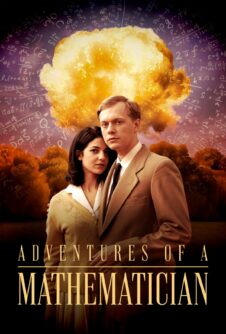
ADVENTURES OF A MATHEMATICIAN
A fascinating period drama with moral questions and a family heart.
Should You Watch It?
Yes, if your family can handle the content concerns. Adventures of a Mathematician offers a fascinating portrayal of Stanislaw Ulam, a Polish scientist whose work helped shape both the Atomic Age and the Information Age. Its low-key drama still becomes compelling and moving through its scientific questions, family relationships, and moral reflection.
The film presents marriage and family positively. It also asks whether developing increasingly powerful weapons can ever be morally justified and rejects totalitarian regimes that destroy human life and freedom. God is mostly absent, however, and the film’s overall worldview is humanist.
The practical answer is simple: older children and adults should find this worth seeing, while parents should use discernment with younger children.
The Story
NO SPOILERS — WE KEEP THE SURPRISESIn 1941, Polish mathematician Stanislaw Ulam teaches at Harvard while worrying about his family trapped in Poland. He meets Francoise, a young Jewish immigrant from France, and soon becomes involved in a secret wartime project at Los Alamos.
As Stan works alongside leading scientists, he contributes to the development of the hydrogen bomb and early digital computers. The work brings scientific achievement, personal loss, moral questions, and pressure on his marriage and family.
Is It Any Good?
Four stars means this is a strong film whose quiet approach works. Writer-director Thor Klein keeps the drama low key even though the stakes include World War II, the nuclear arms race, and the future of computing.
The movie gives vivid portrayals of major scientific figures, especially Stanislaw Ulam and his friend John von Neumann. It also finds moving drama in the relationships between the scientists, Stan and his brother, and Stan, his wife, and their daughter. The result is dramatic, compelling, and moving without becoming didactic or overwrought.
The Worldview
The film has a light humanist worldview. God is mostly absent, and the movie does not explore Stanislaw Ulam’s agnosticism in depth. Instead, it focuses on human beings confronting evil, scientific power, political oppression, and the possibility that destructive technology might prevent even greater destruction.
That human-centered outlook is balanced by strong moral and pro-family elements. The movie supports marriage and family, asks serious questions about nuclear weapons, rejects Nazi and Soviet totalitarianism, and presents America positively as a place where immigrants fleeing oppression can continue their work and live well.
The film’s central moral concern is whether people can use dangerous knowledge responsibly. Scripture recognizes both humanity’s capacity for evil and God’s providence amid suffering: “And we know that for those who love God all things work together for good” (Romans 8:28).
The Content Guide
The specifics — spoilers included by nature — so you can judge for your own family.
Dominant Worldview and Other Worldview Content/Elements
Light humanist worldview overall (the protagonist is a known agnostic though the movie doesn’t specifically bring that up despite its apparent agnostic tone) but with some moral, pro-family and pro-life sentiments where marriage and family are supported, God is mentioned once, man after witnessing the test of the first atomic bomb mentions the awesome “divine power” displayed by the weapon, and people discuss and question the morality of developing nuclear weapons and the dropping of the second atomic bomb on Japan (protagonist eventually and correctly decides that working on the super-powerful hydrogen bomb might ironically help prevent it from being used), and with brief overt expressions of anti-totalitarian attitudes toward Nazi Germany’s murderous socialist regime and the Soviet Union’s murderous socialist/communist regime, plus America is seen in a positive light because it offers foreign scientists and other immigrants fleeing oppression a chance to continue their work and live a good life
Foul Language
Four obscenities (one somewhat mumbled “f” word) and one OMG profanity
Violence
No depicted violence but there are a few non-violent mentions of the Holocaust and war (there’s brief talk about a sister and two parents being killed by the Nazis) and man visits man with terminal cancer at the hospital and later cries when his friend dies
Sex
No sex scenes but a joke is told about sex where a man asks a rabbi if sex is work or pleasure, and the rabbi says, “Sex is pleasure. If sex were work, my wife would leave it to the maid,” and the protagonist’s younger brother appears to be living with his girlfriend, though it’s not clear
Nudity
No nudity
Alcohol Use
Some alcohol use
Smoking and/or Drug Use and Abuse
Smoking but no drugs except for a hospital scene where a man is getting some kind of medicine drip;
Miscellaneous Immorality
Lying in one scene, it’s mentioned that one scientist working on the first atomic bomb has disappeared and defected to the Soviet Union, and two brothers have an argument.
Talk About It
Questions for the drive home, the dinner table, or the youth group.
The film asks whether developing powerful weapons can ever be morally justified. How should Christians think about responsibility, wisdom, and the protection of human life?
James 1:5 · Micah 6:8Stan’s work affects his marriage and family. What responsibilities should come before professional achievement?
Ephesians 5:25 · 1 Timothy 5:8The story portrays people resisting totalitarian oppression. What does Scripture teach about defending the vulnerable and pursuing justice?
Proverbs 31:8–9 · Micah 6:8The film’s humanist outlook leaves God mostly absent. How does belief in God change the way we understand suffering and goodness?
Romans 8:28 · James 1:17The Final Word
Adventures of a Mathematician is a fascinating, thoughtful, and moving period drama with strong moral and pro-family elements. Its brief language and sexual humor call for discernment with younger children, and its humanist worldview deserves discussion. For older children and adults, it is WORTH THE TRIP — OLDER CHILDREN AND ADULTS.















