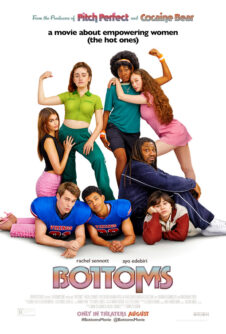
BOTTOMS
A well-made comedy with a corrupt agenda for your teens.
Should You Watch It?
Here is the honest problem with this one: it's good, and that's part of why we can't recommend it. Emma Seligman directs with real skill, the writing lands genuine laughs, and the alternate-reality setup is inventive enough to carry a premise that would be horrifying played straight.
But craft isn't conscience. This is a raunchy, pro-homosexual comedy built to make teenage homosexuality look cool and heroic — and it's aimed at the very teens who are easiest to influence. Around that agenda runs nearly constant foul language (at least 74 "f" words), extreme surreal violence that piles up dead bodies for laughs, and a steady stream of lewd jokes and lying. A handful of moral and Christian touches soften the edges slightly, but they don't change what the movie is selling.
So our answer is plain: this one isn't acceptable for media-wise viewers, and it's too off-base morally to recommend to anyone else. Skip it — and keep your teens and younger children away from it.
The Story
NO SPOILERS — WE KEEP THE SURPRISESPJ and Josie are two "loser" teenage girls desperate to lose their virginities before college — and hopelessly out of the league of the cheerleaders they want.
So they hatch a scheme. Trading on a lie that they spent the summer locked up in "juvie" learning to fight, they launch a female "fight club," pitched as self-defense against the school's predatory boys but secretly designed to attract and seduce the girls they're after. What shows up instead is a ragtag crew of fellow outsiders — and a football team that does not like where this is going.
Is It Any Good?
Three stars, and here's what they measure: pure filmmaking, separate from anything the film believes. The "fight club" scenes are impressively directed, staged as dark comedy in the vein of the dodgeball carnage in DODGEBALL: AN UNDERDOG STORY. The characters and interactions are frequently hilarious, and the plot carries some genuinely surprising twists.
Co-writer Rachel Sennott (who plays PJ) and co-writer/director Seligman build a clever alternate reality where events that would be appalling played straight become undeniably funny. It's the kind of comic control that keeps a premise like this from collapsing. Whatever else is wrong with the movie — and plenty is — the craft is real. That's exactly why saying so matters.
The Worldview
The dominant worldview here is strongly pagan and pro-homosexual, with a heavy dose of political correctness. And the concern isn't just what the movie shows but who it's aimed at: easily influenced teenagers. Its agenda is to make teenage homosexuality look cool and heroic, and that agenda drives the whole enterprise.
To its credit, the film doesn't stack the deck completely. One fight-club member is a positively portrayed black Republican, proudly "super-Christian," and treated as the smartest person in the room. A cheerleader firmly rebuffs PJ's advances, says she's completely heterosexual, and her position is respected. Josie, who is black, has a respectfully rendered picture of a Black Jesus hanging in her room and mentions, offhandedly, going to church with her family. And underneath the raunch run real messages: against lying to be popular, against manipulating people into relationships, for being honest about who you are, and — in the finale — for forgiveness and self-sacrifice, as the girls fight to save an enemy's life.
But those touches only slightly mitigate the whole. The film celebrates deception, seduction, and revenge for most of its runtime before the change of heart arrives.
The story's real ache is the longing to be known and loved without pretending — the very thing its characters keep lying about. Scripture answers that longing not with a better disguise but with truth: "Then you will know the truth, and the truth will set you free" (John 8:32).
The Content Guide
The specifics — spoilers included by nature — so you can judge for your own family.
Dominant Worldview and Other Worldview Content/Elements
Very strong pagan, pro-homosexual worldview with strong politically correct views, but mitigated slightly by some Christian, moral, conservative content, including the two lead lesbian teenagers come to realize their extensive lying has severe consequences and are regretful, one of the girls in the fight club is positively portrayed as a black Republican, “super-Christian” and smarter than everyone else, the lead black female lesbian has a picture of a Black Jesus (respectfully rendered) prominently hanging in her room, and she also talks for an offhand moment about going to church with her family, a heterosexual girl that one of the lesbians tries to seduce stands her ground and says she’s firmly heterosexual and her position is respected, plus after the “fight club” meetings the teenage girls spend much of the time talking about beating up football players who are sexual predators, and in the finale the girls fight off an opposing football team to save their team’s obnoxious quarterback from being killed, and this is portrayed seriously as a change of heart and a sacrifice for their enemy
Foul Language
At least 121 obscenities (including at least 74 F words, mostly in a sexual context), one Jesus profanity, one GD profanity, and nine light profanities
Violence
Lots of strong and very strong violence with blood includes many close-up shots of girls punching, kicking and throwing each other, with lots of blood splattered or cuts and wounds showing, all played for dark laughs, a giant male violently fights a girl in front of an entire school’s student body at a pep rally and kicks her hard in the head after winning the match (the kick is portrayed seriously), many girls fight many male football players in uniform from an opposing team with punches, kicks, throws, one player gets impaled, and one player’s head explodes after being kicked, all the male players wind up dead, but the scene is played comically, and the entire movie’s violence is played in a surreal not realistic fashion despite its often graphic nature (it plays like an altered form of reality), one teenage girl comically says she hopes she can learn to kill her stepfather (she is portrayed as unhinged, however, and nothing comes of it), another girl talks about bombing the school, but instead she bombs the empty car of a male football player who preys on girls with the bombing portrayed as a surprise but darkly comic, and she sets off another bomb outside a football game after the movie, but no one is hurt
Sex
Two teenage girls kiss passionately, as one pulls off her top revealing her bra, and then they lie down on a bed implying sex before camera cuts away, loud moaning is heard while a middle-aged mother and a teenage boy (depicted as 18) have unseen sex, the movie’s entire story is built on two lesbian virgins starting a “fight club” for girls at school in the hopes of seducing female cheerleaders, and there are many crude sexual and homosexual jokes and comments and situations throughout the movie, including two crude references to masturbation and crude references to body parts in a sexual context
Nudity
A mural is a takeoff of Michelangelo’s painting of God and Adam so there’s male nudity, teenager appears in a few scenes just wearing a jock strap, and a teenage girl strips down to her bra in an implied lesbian sex scene after kissing another teenage girl passionately
Alcohol Use
No alcohol use
Smoking and/or Drug Use and Abuse
One minor character smokes some kind of cigar or cigarette in one scene;
Miscellaneous Immorality
The two lead characters lie throughout most of the movie about having been in “juvie” and fought their way through it to survive, their entire plan is built upon deception, as the cheerleaders are not aware the “fight club” is designed to attract them sexually and seduce them, and one of the two lead lesbians bemoans her fear that she will never have sex with a girl since she’s a loser socially and laments her vision of her future as marrying a male pastor and having to endure lying about her sexuality throughout her life.
Talk About It
Questions for the drive home, the dinner table, or the youth group.
The whole plot is built on deception — lies about the past, lies about the club's real purpose — and the movie eventually shows those lies carrying severe consequences. Where does Scripture warn about the cost of building a life on lies?
Proverbs 12:22 · Ephesians 4:25The film's characters are desperate to be wanted and known, but keep hiding who they are. What does it mean to be fully known and still loved by God?
Psalm 139:1–4 · 1 Corinthians 13:12The finale turns on the girls risking themselves to save an enemy. Even in a crude comedy, why does self-sacrifice for an enemy strike us as powerful — and where does that idea come from?
Matthew 5:44 · Romans 5:8This movie was made to make certain choices look "cool" and heroic to teenagers. How do we grow the discernment to enjoy skillful filmmaking while refusing what it's selling?
Romans 12:2 · Philippians 4:8The Final Word
We'll say it plainly, the same as we started: skip it. BOTTOMS is genuinely well-directed and often funny, and that's exactly why its agenda is worth naming — it's aimed at the teens most likely to absorb it, wrapped in nonstop profanity, extreme violence, and lewd humor. There are far better ways to spend a movie night. Start with our latest family-friendly picks.