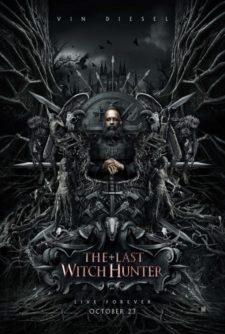
THE LAST WITCH HUNTER
An entertaining, well-acted fantasy undermined by occult syncretism.
Should You Watch It?
The Last Witch Hunter is reasonably entertaining and well acted. Its story has Christian references, a righteous hero, and a clear condemnation of witches using their powers to harm human beings. The action is exciting, though the plot becomes convoluted and includes a couple of silly lines.
The deeper problem is theological. The hero relies on a “good” witch and her occult powers to recover lost memories and help stop the evil witches. The movie condemns some uses of witchcraft while treating other uses as acceptable, which conflicts with the biblical view presented in the source review.
Even though the foul language is kept to a bare minimum, the scary violence and occult worldview make this a poor choice. The practical answer is simple: skip it.
The Story
NO SPOILERS — WE KEEP THE SURPRISESKaulder is an immortal Christian knight who killed an evil witch queen 800 years ago and now hunts witches in modern-day New York. He serves The Axe and the Cross, an organization that has established a truce between witches and humans.
When an evil plot threatens to resurrect the queen and unleash a global plague, Kaulder investigates with the help of a new priest, Father Dolan, and Chloe, a young witch who can help people recover lost memories.
Is It Any Good?
Three stars means this is a reasonably entertaining film with solid acting, but its strengths are limited by storytelling problems. The action is exciting, and the performances are good, including those by Vin Diesel, Michael Caine, Elijah Wood, Rose Leslie, and Julie Engelbrecht.
The plot is a bit convoluted, with too much that must be explained. A couple of silly lines toward the end also weaken the experience. Overall, the film has enough energy and competence to hold attention, but not enough clarity to overcome its larger problems.
The Worldview
The Last Witch Hunter presents a world where witches are an ancient race of supernatural beings with occult powers. It includes positive Christian elements: Kaulder is a Christian knight, priests serve alongside him, and the film treats the protection of human beings from evil as a serious duty.
But the movie’s moral framework is syncretistic. It says witchcraft is wrong when witches use it against human beings, while allowing witchcraft to be used among other supernatural beings or against evil witches. Kaulder himself uses Chloe’s powers to retrieve a lost memory and help stop the witch queen’s plague. The story therefore suggests that occult power can be acceptable when used for a good purpose.
The source review also notes some mostly implied environmentalism. The film’s central conflict is a battle against evil, but it departs from a biblical view by treating some occult powers as usable tools. Scripture instead warns God’s people not to imitate occult practices: “You shall not learn to follow the abominable practices of those nations” (Deuteronomy 18:9).
The Content Guide
The specifics — spoilers included by nature — so you can judge for your own family.
Content Summary
Strong syncretistic pagan worldview with strong Christian, moral and occult elements about fighting evil witches who are part of a “race” of witches, but also with some help from “good” witches who have agreed not to use witchcraft on human beings, and who can be punished by a council of witches if they do, after being exposed by an immortal human agent or knight working for a church council, plus a couple times the human agent uses occult means himself to stop an evil plot by the evil witches trying to resurrect their evil queen, and some mostly implied environmentalism; five light obscenities and one light My God profanity; very strong scary violence but not very bloody, such as witch creature stabbed with sword, scary demonic-looking witch creatures attack warriors, witches trap people with spells, witches trap man and woman using wood and tree limbs encircling their bodies, images of a witch’s heart which has a tree-like texture to it, female witch puts hand through man’s chest and says she’s making him immortal as his skin starts to light up from within, dying man’s body becomes magically somewhat skeletal, witch’s large tree lair burns, scary flies threaten people, fighting, hero fights giant monster creature which looks like a scary, baroque-looking moving tree, images of two dead bodies, evil warlock tries to lure boy with gummy bear tree, but hero wakes boy up from the illusion, evil warlock appears to hero as a little girl and then changes back to attack hero, characters fall, hero’s shoulder impaled, gunfire; no sex; no nudity, but women in skimpy outfits in a couple scenes with apparent female cleavage but shot from afar so as not to be terribly overt; alcohol use; no smoking but woman seems to use magical substance like a drug when she wipes it on her face, and man takes a potion to retrieve a lost memory from long ago; and, betrayal and villains try to trap and fool heroes.
Talk About It
Questions for the drive home, the dinner table, or the youth group.
The film treats some occult power as acceptable when used against evil. Why does Scripture reject occult practices rather than permitting them for a good purpose?
Deuteronomy 18:9–14 · Galatians 5:19–21The story presents a conflict between good and evil. How does the Bible tell us to respond to evil?
Romans 12:21 · Ephesians 6:10–18The hero’s Christian identity is mixed with reliance on a witch’s powers. What should shape a Christian’s trust and decisions?
Proverbs 3:5–7 · James 1:5The film imagines a truce between humans and witches. How can a desire for peace become confused with approving what God forbids?
Isaiah 5:20 · 1 Thessalonians 5:21–22The Final Word
The Last Witch Hunter has solid acting and some positive Christian elements, but its scary violence and occult, syncretistic worldview outweigh those strengths. Because it presents witchcraft as a tool that can be used for good, our answer is SKIP IT. For a better family choice, see.