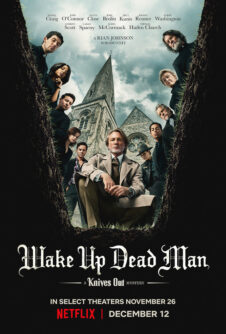
WAKE UP DEAD MAN: A KNIVES OUT MYSTERY
Polished acting can't redeem this profane, misleading portrait of faith.
Should You Watch It?
Here's the honest tally. This is a handsomely made movie — the production values are high, the lighting does real work, and Josh O'Connor and Daniel Craig both deliver strong performances. There's a genuinely interesting debate at its center between an atheist detective and a faithful priest about sin, forgiveness, and God.
But the cost is steep. More than 40 obscenities and profanities pepper the script, including irreverent misuse of Jesus's name. A long, crude confession scene, strong sexual references, rear nudity, and pointed violence round out the content. On top of that, the film builds its central conservative Christian character as an aggressive, abusive caricature — a portrait the source calls false and politically slanted, not a fair picture of the millions who fill American pews each week.
Add in a script that juggles too many storylines and a twist less clever than the franchise's earlier outings, and there's little reason to spend two hours here. Skip it.
The Story
NO SPOILERS — WE KEEP THE SURPRISESFather Jud, a former boxer turned priest, is transferred to a small upstate New York congregation led by the charismatic, hard-edged Monsignor Wicks. Their pastoral styles collide immediately — one preaches grace, the other wields anger as a tool. When Wicks announces he's closing the church and plans to expose the congregation's failures, tensions boil over. Then, on Palm Sunday, Wicks drops dead mid-sermon. Atheist detective Benoit Blanc arrives to untangle a church full of suspects, each with a motive of their own.
Is It Any Good?
Three stars means real craft with real limits, and that's exactly what's here. Director Rian Johnson uses lighting almost as a character, giving the film visual depth, and the acting is a clear strength — O'Connor's faithful priest and Craig's brilliant detective both land well.
Where it falters is structure. The mystery juggles too many storylines and subplots that add little, the final twist is more obvious than in the earlier KNIVES OUT films, and plot holes creep in along the way. The result is a good-looking, well-acted film that's simply less satisfying and less sharp than its predecessors.
The Worldview
There's real gospel material tucked inside this mystery. Father Jud's backstory is a genuine testimony of transformation — a man who killed someone in the boxing ring and found forgiveness and a new life in Jesus Christ. Characters pray in Jesus's name, and the film lets a priest speak plainly about grace. That's worth noting.
But the film sets that good material inside a mixed, pagan-leaning worldview, and its portrait of conservative Christianity is where the trouble lies. Monsignor Wicks — aggressive, physically abusive, obsessed with politics rather than the souls in his care — functions as a stand-in for patriotic, conservative churchgoers broadly, and other characters reinforce the same false caricature: professing Christians who don't act like Christians, and a script that implies people don't really change just because they say they believe. That's not a fair likeness of the tens of millions of Americans who fill church pews every week, nor of a faith that teaches turning the other cheek rather than the sword. The atheist detective, for his part, is given every chance to encounter the gospel and never quite does.
Underneath the murder plot is a real question the film can't fully answer: can people actually change? Scripture says yes — "if anyone is in Christ, he is a new creation. The old has passed away; behold, the new has come" (2 Corinthians 5:17). Father Jud's story gestures at that truth even while the film around him doubts it.
The Content Guide
The specifics — spoilers included by nature — so you can judge for your own family.
Dominant Worldview and Other Worldview Content/Elements
Mixed pagan worldview in a murder mystery set within a Catholic Church community with some positive Christian, moral content marred by politically correct attacks on Christian conservatives, and an atheist detective who argues with a sincere Catholic priest about faith, with references that Jesus saved a broken man, the priest mentions that Jesus forgave his sins and changed his life, there’s some prayers in the name of Jesus Christ, the atheist detective has a long monologue where he describes a litany of sins in the Catholic Church in America, multiple characters portray Christians but don’t act like Christians, movie implies that all people are greedy and don’t change just because they become Christian, the conservative Catholic Monsignor in the movie is aggressive and physically abusive and seems only concerned with politics and not for the care and soul of people and his congregation
Foul Language
36 obscenities (including two “f” words) and six strong profanities mentioning the name of Jesus
Violence
Strong and light violence includes hitting, punching, kicking someone, murder, mentions of killing someone in a fighting ring, a person is stabbed by a sickle, bodies are shown deteriorating in acid, woman beats a child, priest mentions a mother beating a child,
Sex
Strong sexual content includes many references to a sexually promiscuous woman, and there’s a long gross scene where the Monsignor confesses to self-abuse to the Priest
Nudity
Some rear male nudity
Alcohol Use
Some drinking and drunkenness
Smoking and/or Drug Use and Abuse
Some smoking but no drugs;
Miscellaneous Immorality
Lying and deception.
Talk About It
Questions for the drive home, the dinner table, or the youth group.
Father Jud found forgiveness and a new life after doing serious wrong. What does real change look like, and how is it different from just claiming a label?
2 Corinthians 5:17 · Romans 12:2The detective in this film argues that faith is unprovable and never seems to reach a real answer. How would you respond to someone who says the same thing to you?
1 Peter 3:15The film builds one Christian character into a stand-in for millions of others. Why is that kind of caricature unfair, and how should Christians respond when they see their faith misrepresented?
Matthew 7:1–2 · Proverbs 18:13Jesus taught His followers to turn the other cheek rather than use anger and aggression to control others. Where in this story — or in real life — do you see that teaching tested?
Matthew 5:38–39The Final Word
There's a good movie's worth of craft here, and even a real gospel thread in one character's story. But between the excessive profanity, the crude sexual content, and a script that flattens conservative Christians into a caricature, this one isn't worth your evening or your conscience. Our answer stands: skip it. For something the whole family can actually watch together, start with our latest.